Some names have been changed.
Sometimes, there’s a secret that pushes hard against my throat. And in the quiet, unsuspecting moments—when the air sits heavy, and vulnerability surges—I’m tempted to spill it.
It did spill out in the car with my mom on a random, uneventful Sunday—the Lord’s day, as she likes to call it. The silence was peaceful, almost holy, but it pressed on my chest until the words I swore I’d never say began pushing their way out.
“Have you ever felt stuck in your own body?” I asked her.
I glanced over, catching a tense expression on her face. After a beat of silence, she asked what I meant.
I responded with another question: “How would you feel if I referred to you as ‘he’ for the rest of your life, despite you knowing you’re a woman?”
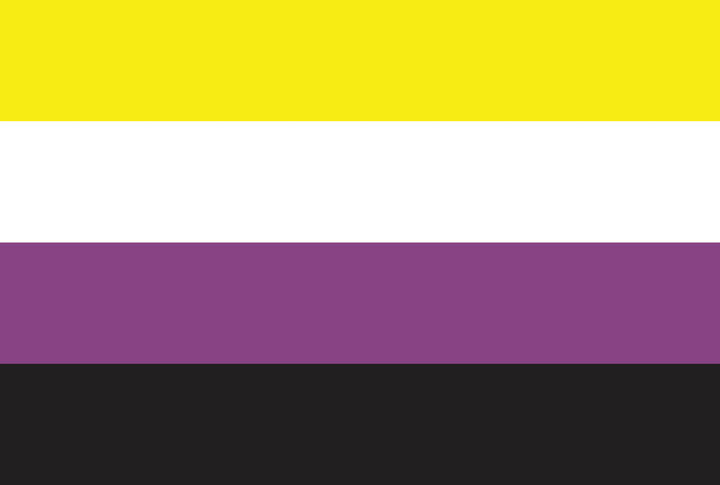
My mom’s grip on the wheel tightened, and her eyebrows furrowed. The silence stretched out between us, but it hadn’t come out of nowhere; it had been festering for years before I asked it to show itself. I didn’t yet know how to express my identity but I tried to explain the concept of being neither a boy nor a girl. I had convinced myself that if I could dance around the actual word—nonbinary—then maybe I wouldn’t feel so different.
For a long time, whenever my mom called me her daughter, it didn’t feel right. And as I grew older, blossoming, as my mom says, into a beautiful young woman, I wanted to crawl out of my skin. I wanted to rid myself of every feminine aspect of my personality and body. I wanted to start anew in a body that wasn’t defined as male or female, one that didn’t have to be associated with one gender. I wanted to be free of societal constraints, expectations, and labels. I wanted to be myself—and each unintentional misgendering reminded me that I could never be myself as a girl.
It took me a while to make sense of my identity—the idea of not seeing myself through a gender binary felt abstract. I’d sat with my uncertainty, trying on different names, genders, and orientations. I considered the possibility that I might be trans, but being called “he” somehow felt even worse than being called “she.” With each new identity I tried, the feeling of dissatisfaction remained. I knew something felt wrong—and that I wasn’t supposed to say it out loud. My parents—although belonging to different religions—shared the same strict traditional beliefs concerning gender and sexuality.
Up until that moment in the car, I had only ever shared any of this with my stuffed animal, Teddy. Admitting to a real person that gendered pronouns didn’t suit me felt surreal. As if, for the first time in my life, I could imagine a second skin, one I didn’t have to mold myself to fit into. I could breathe, even if it was only for a moment.
I looked over at my mom again. I was trying to say I’m not a girl, but she seemed to think I was saying that I’m a boy because she broke the silence by asking if I wanted to go to the barbershop to cut my hair. My hair, which I’m deeply attached to, wasn’t going anywhere, and as I twirled it between my fingers, my anxiety increased.
My mom reminded me that no matter what, she would “always see me as her daughter.” Her tone sounded clipped, as if she was forcing herself to say what I’m sure she thought were words of acceptance. I didn’t hear them that way. I wanted to correct her inaccuracies, but I knew what she thought of people like me. I’d listened along to right-wing rhetoric from the podcasts she played in the car, hoping for her not to ask my opinion on anything. I’d also seen her purposely misgender trans people. “God doesn’t make mistakes,” she’d say.
It did feel good to hear her affirm that I was still her child; even words of artificial warmth were better than none. But in that moment, I knew I would never again believe my mother was something other than who I knew she was.
I pleaded with her not to tell anyone yet, especially my father. She rushed out her shushes and assured me she wouldn’t.
Facing Betrayal
A couple of days later, she unexpectedly handed me the phone as we walked through the mall. My father’s rough and baritone voice called out to me, his somber tone keeping me on edge. My father got straight to the point. He questioned me about my identity, and despite giving me no chance to talk, went on a tangent about what Allah intended for me—how it was wrong of me to ever question his actions. It was all expected, of course—which is why I’d told my mother not to tell him—but that didn’t make his words any easier to hear.
My mom was the one person, the one confidant, I had trusted. Even if she ended up hating me for my identity, it wouldn’t have hurt as much as her shattering the belief that I was safe with her. But as we got in the car to drive home, I felt as if my vulnerabilities and wounds had been shown to the world. I felt naked, and as I curled further into the passenger seat, I imagined jumping out of the car and never looking back.
In the weeks that followed, nothing was ever addressed directly. At times, I wondered if I had ever come out to my mom at all. There were no more questions, no attempts to understand—just silence; a silence that felt deliberate, like something we had all agreed not to touch.
I’m learning that not knowing everything doesn’t make my identity any less real.
Yet sometimes my mom would break the illusion of ignorance I wanted to have. I overheard her telling a friend that I was “brainwashed” and “confused” whenever gender was brought up. I wished I had spent more time figuring out how to explain it better before I spoke up. But even if I had the textbook definition of what it means to be nonbinary, I’m sure my mom would have still found a way to misunderstand me.
No one in my family ever brought it up again and, in hindsight, I feel almost grateful that I never had to try to explain myself. For a while, I hated myself for realizing who I was. But something compelled me to share my newfound identity with people outside my family who might understand.
Finding Understanding
During my sophomore year of high school, I made a friend named George. We sat together during our free periods. At first, he spoke quietly, often listening more than he talked. He was awkward, but eventually he relaxed around me.
One afternoon, George mentioned that he was gay. He said it plainly, without hesitation, as if the fact were no more significant than any other detail about himself. He possessed an ease that made my own silence feel heavier. I don’t remember when the idea to tell him planted itself in my head, only that it lingered. I imagined how George might respond, and as I did, I heard my father’s cold, baritone voice.
Fear settled deep in my stomach—a fear that criticized me for believing my identity was something others could accept without question. “Remember what happened with mom,” my inner voice would taunt.
But, still, I formulated a plan for how I would announce my identity. It was a simple plan, hinging almost entirely on a phrase I wrote at the top of my notes months earlier: rip off the bandage.
When I told George, I felt somewhat prepared. I finally had a stable understanding of who I was, enough to explain it to someone else. I was still nervous, enough that I wasn’t actually listening to what he was saying, but waiting for my chance to speak. Maybe it was the way I fell quiet, failing to respond to his story, or the way my hands picked at the leather on my jacket, but George finally broke the silence.
“What’s wrong?”
The familiar silence wrapped around us, urging me to confess my sins. The voice in my head called me a coward, and perhaps, in a rush to prove that stupid voice wrong, the words “I’m nonbinary,” fell out of my mouth before I could stop them.
My internal crisis was cut short when George thanked me for trusting him and asked what pronouns I now use. I told him I use they/them and he accepted it with no complaints. The topic soon switched to another, just as I’d hoped it would.
After that day, George treated me as he always did, as if he truly thought I was normal. As if my revelation was no big deal, and despite the changed pronouns I was still me, and our friendship was still valued. I am, of course, normal by objective standards. But socially, I could never fully understand what it was like to be a girl, and I didn’t fully fit in with “the guys.” For a long time, I felt like a walking contradiction.
Even after finding the right word, “nonbinary,” the pit in my stomach right before I tell a new person never seems to lessen. I was—and continue to be—anxious about the words they may spew, and more importantly, how it’ll remind me of the two people in my life who may never understand who their child is.
I sometimes think back to the day I opened up to my mom and wish I could take it back. I wish I could maintain the sense of hope that was destroyed on that random Sunday six years ago. In some ways, I still struggle with understanding who I am. And I’m working through the self-doubt that my mother’s words planted in me.
But there are certain truths I stand by, certain aspects of my identity that restore parts of the hope I thought I lost. I am nonbinary. I am not confused, though I admit I don’t yet know everything about my identity. And for the first time, I’m learning that not knowing everything doesn’t make my identity any less real.
- Family
- Friendship
- Gender & Sexual Identity
- LGBTQ+