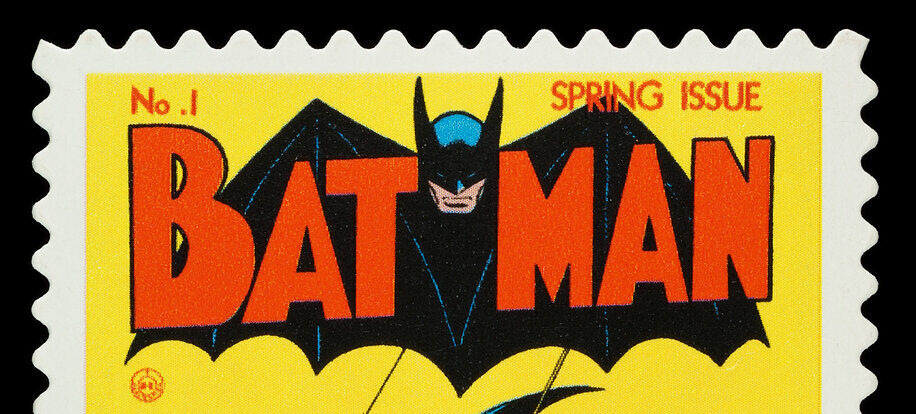
When I was younger, I was reluctant to speak. Then, when I was in the 4th grade, my mom handed me a journal that was like nothing I had seen before.
On the cover were all my favorite DC Comics characters: Batman, Superman, Wonder Woman, Aquaman, and the Flash. I had met these characters in more recent Justice League movies or TV shows, so I knew them from their costumes, and felt a connection to them. They gave me a sense of security and of possibilities.
Maybe that’s why I started opening my heart to them. The first time I picked up the journal, I started writing to Batman, the first superhero I loved and the only one who doesn’t have supernatural powers. I appreciated his backstory. A robber killed his parents, which as a kid is such a scary thought. It gave him a sense of urgency to clean up the city. I also liked that he stayed in the shadows and fixed things that others couldn’t fix.
But I also was inspired by Batman’s enemy, the Joker. I related to how he protected himself by laughing and making jokes. It was a coping mechanism I used when situations got too serious. Joker is a villain, but it was hurt and trauma that changed him. There are different versions of his back story: he’s been a struggling comedian and he’s been in a psych ward, but one thing that is constant is him falling into a chemical that scarred his face and transformed him into the Joker.
“Hey, Bruce Wayne,” I began. “I know you’re busy fighting your arch-nemesis the Joker, but I had a crazy day…..”
In the following weeks, I shared the love and wrote dispatches about my day to some of the other superheroes. In journal entries varying from a paragraph up to a full page, I’d tell them about going to church and serving as an usher or interactions with my brothers. I’d write out my feelings about the day, whether I was excited or angry or just in a bad mood. I usually sat on the floor with my back against the blue wall in the bedroom I shared with my brothers Zacharias and Shiloh. I wrote when I had the room to myself.
When I addressed the characters, I imagined myself into their worlds. My dad called himself Batman and me Robin, so I’d write about us doing errands, but instead of my dad’s small four-door, we’d be in the Batmobile. I stuck to my dad like a shadow because I respected him. He was always putting his family first: working, cooking, and keeping things running, all on limited sleep. I wanted to be just like him, as Robin idolizes Batman.
I kept writing in that journal for a year, then stopped. I moved toward whatever creative writing school let me do. I stayed connected to superheroes over the years, in part by watching my Dad’s Iron Man DVDs. I switched my loyalties from DC to Marvel.
Learning by Writing
In 10th grade ELA class, we got an assignment to build onto an existing unfinished story with a new narrative. My brain jumped right to the show The Flash, which ran for nine seasons.
The Flash series follows a forensic scientist named Barry Allen, who was struck by lightning just as a particle accelerator that was filled with dark matter exploded. This gave him the ability to run faster than the speed of sound. Throughout the show Barry uses his extreme speed in different ways: vibrating so fast he can go through objects; making tornadoes from his hands; and most exciting to me, running on water. Though Barry has “only” the power to move fast, he adapts that one ability to navigate any situation he’s faced with.
As I wrote, I filled in details…. I’m not sure where they came from; they just flowed out of me onto my laptop screen.
In the series finale The Speed Force, which is the source of the Flash’s power, moves on to a new host. My idea for a sequel, which would take another 10 episodes to complete, follows three people who receive the force next. One of them is Avery, whose name I got from fanfiction, but I filled out her story.
I decided to make Avery a journalist-scientist living in Central City. The Speed Force strikes her on the way to work, also via lightning. Then Avery begins a journey that will test her courage, force her to confront her past, and determine whether she is worthy of carrying the Flash legacy.
I thought about color as I created Avery. In the original show, when Flash ran his fastest, he left a trail of red lightning. Red can symbolize many emotions, but it struck me that the creators went with love. Every time Barry was challenged to go faster than he ever had before, he seemed to be motivated by saving a loved one, like his dad or his fiancee.
I wanted a different color and motivation for Avery’s speed. I went with green because it can represent both rage and healing. But to identify the rage and get to the healing, she must acknowledge the trauma. I wrote Avery as being raised by a father with a drinking problem who beat up Avery’s mom. Avery’s speed at first feels like running away from that trauma: She sees images of the abuse when she runs.
In my story she moves toward healing, and she can run even faster once the past isn’t holding her back. With the same green trail of lightning behind her, she moves from running away to running loose and free.
Emotions Lead to Self-Understanding
My ELA teacher’s first advice was to “write without thinking.” It wasn’t until I wrote about the color of Avery’s speed that I even knew I wanted her story to be more emotional. I didn’t know my episodes would explore her healing until I wrote that one scene. As I wrote, I filled in details, not from my life or even from specific things I’d read or seen. I’m not sure where they came from; they just flowed out of me onto my laptop screen.
I made Avery a journalist because she needs answers. Her parents are both dead, and curiosity about the events of her childhood made her into a person who digs for answers.
I have Barry give Avery advice on how to use her speed and assure her that her emotions are valid. He shares that his own mom died right in front of him and he initially ran away from his own feelings. Anger for not getting justice for her is part of why he works as a forensic scientist on crime scenes and why he uses his speed to help find justice for others.
Because of his pain over his mom’s death, Barry knows that Avery must acknowledge and sit with her grief. He tells her that on the other side of the trauma is something beautiful that can still keep her running. She thinks back to those words often over the course of the show.
Writing Barry as a shoulder for Avery to lean on, someone who listens, sprang from my connection with my mom. She lets me express my feelings and nudges me to examine them; sometimes she will respond with, “But why are you feeling this emotion?” and that can make me break down and start crying. Having deep conversations with her helps me feel what’s inside me: She walks me through my emotions.
Everyone, from gods to superheroes to me, needs self-knowledge to be their best. My characters are constantly learning who they are, and as I write them, I find myself doing the same. Like Avery, I am still discovering what’s been inside of me all along.
The Author

Yeshaya Benknockee
- Arts/Culture
- Family