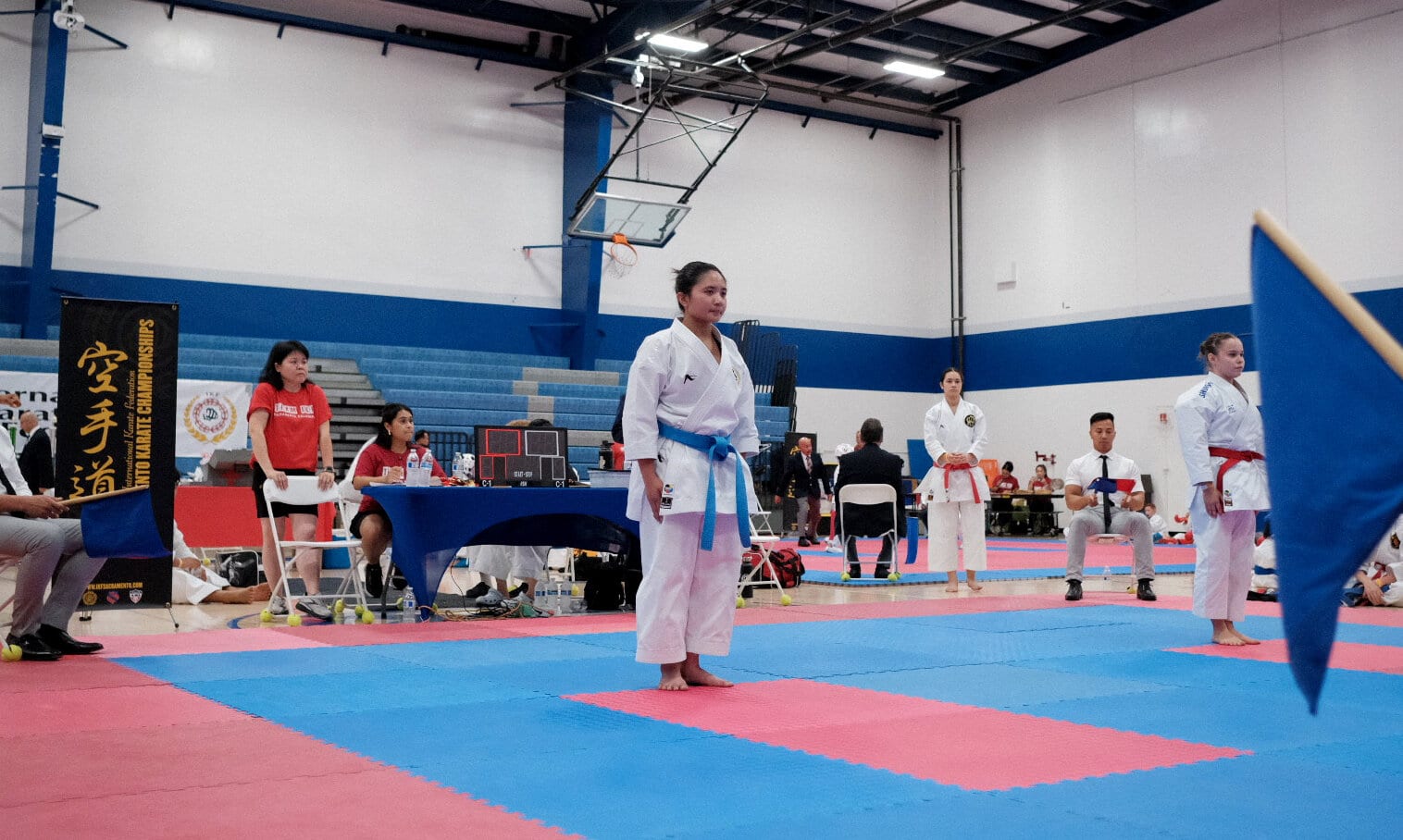
Ichi, ni, san…
“Next in line, please count 10 pushups,” the black belt leading the class commanded.
Sweat dripped down my forehead. My mouth was zipped shut. It felt like everyone’s eyes were locked on me, waiting for me to begin the count. Silence filled the room, and I felt an overwhelming guilt for knowing nothing.
Finally, another black belt noticed.
He took over the count, and began with the same “ichi, ni, san” and so on. As he counted to 10 in Japanese, I felt a growing desire to make sure this never happened again.
I was not new to martial arts, although it seemed that way to this introductory class. Today marked the 1,825th day of my karate journey, but it was my first day at my new karate school. I immediately stood out in the dojo: My gi, the traditional karate uniform, was all black in a sea of white.
I had already earned my black belt in Kajukenbo—which combines karate with other mixed martial arts—years ago, before the pandemic. But this school’s style was strictly traditional. With my previous experience, I thought I would be at an advantage. My confidence was soon humbled.
How Did I Get Here?
I thought back to six years ago, when my fists were smaller, the punching bags felt gigantic, and little 7-year-old Yma did not yet know that karate would become a big part of her life. My mother brought me to a local dojo one day. I was met with the bright smile of my new instructor. Being shy and timid, I was scared to make a mistake or mess up the moves. With each “Good job!” I felt more confident in my ability.
After class one day, another parent came over to me and my dad. “Wow,” she complimented me, asking “how is your daughter so focused?” That sparked pride—pride that rested on my ability to perform at a high level.
My pride in being good at karate was a huge part of why I continued, but I also came to love karate itself. I never wanted to miss a class. The moves came naturally. I genuinely could not imagine myself in another sport.
Before I knew it, I was promoted to yellow belt, then orange, and so on. Three days a week, my mom picked me up from school and drove me to the dojo. After regular classes, I stayed for competition practice, and on Fridays, I practiced sparring and forms until 9 p.m. By 7 a.m. the next day, I was back for black belt training. I continued to excel at karate, joining the select few who competed and represented the school.
Now, six years later, here I was. It seemed familiar, but I also felt like a beginner once again. I had taken a break from my first dojo for a couple years when Covid shut things down, and my old Sensei and teammates had also left. I decided a new school would help me get a fresh perspective on martial arts.
One of the major changes in the new school was bowing to your Senpais, the dojo instructors and black belts, to show respect. Since I earned my black belt in my previous style, the owner wanted to honor my experience and dedication, so the school gave me a black belt to wear—even though I had not passed their test yet. Many students who did not know this bowed to me in respect. One day, as a brown belt approached me to bow, another girl stopped her. “Oh, you don’t need to bow to her,” she whispered to the brown belt, “she’s not a real black belt.”
Getting better was not going to be impossible, just more difficult.
What she said, though, was simply the truth. I felt like a fraud, a fake black belt.
I thought about returning to my old style, something that came second nature to me, numerous times. I missed being at the top of my class. But I fought against it, because, in reality, there was nothing left for me to gain by doing the same old. I had reached the highest level.
Instead, I propelled myself into the world of traditional Japanese karate. While the punches and kicks felt the same, the names were called out in their Japanese translation. The forms, also known as kata, were more complex. The movements felt more fluid, and they took more strength and concentration than the ones at my old dojo.
Getting better was not going to be impossible, just more difficult. I stayed after class to work on my kata and techniques, still sweaty from my regular class. By the end of each practice, the night had already consumed the bright sky.
Seven Months Left
Thinking about my upcoming black belt test made my stomach churn. I found myself comparing my skills to the others, who had been training longer than me. I did not realize, though, the experience I had combined between the two martials arts and my efforts were manifesting into results. My eyes no longer darted around or looked for an upperclassmen to copy their moves. I could even count from one to 10 in Japanese—confidently now.
Pushups were not exactly a breeze. Initially, my arms would shake uncontrollably, unable to hold up my body, while my core sank to the floor. But I eventually could do two, then three, and then 10.
The night before the test, I was stuck inside my room, practicing the moves over and over again until they stuck in my head. I checked off the list of requirements, punching the air as my feet slid around the carpet.
Then came the test, divided into kata—moves we performed solo—and sparring. For the first part, we needed to show we had memorized each form and sequence and perform it well. This meant moving with balance, sharpness, speed, and low, firm stances.
For sparring, we were not expected to beat every single person; instead, they looked for improvements, like trying new techniques or gaining faster footwork. The most important thing was trying our best.
The test lasted four hours. Then, the Grandmaster called us one by one to receive our belt and certificate, going down the list of names alphabetically. Some would not hear their name, indirectly finding out that they had failed. Afraid that would be me, I prayed and hoped as they got closer to “S.”
At the sound of my name, I rose to my feet. I gratefully accepted my certificate and black belt with a loud “arigatou gozaimasu” and bow. Tears of joy streamed down my face for the first time in my life.
The doubt had faded from my body. I wondered why I had doubts in the first place.
Would I have done it all again knowing the hardships ahead of me? Yes, a hundred percent. To venture on a new path is to cultivate new strength. I did not want to be stagnant, grasping at the past.
I learned that my desire to grow is bigger than any fulfillment the easy way out can bring me. Now, I feel more ready to take on challenges—in and outside of karate. That includes running for school office, despite losing the first time, or something small like conquering a towering pile of dishes.
I used to believe that being the best is what matters the most. Winning. Praise. Glory. I learned at my second karate school that I only have to beat one person: Myself. Being the best at my old school was great, but if you’re always the best, there is no motivation to improve. I was settling for gold at the cost of getting better.
About the Author

- Arts/Culture
- School