Names have been changed.
My first day of 6th grade seemed like any first day. My clothes had been carefully set out the night before. My bag had been meticulously packed. My sister and I had taken a picture in front of the apartment door.
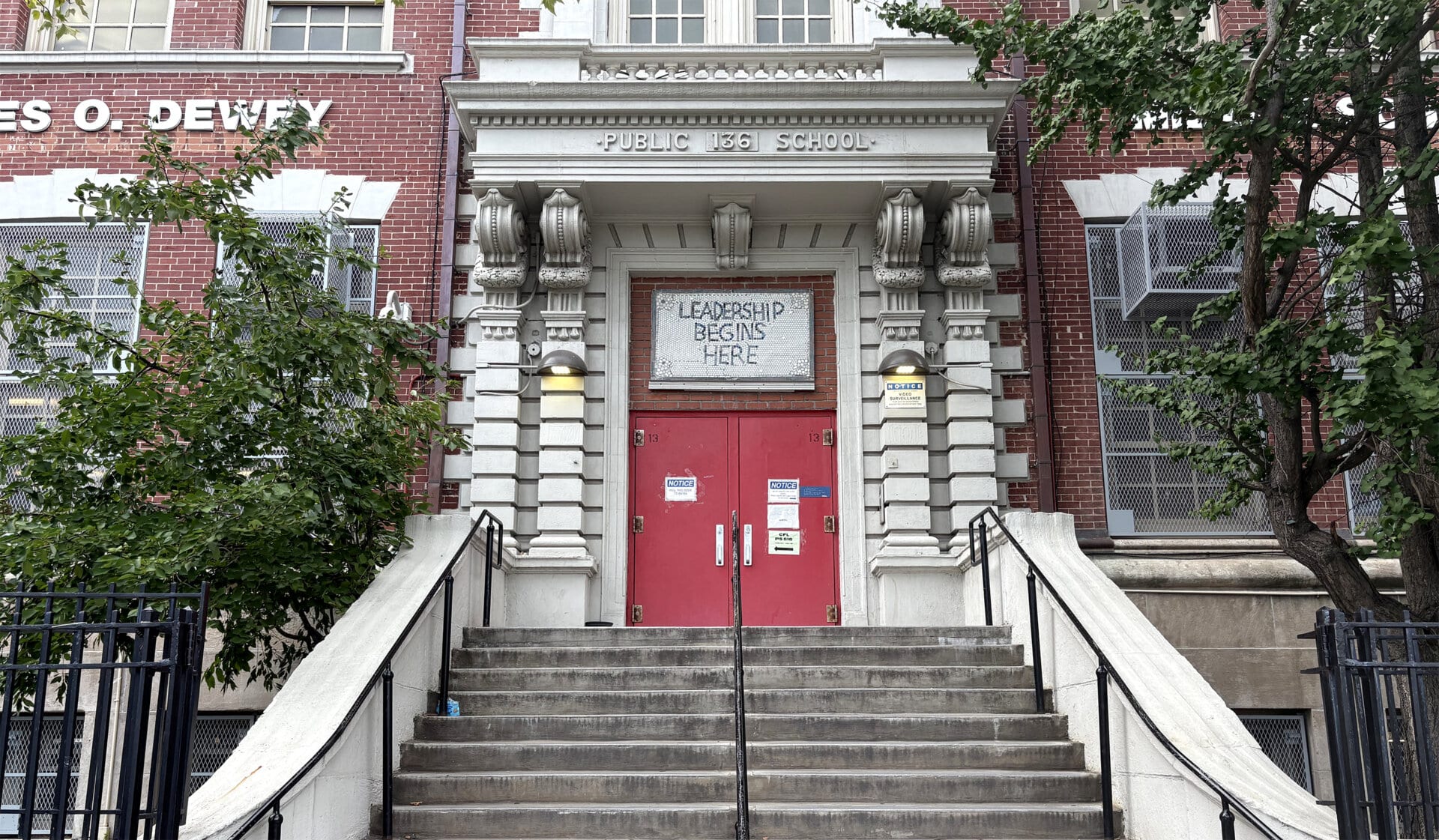
But so much had changed. My clothes were no longer my own, but instead a new uniform; my commute was no longer a drive in the car, but a subway ride. I was no longer headed to a cozy, familiar elementary school in Cobble Hill, but instead, to a middle school in the daunting, far-off land of Sunset Park.
My move to this new middle school was part of a change much larger than myself — the District 15 Diversity Plan, meant to desegregate one of the most socioeconomically and racially segregated school districts in the city.
Pushed by parents and community groups, the plan eliminated admissions criteria for middle schools and mandated that schools in the district set aside 52% of their seats for students who were low income or learning English. But all I knew was I hadn’t gotten into any of the 12 middle schools I’d put on my list, and was heading into the unknown.
Throughout the subway ride, the voices in my head tortured me. What if I can’t make friends? What if the other kids are mean to me? What if I hate all my teachers? As the anxieties built up, it felt like a black hole had opened in my stomach, threatening to devour me.
I was transitioning from a school where nearly everyone was more privileged than me to one where I was one of the most privileged students.
When I arrived, I made my way shakily to my homeroom. Inside, kids sat in groups, talking, laughing, and making TikToks — a sight that might put some kids at ease, but only made me more nervous at the realization that most of my classmates already knew one another.
As I searched for an open desk, I scanned the room for a potential friend. I quickly realized that here, my whiteness made me different. While nearly all the kids in my elementary school had been white, my new classroom was almost entirely Hispanic kids. It felt like an ocean of difference separated me and my peers.
Most of my classmates were using social media, something my mom did not allow me to use (“It’s too addictive for young, developing minds!”). Many of them were speaking in Spanish, a language barrier I couldn’t find my way around. The conversations I could pick up on were about TV shows I didn’t know, in between bites of foods I didn’t recognize. I didn’t know how to bridge the gap between us.
What Am I Doing Here?
That year, I went from an overwhelmingly white elementary school in one of the wealthiest neighborhoods in Brooklyn to a middle school where over 80% of students were Hispanic and over 90% were low income. There, I was one of just three white students in my grade.
Unbeknownst to 11-year-old me, integration initiatives such as the D15 Diversity Plan are often controversial, with some parents arguing that such plans put their children’s academic success at risk. Community members were deeply involved in the D15 Plan from the beginning, giving it the support needed to pass, yet some parents were still displeased with their child’s middle school placement.
News outlets reported that my middle school had 50 appeals from incoming students asking to be assigned to a different school — more than double the 22 appeals from the previous year. In particular, many of the white parents whose children were assigned my middle school chose instead to send their kids to private or Catholic schools. They cited concerns that the school would not be able to serve their “high-performing” children while also meeting the needs of lower income students, who they presumed to be lower-performing.
My parents didn’t share such concerns — when we toured the school, we could see it had plenty of resources and good teachers. However, it became clear to me that I was transitioning from a school where nearly everyone was more privileged than me to one where I was one of the most privileged students.
When I watched the other kids make friends, I wondered if that privilege prevented me from connecting with others. The other kids enjoyed going out during lunch, walking around the neighborhood they loved, but the area was louder and busier than I was used to, and I was scared by the unfamiliarity — just one instance of the distance I felt.
I was still discovering who I was, but I felt stubborn that I didn’t want to change myself in order to fit in. I put in little effort to connect with my classmates, and spent most of my time at school alone, as I felt like there was nothing I could do to change my situation. I didn’t understand how to make friends with my peers when it felt like we had no common ground. I gave up before even trying.
Learning About Integration
In my second year of middle school, the pandemic forced us into online classes, and by then I had grown used to my solitude. I participated frequently in my classes and asked questions whenever I could. My teachers caught on to my deep curiosity. One day, my social studies teacher told me about a meeting I might want to attend: students from across the city were coming together to talk about issues impacting them at their schools. Intrigued, I decided to check it out. When the day of the meeting arrived, however, my nerves did as well.
I stared at the “Join Zoom” button, my mind racing. What if everyone there was more prepared than me? What if they put me on the spot and I didn’t know what to say? I took a deep breath and pushed the anxieties away: my teacher thought I’d be interested because I want to learn, not because I already know everything.
As the meeting began, I was floored to learn that the group hosting was youth-led—students, just like me, had done all this work! They were part of IntegrateNYC, an organization whose mission was to desegregate public schools.
I felt stunned; I had thought of segregation as a thing of the past, but thinking about the majority white students in my elementary school and the majority Hispanic kids in my middle school, I realized that segregation was and always had been my present — and it wasn’t just mine. I learned that NYC’s public school system is one of the most segregated in the country. I hadn’t realized it before, but the D15 Plan was intended to remedy the “de facto” segregation that ran rampant in our schools. Suddenly, I felt a swell of pride. I hadn’t felt much for the D15 Diversity Plan before, but knowing all the good that could come from it, I was glad to be a part of it.
I found myself in awe of the youth leaders who were presenting this information. One of them especially stood out to me: a girl two years older than me who led several of the activities, Rosalie. She spoke with such ease, as if she had never been nervous a day in her life. And when she explained things, it seemed as if she possessed all the knowledge in the world, something I deeply craved.
When the meeting came to a close, the youth leaders encouraged us to volunteer to lead similar meetings in the future, and my mind sped up once more. I thought about my elementary school, and what it had been like to go to a completely different middle school. I thought about everything I had learned that night, in just two hours, and how much there must still be left for me to discover. I thought about Rosalie. Maybe I could be like her.
Different, But Friends
For the next few years, I volunteered with IntegrateNYC. A diverse group of students from middle schools across the district and I spent hours planning meetings and brainstorming activities to educate other students about segregation and activism. We encouraged other teens to speak up when they felt discounted or ignored by administration, teachers, and adults in general.
The more I learned about de facto segregation — segregation that still exists as the result of neighborhood housing powers and social and economic forces — the more I understood the importance of integrated schools. School is one of the only times in one’s life where people are forced to interact with others who are different from them, allowing everyone to learn from and about people from other cultures. And the more I spoke up about this, the more confident I grew in my own voice, even leading parts of the meetings I initially attended.
I also ended up working closely with Rosalie. I learned that, in some ways, her story was the opposite of mine — she was Hispanic, and grew up in a low-income family in Sunset Park, but ended up in a predominantly white middle school, one of the schools I’d ranked high on my own list. Although at a glance our upbringings were complete inverses, our differences didn’t prevent us from building a friendship. That friendship with Rosalie helped me realize that maybe the differences between my classmates and me weren’t insurmountable.
The success of the D15 Diversity Plan gives me hope that other districts may adopt a similar plan, and that other parents won’t be afraid to send their kids to a school like mine, which was just as good as, if not better than, many of the other schools in my district.
When I first learned that I had been placed at a middle school I had never heard of, I thought my luck in the lottery must have been horrible. But looking back, I got really lucky by not going to any of the schools on my list.
Middle school isn’t perfect, but I’m glad I went to the school I did. By 8th grade, I was finally able to laugh and chat with friends in my class just as I had seen everyone doing on my very first day of 6th grade.
Further Reading & Listening
This American Life: The Problem We All Live With, The New York Times: Nice White Parents, The Wall Street Journal: Inside the Effort to Diversify Middle School
- Race & Ethnicity
- School