On the morning of the World Trade Center attacks, I had a lot on my mind. Riding the subway from Brooklyn to Stuyvesant HS, in Battery Park City, I debated my decision the night before to sleep instead of doing my homework. I’d been 20 minutes late to class the day before because I’d overslept.
I was also peeved at the woman sitting next to me, who hadn’t said “Excuse me” when she squeezed her big butt into the little amount of space left on the bench.
I knew, though, that this school day would pass like all other school days had before it. I’d trudge through the day, bear the monotony of subway rides and anticipate the relief of home, only to fret over all the things I have to do once I’m there. This day would fade to become as indistinguishable as the rest.
First Thought: Lunch
It didn’t happen exactly like that. “A small plane has hit the World Trade Center,” a voice said over the loudspeaker during my 2nd-period music class. Stuyvesant’s just a few blocks north of the World Trade Center, built on landfill created when the Twin Towers’ foundation was dug out.
“Aw,” I thought. “It’s a good thing the World Trade Center was built for these kinds of things.” And when we were told that we wouldn’t be allowed out for lunch, I just thought, “It doesn’t really matter to me since I rarely go out for lunch.”
Seeing Is Believing
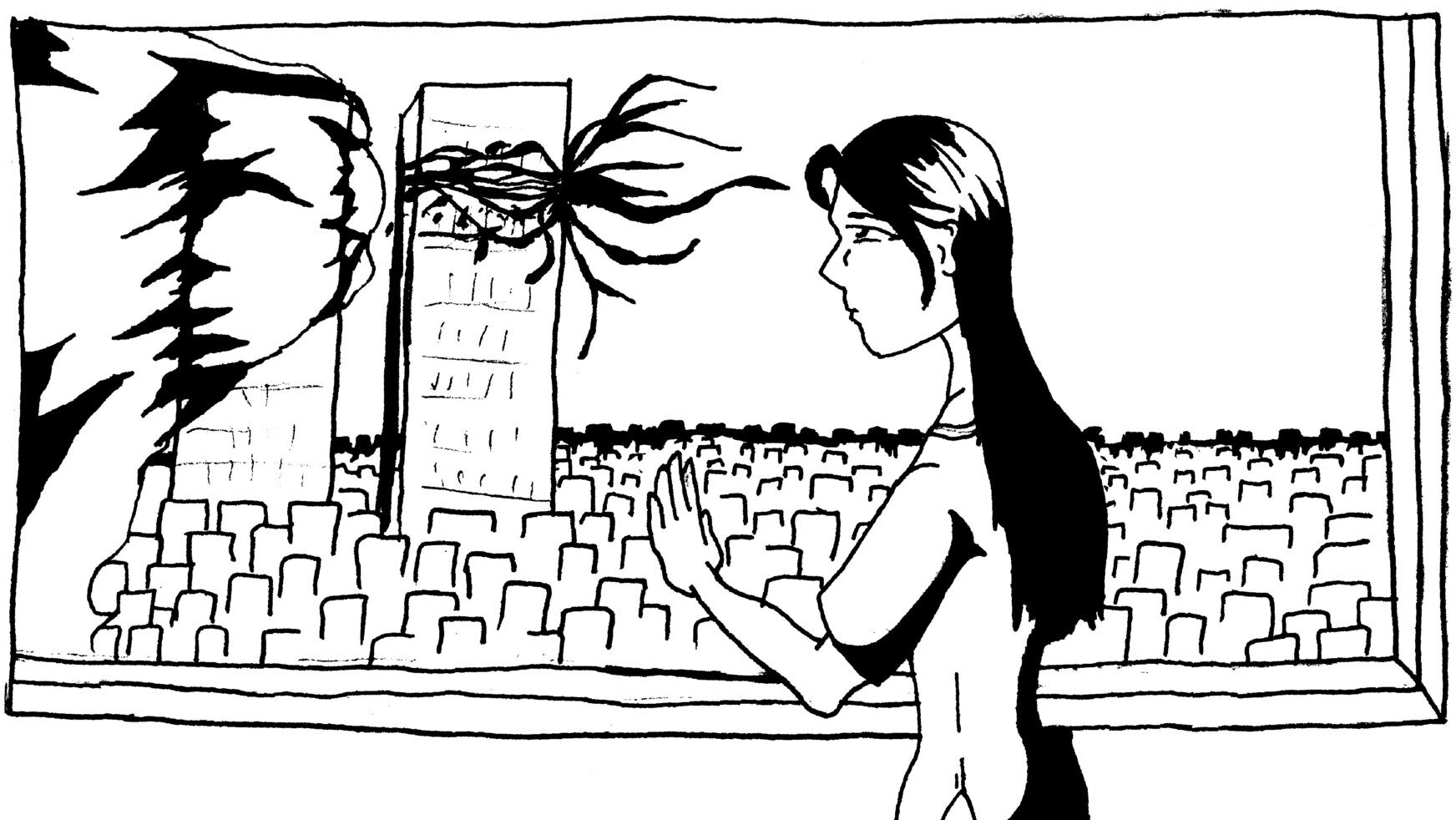
But seeing the huge gash cut into the side of the tower and puffs of white smoke cascading into the clear blue sky from the window of my next class was a different story.
“Oh my God! That’s pretty bad,” I said aloud.
“Yeah, it is,” was the reply of a classmate who’d been watching it for a while.
The rest is pretty much history. We watched the events unfold on the classroom TV set and out the window until the power went out. Then most people moved away from the windows, though some stayed and gawked as the first tower collapsed. That’s when I wondered what the point of shelter drills had been.
Evacuated
After following instructions to go to my seventh-floor homeroom (closer to danger, as I would later realize), I was evacuated along with the rest of the school at around 10:30.
A friend and I trekked uptown for an hour or so to the NYC office, where we could stay and have access to a phone. There really wasn’t time to think about what had happened, but my initial reaction was to be angry with the U.S. for provoking the attack with its foreign policies and attitude.
I was also critical of my school’s lack of instruction as to what to do after evacuating. “All those poor freshmen,” I thought. Hours later, all this simmered down to a sick feeling in my stomach.
No School for a Week
There was a lot of time to think about it afterwards, though, since we had no school building to return to for the next week. Even before we were completely evacuated, Stuyvesant HS was being used in the rescue effort.
During that time, I tried to go out as often as possible, even though the air didn’t smell too healthy in southern Brooklyn. There was something unsettling and depressing about staying home on a pleasant weekday, watching the never-ending reports on TV.
So I went over my friends’ houses, enjoying the opportunity to play board games, study SAT words and bake cakes.
Constantly Aware
A psychologist would probably say that I was distracting myself, but I can honestly say that I was also constantly aware of what had happened.
I thought about that woman on the subway who’d annoyed me. Did she get off at Cortlandt Street, the stop right before mine, in the World Trade Center? Wow, she could be dead right now.
What about all those people I saw getting off there every day? They could’ve met a similar fate.
There was also the bigger question of “what exactly did happen?” that was constantly nagging at my brain. Something terrible. Something that would change us forever, was what they said on the news. Something that made people analyze every aspect of their lives connecting them with the event.
Business People Covered in Dust
I kept thinking that if people so indirectly affected by this are crying in the streets, lighting candles and preaching about humanity, then someone like me who was so close to the attack should be completely changed.
But was I?
Thinking about the woman on the subway, I realized that this experience humanized some people for me. I’ve never really liked business people, with their uppity attitude and nasty glares if you happen to be in their way as they’re rushing for the train.
But after seeing some of them covered from head to foot in white dust and imagining them running for their lives, I had to feel for them.
Teachers Are Human, Too
My perception of teachers changed, too. During the attack, most teachers at my school kept a cool head and acted in a way that was extremely commendable. But then there was one who I heard “lost it” and another who ran around with an excited glint in his eye.
I’d always known that teachers were human, but seeing so many different reactions in a time of crisis made me sympathize with and respect some of them more.
Above all, though, the World Trade Center attack put a damper on my feeling of invulnerability. Before this, the city was my oyster. And the World Trade Center, so close to my school and so easy to get to by many subway lines, had special meaning for me.
Making the City My Own
Just two months earlier, I met my friend Jordan at the mall in the World Trade Center. Someone had just stolen money out of my wallet that day while I was sleeping on the train, so I was feeling very bitter, like I couldn’t trust anything or anyone in this city.
But there, at the World Trade Center, Jordan instantly cheered me up by singing a spontaneous song about “living it up” in this “helluva town.” It revived my feeling that little bad things can’t throw me.
All my experiences there contributed to my sense of independence and confidence in this city. My memory is filled with images: shopping for ridiculous raccoon binoculars at the Store of Knowledge, balking at the prices at Godiva, friends showing me the free bread at the bakery. With each new discovery came a feeling of having conquered something and made it mine.
Nothing Feels Secure
With the destruction of the World Trade Center, that feeling has gone too. The place so central to my expanding world had been destroyed.
Perhaps it was with the intention of recapturing some of those feelings that I went to Grand Central Station recently. Like I’ve done before, I talked to my friends from opposite corners of the chamber in front of the Oyster Bar. I’d always had fun playing with the way sound travels with a curved ceiling.
“I felt a creeping anxiety that I should be
anticipating the worst, everything from the world
ending to my own mental breakdown.”
But it just wasn’t the same. I couldn’t shake the awareness that this could all be taken away in an instant, that nothing was secure and certain.
Stuyvesant Goes to Tech
With that on my mind, I went back to classes nine days later, which were held at Brooklyn Technical HS. I rejoiced at this since my commute was a few minutes shorter and I prefer the landscape of Brooklyn to that of Manhattan (trees, houses and buildings with history as opposed to new, impersonal buildings and artificial parks).
Students from my school were given a schedule of 26-minute periods from 1:30-6:30 (with free lunch in between!). I felt that was appropriate since we’d just gone through a traumatic experience. Not only did we not have to wake up so early, but it would allow for people to gradually get back into the routine of things.
Overwhelmed
On the first day or so, getting back to some sort of a routine helped me get through my head that there was still a life to be lived. But then I started to realize all the things that lay ahead for me to do.
I had chapters of homework to catch up on, PSATs, SATs, SAT IIs and APs and colleges and extracurriculars to think about. I became overwhelmed. And on top of all that was the creeping anxiety that I should be anticipating the worst, everything from the world ending to my own mental breakdown.
I tried to put all the stuff about the attacks to the back of my mind, but that was nearly impossible. Every time I succeeded in getting myself into a quasi-work-focused state of mind, something dragged me back into feeling the full impact of what happened.
Visit From a Counselor
About two weeks after the attacks, a guidance counselor came into our social studies class to talk about the counseling services available to us.
He passed out sheets put together by the American Red Cross explaining some common reactions to disasters, such as grief, anger, shock and fear. He commended us on our calm dispositions and told us we should pay attention to any changes in our regular behavior.
Is It Trauma, Or Is It Me?
Everything was done with good intentions I’m sure, but it made me more paranoid and anxious. I hadn’t experienced some of the things on the list like flashbacks or survivor guilt, but I’d also heard that signs of trauma can appear a month later or even longer.
So now I worry that some time in the future, probably when I’m in the middle of taking my SATs, I’ll have a panic attack or a flashback.
There were also reactions on the list that I had experienced, like the inability to think clearly and temporary memory loss. While I’m sure the attacks have contributed to my feeling of being overwhelmed, and these symptoms, I also wondered whether my less-than-perfect state was the result of “the effects of trauma” or just regular, stressed-out me.
We’re Not Unfeeling
But what made me feel even worse was when my social studies teacher said she believed the reason we seemed so unaffected was because we’d become desensitized from movies and such.
Classmates with downcast eyes dropped their faces into their hands; reflective faces turned into those of indignation. The counselor looked uncomfortable. One student raised her hand to dispute this, but my teacher just said we took it the wrong way.
I felt hurt; we’re still trying to figure out how we’ve been affected, and insensitive generalizations like that don’t help. I’m sure there might be some people detached and desensitized, but it’s important to watch what you say because a lot of us are not.
No Easy Return
Now that I’m back at Stuyvesant-we returned to our building on October 9-I feel like things are finally settling down. I’m actually relieved that I can refocus myself, even though I’m getting less sleep now that I can do my work. But I’d give up sleep for more peace of mind any day.
At Tech, it was too easy not to focus on school and dwell on what had happened because the situation was temporary, a constant reminder that things weren’t stable.
Still, I was afraid that this “return to how things were” would be only an illusion or distraction, and these first few days have proved to me that this event can’t be shaken off easily. I can see huge machines out the window. Strange men come into class to check the air. Sympathy banners hang throughout the school. Police check our IDs before we enter the building.
My friends agree that the impact of witnessing such an event at this close of a distance will stay with many of us for some time. Now I joke that it’s not just whether I’ll get into the college of my choice, it’s also whether I’ll live to attend it.
- Grief
- Mental Health