
Walk into my neighborhood; I live in Harlem.
Come to my building, pass the drug dealers who lean against the gate, step around the women who sit on the steps, dodge the kids who play in the lobby, and press the elevator button 20 times.
When it finally comes down, open the door and step in, but watch out for the corners, because that’s where they urinate.
Go to the fourth floor, step out, hop over two stink bags, turn left, and my apartment is right down the hall.
Go right in. Don’t worry about what you had to go through. You’ll eventually develop a sort of nearsightedness and get used to the building.
Harlem From My Window
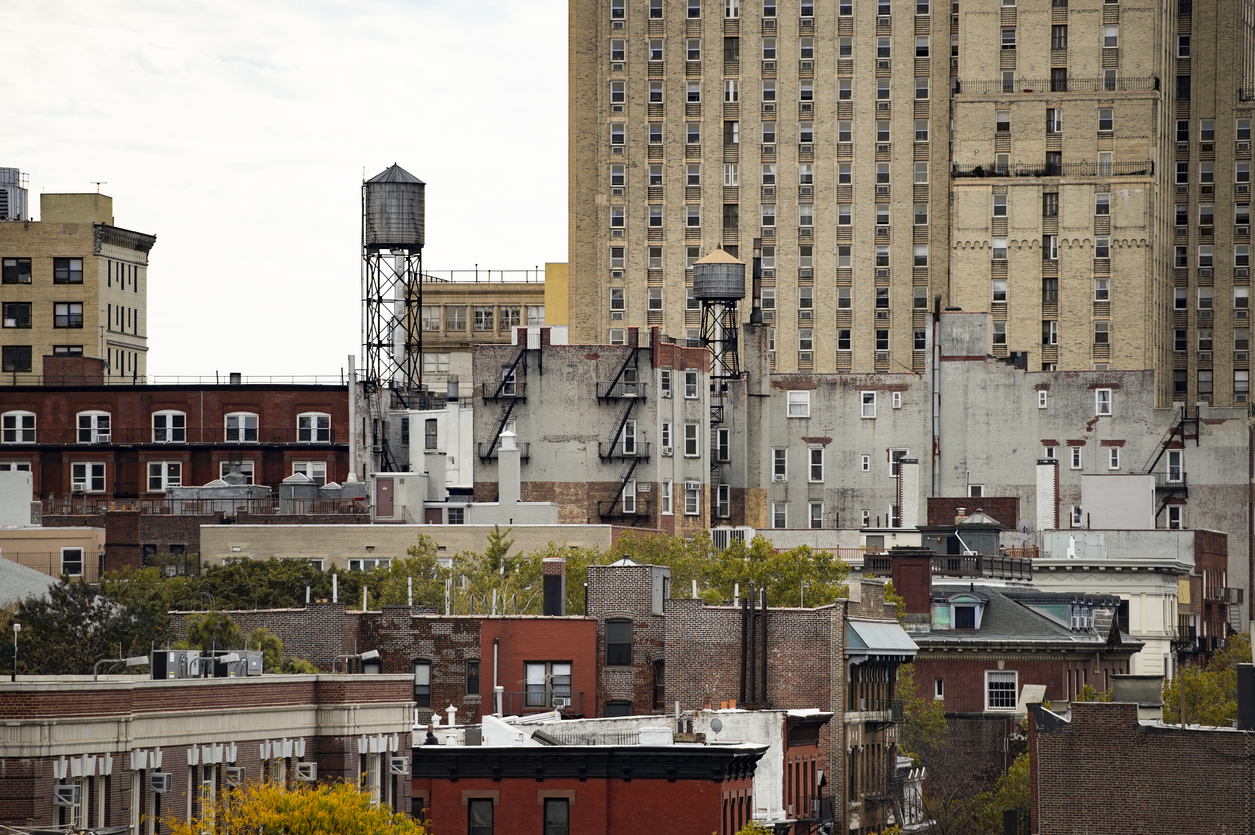
Now that you’re inside, I want you to go into my sister’s room and look out the window. There’s a church across from here, a laundromat down the street, a weed spot two blocks down, a liquor store, a check cashing place and a housing project somewhere nearby.
The pattern repeats itself every couple of blocks until it reaches the river. Look at how the city trees stretch out of the sidewalk, contrasting nature to concrete, green to gray.
No one is in a hurry. Teenagers hang out, lounging on parked cars, just talking and having fun.
The older men do the same thing, only they find their place inside barber shops and such. See that guy stroll into the corner store? He’s going to buy something, then argue about nothing with the Arabs who own the store.
The Black-White Divide
You see him leaving now, but wait a couple of hours and he’ll do it again.
Keep watching from here and you’ll see a lot. But you want to get a firsthand experience? Then go from 7th Avenue to Amsterdam on 110th Street and you’ll be surprised at how sharply the neighborhood changes from Black to White.
Or walk anywhere on Broadway between 135th and 145th Street and be prepared to be harassed by the guys selling drugs.
I’m more comfortable at this window. From here, I see everything in Harlem while managing to remain apart from it.
Though I was born here, and I’ve lived here for six or seven years of my life, Harlem has always been my in-between home.
I’ve lived twice in the Bronx and twice in Queens, and I’ve stayed in Chinatown and also on Long Island. Anytime I would stay somewhere else, I would still come back here to visit family and to travel on familiar avenues. Of all the places I’ve lived, it’s Harlem I consider home.
The “Cosby Show” Protected Me
Still, in some ways I feel more like an observer than someone who’s entangled in everything. I’ve never had enough time to make friends, and friends have never had enough time to make me.
I grew up with television and books instead, and didn’t spend my nights hanging out. Years of watching “Growing Pains” and the “Cosby Show” protected me from becoming as pessimistic and cynical as other people my age who live in Harlem.
Unlike me, my brother’s friend Kevin has lived his whole life in Harlem. He’s been my brother’s best friend since before I was born. They played together in the sandbox when they were younger and now work together as gofers in a law firm.
When Kevin comes over to my house, he usually stands in the middle of the living room, politely waiting for someone to offer him a seat.
After he’s been invited to make himself at home, he slides onto the couch, letting his skinny body sink into the cushions. His oversized shirt and baggy jeans always drape his frame in a surprisingly neat way.
If I happen to be sitting on the couch with him, he’ll tilt his head toward me and say in a lazy monotone, “So, ‘Shim, still writin’ rhymes?”
I’ll nervously say, “Yeah,” and he’ll get me to recite one.
Slow, Broken-Off Sentences
After I’m finished, he looks at the floor for a second, thoughtfully absorbing every line that I said. I wait for a response or some sort of reaction to register on his face.
“Yeah,” he proclaims while giving me a pound. With Kevin, this is as close as I can get to real communication.
Behind his sleepy, half open eyes, I can sense that he enjoyed at least some of my lyrics, and as a senior to a freshman he sympathizes with my mistakes and wants to encourage my talent.
But most of this is left unspoken as he struggles with slow, broken-off sentences.
“Keep on writin’ and just find ways t’flip this on some new higher…you know, some next level or somethin. Y’know?”
Disappointed Expectations
I usually look away and nod. It frustrates me to stare at Kevin’s complacent face for too long. I become weary with the expectations that I have and disappointed when Kevin resigns himself to existing quietly in Harlem quietly just as Harlem exists between the cushions of Washington Heights and Central Park.
When he was born there wasn’t the sound of one trumpet and the earth promises not to crumble once he dies. He spends the days of his life unable or unwilling to make a loud sound.
In a way, Kevin’s aimless and lukewarm nature reflect the worst of the neighborhood. But he is also the best of this place.
A Gushing Flood Of Words
Once he finishes taking in my lyrics he exhales his own, repainting pictures of real life in the colors of rhythmic poetry. And in an instant he floods every shallow stereotypical path with a gushing flow of words.
As I compare and contrast myself to Kevin and Kevin to Harlem I wonder how different I am from him.
We each have our own hopes, yet both of us seem indifferent about our futures.
Kevin’s lackadaisical attitude was probably formed by seeing one too many friends in Harlem fail. For someone in that situation, dreams aren’t realities waiting to happen, but imaginary cords that prevent a slide into depression.
Trying to climb up would be an act of pure faith, and to fail would be devastating.
I think of myself as different. But there’s also a certain expectation in me that makes me feel that whatever I receive will come not by hard work but by pure talent. I don’t know why this is.
Maybe it’s because I haven’t had too many hard-working role models.
Black Success-A Fairy Tale?
All of my life I’ve known that there are successful Black people around, but I’ve never spent extended time up close with one. So they remain a fairy tale to me. And in fairy tales the drawn-out process and all the hard work it takes to become a success aren’t important, only the magic that comes out in the end.
I hope to be a novelist sometime in the future. Once I walk that path and reach my goal, I plan to come back to Harlem and teach others the secrets of taking those same steps.
But I’m afraid. In order to heal something and play doctor, I would first have to deal with how deep the disease runs.
How would I be able to do that in the future when even now I walk through Harlem with my eyes down, trying not to notice the heroin addicts and abandoned buildings and every other symptom that shows the sickness that exists here.
The prejudices about my neighborhood are clear: unsafe and dirty, a typical drug-infested ghetto.
But there’s a sense of history here that makes me feel unreasonably proud.
How many people know Tribeca’s past? Was there ever a Bushwick Renaissance? Has anyone ever heard of the Canarsie Globetrotters?
A Soil Rich With History
My neighborhood has an autobiography that’s beyond the New York experience, yet connected to it. Tourists come through here on tall buses with cameras set on flash.
Harlem isn’t just a pit stop between the Cloisters and Times Square. It’s an attraction within itself.
And although this place is built on stiff concrete, I know that underneath, there exists a rich soil where things used to grow.
The seeds of a culture were planted here. The Renaissance blossomed and the revolutionary movement sprouted from Harlem’s street corners. Poetry could be heard from Marcus Garvey Park, politics were preached from soap boxes on the street, jazz played in the hippest clubs.
What people had wasn’t satisfying, but what they looked forward to gave them a sense of hope. Harlem is still discontented today, but without a bright future to focus on, I draw honor from the past.
Acrobatic Dunks
Still, even today, Harlem has a unique energy that’s most clearly seen during the summer. At the Rucker tournament, people crowd into a little outdoor basketball court across the street from the Polo Grounds to watch the local stars.
Celebrities come out, and there’s loud music playing. People have fun as they forget about the world and become mesmerized by each acrobatic dunk.
And on 125th, you can find genuine brand names and quality bootleg merchandise being sold in the same store. There’s a place where one man does income taxes, makes copies and sells jerk chicken.
The women dress in the latest fashions and carry the mixed smell of baby powder and peppermint as if it were their own.
The record shops set their speakers outside and fill the air with music, while the electronic stores do the same thing with TVs that play kung-fu movies all day long.
The few vendors that Giuliani still allows outside sell books and incense. They light a dozen sticks at a time and let the wind carry the sweet smell through the street.
At night the same sidewalks fill with people who have just come out of the Apollo or are pretending they did. No one notices the police presence as they mingle in their unofficial afterparty…
Like a Little Brother
This is the Harlem that I brag about to outsiders. Of course when I’m around my friends I insult the place as much as possible, but I can never let a foreigner do the same thing.
This is probably a modern form of tribalism. I think of it like this: Everyone beats up on his little brother, but if he gets into a fight on the street, you’ll protect him.
I feel the same way about Harlem. It’s my home.
Waiting for Harlem to Happen Again
About These Stories
YC runs intensive nonfiction writing programs for teens in New York City, where they’re mentored by a professional editor to write personal stories about their lives and about issues that affect young people. Their stories are then published and read by thousands of teens, educators, policymakers, and other adults who work with and for young people.