
The conditions under which New York City student athletes play baseball must look laughable to visitors from the suburbs. The city’s so stocked up with skyscrapers and people, there’s little room for recreational space.
On the island of Manhattan, where there are at least 70 public high schools, there are only 11 locations with full-sized baseball fields. Most Manhattan public school baseball teams don’t have their own home field and are forced to play on dilapidated fields where the grass is often chewed up or even missing entirely, and which are often covered in garbage. We know this because we play on many of them, traveling all over Manhattan with our high school team, looking for any place to play.
Too Small for Baseball
Fields need grass because it slows the ball down. Without grass, it’s just dirt and rocks. It’s much easier on the knees and elbows to dive onto grass than onto jagged rocks. And rocks can cause the ball to hop unpredictably, adding to the risk of injury.
Size is another problem. Some of the fields Manhattan teams play on are softball fields, which have smaller infields with shorter paths between bases. When we put down our baseball-length bases, they’re on the fringe of the outfield grass, which makes the outfield too short. One field, in Morningside Park, is so small that if the ball’s hit out of the park, it’s considered only a ground rule double, not a home run.
Lousy baseball fields are not just a Manhattan problem. Gerald Levy, the baseball coach for Thomas Edison HS in Jamaica, Queens, said that New York City high school teams face “a very unfair multi-layered dynamic.”
‘Unfair Field of Play’
“Teams with their own fields are the elite teams,” Levy explained. “Then there are teams who struggle with the [Department] of Education fields and then there are the teams who don’t even have home fields and travel all over the city to play. It’s wrong because it creates an unfair field of play before the games even start.”
Levy is also upset by the New York City Parks Department’s neglect of public fields. His team plays at Joseph Austin field next to Edison HS. “They don’t take care of our field at all,” he said. “One time, they brought huge mounds of clay to spread, but then forgot to spread it, so we had to do it. They also let soccer players play on our field, which is only a baseball diamond, and they tear up the grass.”
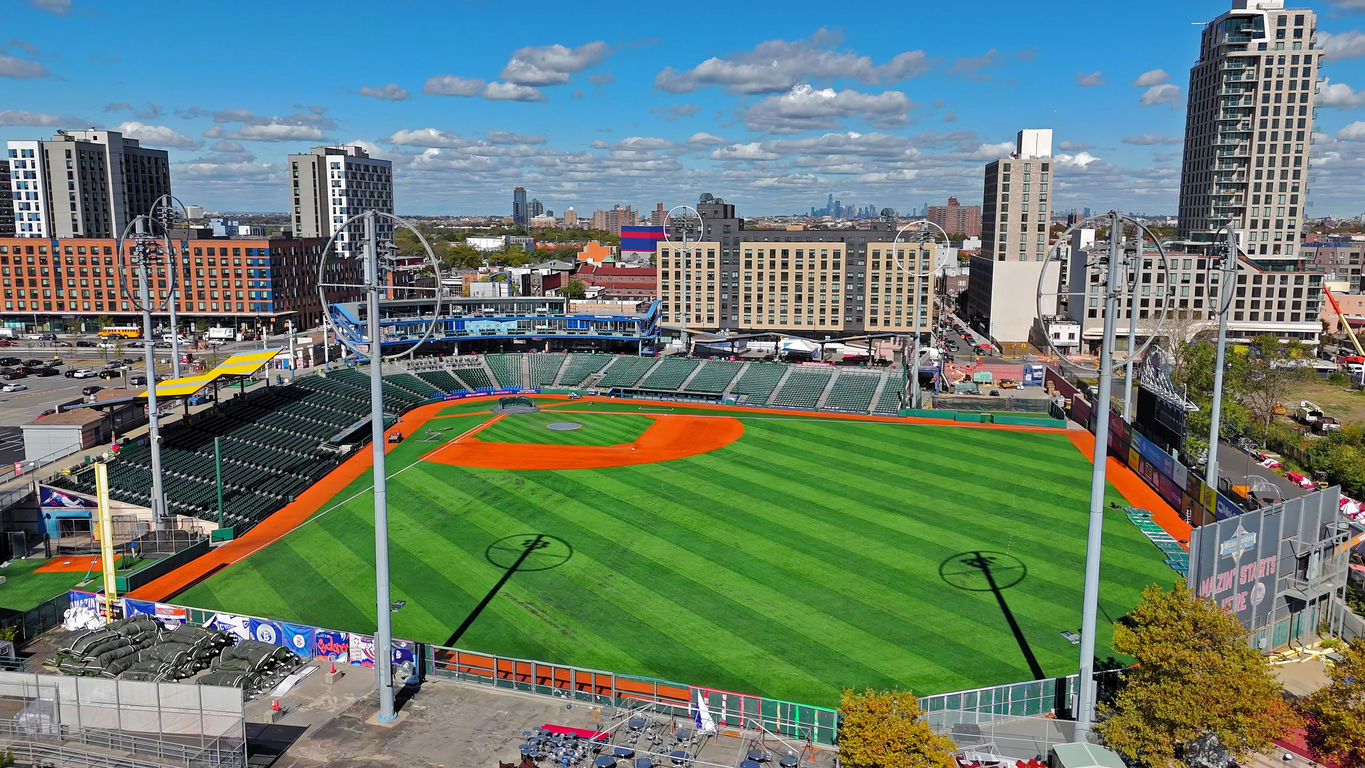
In an effort to improve the playing fields, and adapt them to their urban environment, the Parks Department is now trying to convert rundown parks into state-of-the-art Astroturf fields. According to a spokesperson for the Parks Department, “The new artificial fields solve a lot of the drainage problems that we’ve had and also require much less constant maintenance than regular fields.”
Take the Field to the Rescue
Another advantage to the new turf is that it doesn’t hurt like hell to skin your knees on it when you slide, a sensation that’s become quite familiar to us and to anyone who’s had to slide on the rock-laden dirt of New York’s grass fields.
Despite the promises of the Parks Department to fix up these fields, though, most of them remain unchanged. Fortunately, an organization for field improvement, Take the Field, has stepped in.
Take the Field is funded by a combination of public and private donors. The city pays $4 for every one dollar that private donors contribute. Take the Field has fixed up or has plans to fix up 32 fields around the city, 26 of which are fully operational and in use.
Most of those fields, though, are far out in the boroughs where there’s more space and larger athletic schools. Of the four fields improved in Manhattan, one, Seward Park HS, is just a fix up of the courtyard. New concrete was put down and the basketball and hard court tennis courts were resurfaced; the renovation didn’t include any athletic fields.
Another improvement is a minor job done on the asphalt yard of elementary school PS 61 in Harlem. It helped give the kids a much needed nice place to play, but it doesn’t involve any green.
Only Top Teams Benefit
George Washington HS has a beautifully redone athletic field, though. But they already had a baseball stadium of their own, which didn’t need much fixing. George Washington happens to be consistent city baseball champions, producing players like major league slugger Manny Ramirez.
Other schools that have benefited from Take the Field are Jamaica HS, Benjamin Cardozo HS, Abraham Lincoln HS, and Adlai Stevenson HS, all large schools whose teams are also regularly noted for their prowess.
According to Mary Musca, a representative of the Take the Field Organization, the fields “are restored in places that need the most attention, have a school that really wants the field, and to ensure that the entire community can use it when the schools are not.” Of course, every neighborhood in the city needs more recreational space and every school in the city would love a new field to play on.
The selection of fields marked for improvement leaves smaller, less athletically stellar schools in the dust. Jamaica’s field, recently fixed up by Take the Field, is across the street from Edison HS. From their windows, Edison players can see the beautiful new turf field-but they’re not even allowed to practice on it.
‘Kids Feel Cheated’
Frank Roberts, athletic director and dean of Thomas Edison, feels angry at the imbalance. “Our kids feel so cheated,” he says. “All we have to do is look across the street and see the field of dreams.”
There seems to be a similar pattern all over the city. The well-maintained fields, while slowly growing in number, are merely mirages for most of the city’s teams, who still stumble over glass and pebbles.
It’s a difficult situation to resolve in a city strapped for money and space. Still though, something needs to be done. It’s only a matter of time before someone seriously hurts themselves on these dangerous fields.
New York City Fields Strike Out
About These Stories
YC runs intensive nonfiction writing programs for teens in New York City, where they’re mentored by a professional editor to write personal stories about their lives and about issues that affect young people. Their stories are then published and read by thousands of teens, educators, policymakers, and other adults who work with and for young people.