
Last year, I decided I wanted to improve my Spanish. My family is from Panama and my mother and grandparents speak the language fluently. I, on the other hand, only understood a few words and phrases. I decided the best way to learn would be to go to a country where they speak it.
I found out about World, Inc., a program that helps American students go to other countries to study their languages, culture, and customs. With the organization’s help, I arranged to spend part of last summer in Oaxaca, Mexico.
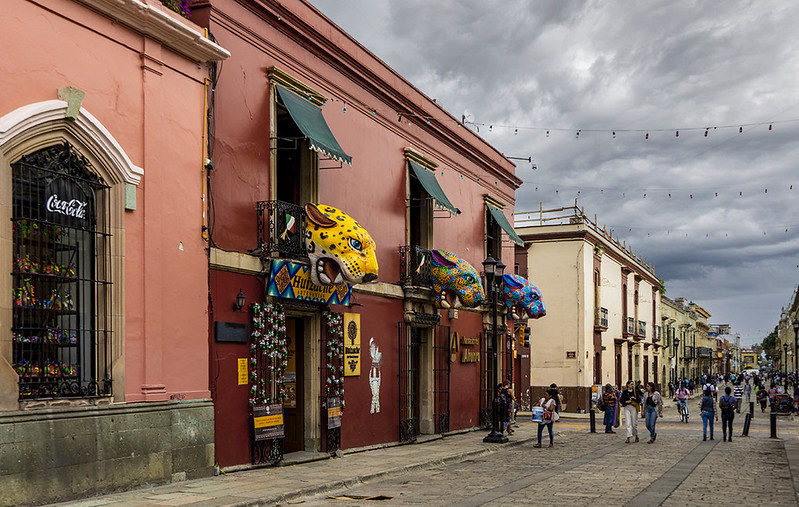
Oaxaca is a great town, surrounded by mountains and filled with artists and craftspeople. There are indoor and outdoor markets all over, where vendors sell their goods-handmade rugs, clothing, wall hangings, ceramics, and so on. The artists have their own little section of town where they display and sell their drawings and paintings.
Although the program had arranged for me to live with a family, it didn’t turn out the way I expected. At the time of my visit all the family members were away except for one of the daughters, a 25-year-old woman. She didn’t seem too interested in getting to know her American guest and we never developed a relationship (this was unusual; most of the other foreign students I met in Oaxaca had good relationships with their Mexican families).
Conversation, Grammar, and Ceramics
My typical day would start at my language school, where I would meet with Claudia, my conversation partner. She was 22 and a native of Oaxaca. I would practice my Spanish with her and she would practice her English with me. We would spend an hour discussing music, food, soap opera stars, and astrology. One day I went to her house and attempted to cook Mexican food. It wasn’t bad, but I went a little heavy on the chili peppers.
Following my meeting with Claudia, I had ceramics for two hours. That was a great class. My teacher, Enedina, had been doing ceramics for 40 years; the work that she did showed the many years of experience. As I struggled to make cups and little trinkets, she was always willing to help my ailing projects. Our last meeting was held at her house in a village outside the city. That was the best class because I got to see Enedina in her own environment and to meet some of her family. She let me use her equipment to fire and glaze my work (firing makes the clay hard and glazing makes it shiny).
After ceramics I would rush home to eat. Lunch always started off with soup and bread. Then I would usually have tostadas, which are fried tortillas topped with tomatoes, cheese and avocado. Instead of ketchup, salsa (a green or red hot sauce) was the condiment of choice.
After lunch I would hurry back to school. Because I had never actually studied Spanish, I was in the beginner’s language class. I was familiar with a lot of the material, however, because of hearing Spanish spoken at home.
Our class spent three hours a day on grammar and one hour on conversation. We discussed the death penalty, abortion, euthanasia, and the politics of Carlos Salinas (the president of Mexico) and Jorge Arbusto (as we liked to call George Bush). At times, I would get so caught up with the Spanish language that I would forget the English words for things. Most of the people in my class were other Americans, but they were all different ages and from various parts of the country. These differences made the conversations we had interesting.
Hangin’ in the Zcalo
After class, I would go out and explore the town. I would walk through some of the different outdoor markets or I would go down to the zcalo, or town square. It was an open area with a gazebo in the center that had lots of restaurants and cafes surrounding it. There were always many vendors there selling candy, balloons, jewelry, food, clothing and other items. At night the zcalo was the hang out. Mariachis (strolling guitarists and singers) and an American band would play for the cafe regulars.
During my walks, I noticed the differences that existed among Mexicans. Some are White; some are Mestizos (mixed race); others are indigenous (native or Indian people). In Mexico, like in the U.S., a person’s skin color seems to play a big part in where they are on the economic ladder. The indigenous people I saw were clearly at the bottom. They were the ones who sold their merchandise at the outdoor markets, rain or shine. Most store owners I saw were Mestizo or White-they were the ones who could afford to rent a shop.
They Called Me ‘Negrita’
I did not see any Black Mexicans. As a Black person, I stuck out like a sore thumb. The words “morena” and “negrita” (Spanish for “Black girl”) followed me everywhere I went, like a chanting in my ears.
At times, being called “morena” was annoying, especially if it came from the soldiers and police officers I encountered every day (I was staying just three blocks from a military base). When these guys said it, it sounded like an insult. They harassed every unescorted female tourist they saw.
When a child said it, on the other hand, it was an expression of honest curiosity. For example, one day I was passing by an outdoor market where a group of native women and their children were selling crafts. A little girl came up to me and touched my hand. As she felt my skin, she asked my why I was “negrita.”
I told her that I was “negrita” because my parents were. But that answer was not good enough. So, I received another, “ÀPor que?” I gave my new friend a crash course in geography. I told her there was a land called Africa and that most of the people who live there are “negritos.” She had never heard of Africa, but she listened to the rest of my explanation and seemed satisfied.
My Pequea Amiga
I later found out that my new acquaintance was a 7-year-old named Rosa. Instead of going to school, Rosa helped the other female members of her family sell bags, bracelets, pens, and wall hangings at the market. Rosa became my “pequea amiga” (little friend) and I would stop and visit her whenever I passed the market. Before leaving Oaxaca I spent my last 10,000 pesos ($3.30 in American money) on a small red wall hanging that Rosa had made herself.
After my walks around town, I would go home to rest, eat dinner and watch “Telemsica” (that’s the Spanish version of MTV). After “Telemsica,” I headed back towards the zcalo to hang out with friends from my Spanish class. On weekends, we took sightseeing trips to other towns.
My trip to Mexico was a great experience. I definitely think the best way to learn a language is to be immersed in it. My confidence in speaking Spanish grew a lot. I also got to meet a lot of people from different backgrounds and to experience life in another culture. If you ever get a chance to study in another country, go for it! You won’t regret it.
My Summer in Oaxaca
About These Stories
YC runs intensive nonfiction writing programs for teens in New York City, where they’re mentored by a professional editor to write personal stories about their lives and about issues that affect young people. Their stories are then published and read by thousands of teens, educators, policymakers, and other adults who work with and for young people.