
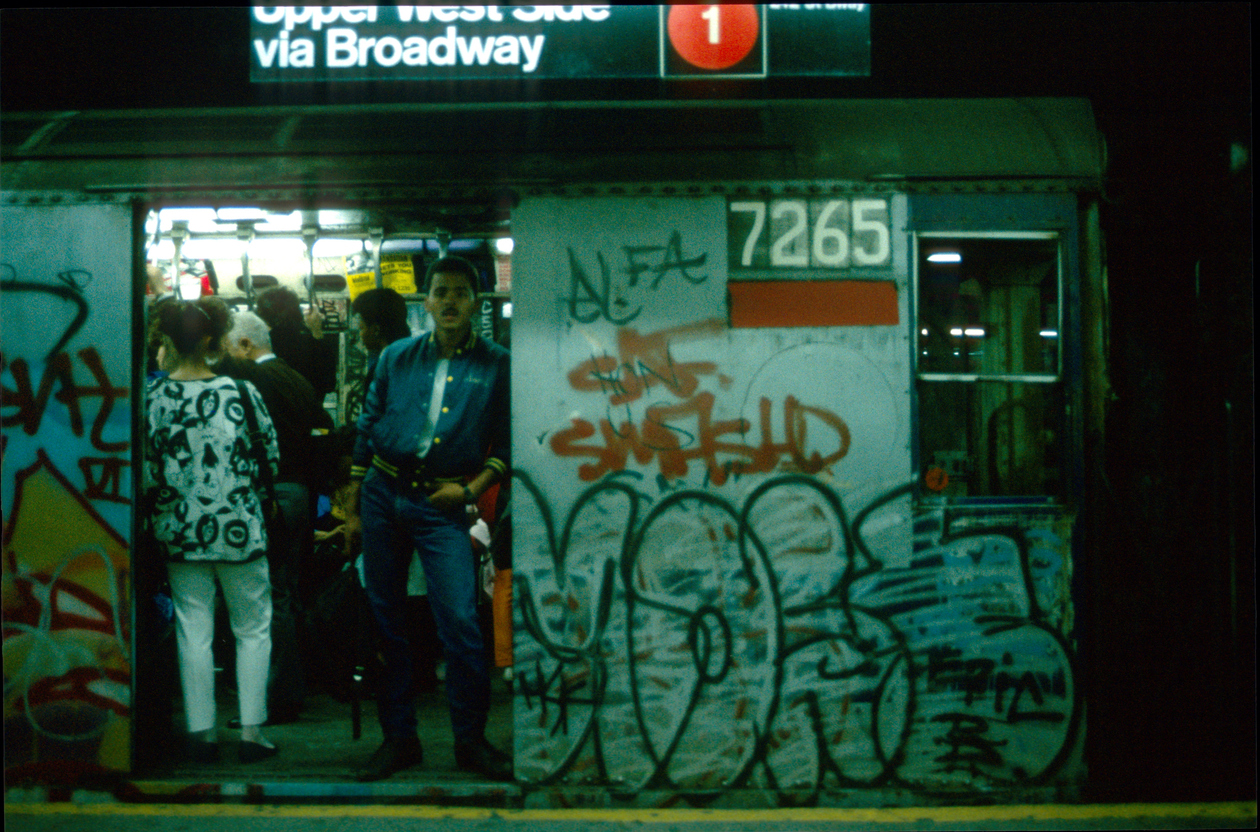
NYC: Is Graffiti Writing Dangerous?
BM-1Yeah. A couple of times we almost got shot. A cop found us and said, “Who’s the first one who wants to get shot.
We ran. It was the RR layup [a third track where the MTA sometimes parks trains] so we ran across the track. It was an elevated platform, so the next thing we knew we were looking for the first light pole to slide down. One dude jumped, missed the pole completely, and fell on a car.
REV: Once a guy was painting next to me and you could smell the paint vapors real strong. Suddenly the train started. You know how they spark sometimes? It sparked right near him, and all of a sudden there was a fireball where he had been standing. We took off.
NYC: Why Didn’t That Scare You Away From Writing?
BEA: That’s not much. We had been around gangs for a long time. After you’ve had guys chasing you with knives and guns that wasn’t anything much.
NYC: Where Did You Get Your Tag?
BEA: I tried lots of different names, but some didn’t look right. Some didn’t draw right. I tired TOKEYO, like Tokyo, but people didn’t pronounce it right. So I finally hit on BEA.
REV: I tried a lot of names too, like SEARCH and FURY. I finally settled on REV, like Reverend.
BEA: At first you take a lot of names, but then you settle down and stick with one. You say, “That’s me.”
BM-1: They call me BM. That stands for Big Man, or Big Money. It was just a regular street name.
NYC: What Did You Do The First Time You Wrote On The Trains?
WERK: We did motion tags. We had some regular and some homemade markers. We went in a group. We were neighborhood friends. We had done it in the neighborhood before that. I was really nervous. That first time I had to run from the cops.
SPIRO: The first thing I did was my name plain out. It was scary because I didn’t want to get caught, but it was fun because I like seeing what I could do.
NYC: After The First Time How Many Times Did You Tag?
WERK: A lot. It took a whole year to get fame in my neighborhood.
NYC: Why Do People Tag?
BEA: The more you get up [get your tag in cars] the more fame you get. “BEA is up,” people would say. If you get enough , say 1,000 times, you get famous. People call you King.
BM-1: On trains everybody sees your name and people know who you are. They say, “Yeah, he did this. He’s alright.
WERK: People tell you, “I saw your tag.” That’s fame. If feels good. Also, some kids do it just to let out their anxieties.
BM-1: In a way, it’s like a revolutionary thing. You may feel like doing something like killing somebody. You take your marker in your hand, and write your name. It calms you down.
WERK: We try to stay on one line so we can see our tags. We have to put our stuff where people we know can see it.
BEA: We also have to fight to control our space.
Rev: It takes a long time to watch the trains and figure out their schedule. When you know, and you decide one spot is your turf, you have to control it.
RALPH: For example, if somebody’s been going over your tags, you’ll find him and work him over.
NYC: When Do You Write On Trains?
WERK: At nine o’clock they start laying up the trains-parking them. The night traffic is not so heavy. So like on a weekend, we’d go about 12 o’ clock.
SPIRO: We go on a Sunday because it is nice and peaceful, and nobody want to ride the train.
NYC: How Often Did You Go?
BM-1: We did it once a week.
NYC: Are Drugs An Important Part Of the Scene?
WERK: A lot of writers prefer to go into the yards high. Mostly they use speed, mesc, and sens. But others make sure they’re straight because it requires concentration.
NYC: Has There Been Any Changes In The Way They Patrol The Yards?
ZIM: We go to 180th Street. They just put up gates and fences with barbed wire.
WERK: You used to be able to walk into the yard from the station. Now you can’t with the fence.
NYC: What’s The Easiest Yard To Get Into?
RALPH: The #4 at Mosholu Parkway. The fences are full of holes, but they’re re-fencing everything now.
BEA: We get keys to the trains, sometimes by mugging the conductors. One guy is notorious for the stuff he’s got. He was anything and everything: keys for every kind of door, uniforms, badges, conductor’s hats. He can get into substations. He’ll just open one up from the street, and bang, he’s in the system.
Once were in, we bomb the inside [tag every available spot] for recognition, to show it’s our car. We do it until there’s no room for anyone else. Some people become famous for it. They practically own one line. They’re called “24-7s.” They bomb 24 hours a day, seven days a week.
Sometimes we even get the solvent that the MTA uses to clean the inside of the trains and carry it with us to clean up the headboards [the best spots in the rain to tag]so we can put in our own tags.
NYC: Do You Plan What You’re Going To Do?
REV: Everyone has black books. They sketch out things they’d like to throw up. We’ll break down the job at first. One of us will design the style. Another will select the colors. And the third will choose the characters. Then we’ll all get together and work out the details until we get something we like.
RALPH: It takes three to four hours to throw up an entire car. You have to wait for the right weather too. It it’s too cold, the paint will run. As you paint you have to wait for the sections to dry before you can over paint. You have to correct mistakes that you see as you go along. We work in sections, so they have to come together.
NYC: How Much Paint Does It Take To Do A Whole Car?
Ralph: It takes 25-50 cans to do an entire car, at$4 a can. That’s why we have to steal it.
But even kids who have money steal paint. I know one guy whose family owns a Chinese restaurant. One the weekends he’s not writing on cars he’s off skiing somewhere. But he steals the paint.
Ralph: A couple of years ago when KEAN did the Bicentennial train-all 10 cars-he used 1,000 cans of paint. We’re working out a project even bigger than that. We plan to do an entire train, both sides.
WERK: We’re going to do one after I get accepted into college. It’s going to be my celebration. We’re going to do a scroll with a message and two characters in the middle, and our names on it.
Stealing paint is called racking up. Being brave enough to go racking up is part of being accepted.
Ralph: To get into our crew (Vandals in Control-VIC) you have to rack for us.
BEA: It’s getting harder to get paint. Stores are becoming more careful with their spray paint. When the owner looks over at the rack and sees that 50 cans are gone by the afternoon, and he’s only sold one, he wises up and starts putting them away. In the stores in my neighborhood they practically keep them locked away in the basement.
In some stores I can go in and get 10 cans up against my body. You have to dress like a student. You have to go in and act natural, ask questions, browse, like any other customer. Nowadays we mainly go out of state, because they’re not hip.
NYC: Is It Hard To Get In A Crew?
BEA: Yes, there are always people dying to get in.
RALPH: People steal our tag VIC. They’ll put up their work and sign it with our tag because they want to be part of our crews. Our crew name stands for Vandals in Control.
WERK: I’m in Bronx Artists. It’s a group. Mainly we hang our together. The more good writer you have in your group, and the more you get up on the line, the more fame your group has.
NYC: How Many Crew Members Work Together On A Train?
ZIM: We usually work with about eight in a group.
WERK: Sometimes when the crew leader gets to know his yard he goes alone with one other guy, but generally they go in groups for safety.
NYC: For Safety Against Cops?
WERK: For safety against the cops and other groups if there is war going on.
REV: When you’re in a tunnel or yard every sound can make you jump. You’re trying to concentrate on what you’re painting, but you keep having to look over your shoulder. So we usually have several guys writing while four or five watch the yard to see if anything’s coming.
WERK: Lately, there’s been a lot of fighting among clubs. It’s gotten down to guys having gun fights over graffiti. Like when somebody’s stuff has been crossed out. It’s almost like a graffiti war.
BEA: One writer with the tag PJ shot another writer called PG because his tag was too close.
REV: Someone will work with you for a month, he’ll be down with the crew. Then all of a sudden he’ll turn on you. He’ll frame you, set you up for a fight.
Even in the Bronx it’s getting out of hand. When we controlled the #4 train it was good, but now there are so many wild kids that it’s no good.
BEA: Out of the 50 writers you’ll find at the Bench [at the 149th Street and the Grand Concourse station] 40 of them will be in a fight within a month about graffiti.
NYC: Do Most Writers Carry Weapons?
WERK: No, but some do.
REV: One writer, CASE, is handicapped. He’s got a wooden leg and is missing one arm. One night he did a burner and was waiting for it to dry. Another writer, CAP, started throwing up on it. CASE hit him over the head with a pipe.
BEA: The only way to get respect is to be tough, a hard rock. Ducks don’t make it. It doesn’t matter how good your art is. If people can walk over you they will. Strength is the only thing that’s respected.
REV: Most of these people are punks. They’re just following the crowd. Only a few really care about good illustration.
MB-1: I respect writers unless somebody goes over my tag. I’m gonna be mad at this guy. We’re gonna put our name right over his, boom, boom, boom. Until you come to a settlement.
NYC: Do You Get Harassed By The Police?
WERK: One time I went to the Bench and the guys said there had been a raid and the police took all the markers and spray cans.
RAPLH: There are a couple of cops, Hickey and Ski. They are like Starsky and Hutch. When they catch you they don’t bust you, but they work you over. They put the cuffs on you, then they may slap you up. They ask, “You like to paint?” And then take your paint and start spraying you with it. They cover you. It takes hours to get it off.
NYC’: Do Transit Workers Bother You?
WERK: They sometimes throw wrenches at us. Sometimes the transit workers take it on themselves to rough you up.
REV: But sometimes the workers will warn us. One writers father is a conductors and he gets us schedules.
NYC: Have You Ever Been Caught By The Police?
REV: Just once. Sometimes when you’re in a yard three or four trains will pull in slowly, and all of a sudden the doors will open and dozens of cops will leap out. It’s everyone for himself. I try to keep one of the train workers’ orange vests. I put it on and walk around like I know what I’m doing.
NYC: Is Writing Worth It If You Could End Up In Jail?
WERK: Obviously. I’m doing it. So are a lot of other people.
NYC: What About The New White Cars?
WERK: They look nice, but the white paint is supposed to be real easy for the MTA to buff.
BEA: The paint the MTA uses sheds the spray paint, so anything you put on can be buffed right off. But we discovered that if you prime it first with white spray paint, the job will last. You have to get a Fat Cap, a nozzle that turns the narrow spray into a spray 4 inches wide, so you can cover the car quickly.
NYC: Have You Ever Been Caught?
ZIM: I got caught by some cops and lied about my age. I had my hood on so they couldn’t see me good. They let me go.
WERK: The cops let me go, too. One time a cop caught me doing a motion tag on the #1 train. That’s when you write on the train while it’s moving. The cop pulled me off the train at 23rd Street and took me into the porter’s room. He kept me there for awhile, but he didn’t do anything. He was just trying to scare me.
ZIM: If they catch you, the older you are the worse it gets. If you’re under 15 and get caught they usually just scare you, but as you get older they sometimes take you in, or make you scrub cars, or sometimes send you to jail. Most kids quit by 18.
NYC: Will You Quit?
ZIM: I’m thinking about quitting and going onto canvas. I’m already 18.
REV: I don’t want to stop. There are gigantic school walls in my neighborhood that are just blank. We want to get community support to throw up some nice murals.
NYC: Is Quitting Hard?
REV: Writing becomes an addiction. You can’t stop. Everyone you hang out with does it. The feel of the markers, the drip of the paint all become something you can’t do without. No matter how many times you say you’ll stop, you don’t. The only way to do it is to chill out slowly.
NYC: Will You Do It All Your Life?
BEA: I took the police exam and passed it.
REV: You’ll probably become a transit cop. [Laughter]. I want to become an illustrator or an animator. I’ve got some ideas for Saturday morning cartoons, like “Fat Albert.”
WERK: I’m starting to grow out of working on trains. Maybe I’ll work on canvas. My father got me a job doing a candy store. I did a whole wall at 163rd Street and Union, in the Bronx.
BM-1: I’m doing more creative things on t-shirts and canvas. But sometimes when I do it on paper I feel bored. I want to see it bigger. I want everybody to see it.
NYC: Have You Done Anything Beside Trains And Murals?
WERK: If you can do it on something that moves, everybody will see it. I want to do an Amtrack train so the whole country could see it.
ZIM: I don’t think it’s been done before. It would be a first.
NYC: Why Do You Like Graffiti?
ZIM: It’s art. You’re expressing your talent on a wall. People who are good are really artist.
NYC: What Do You Think Of Tagging Inside The Subways?
WERK: I’m against it more and more, although it’s a lot easier and faster than working outside.
ZIM: But the inside is where you get more of your fame.
WERK: If graffiti is really art, then it doesn’t belong inside, just outside.
SPIRO: It’s messy on the inside. Outside it’s better because people will see it more. The colors make the train look better than the dull gray.
NYC: How Come Nobody Does Nice Work On The Inside Of Cars?
WERK:’ Cause seats and doors get erased really quickly and windows get buffed right away. It wouldn’t last.
NYC: Will The City Ever Stop Graffiti?
WERK: Never. There’s over a thousand writers out there at any one time.
NYC: Why Wasn’t The Campaign The City Ran Last Year Effective; The One With Poster Saying, “Make Your Mark In Society, Not On It?”
ZIM: Graffiti writers don’t care. No graffiti writers paid it any mind.
NYC: What Should The City Do About Graffiti In Public Places?
WERK: Work with the artists. They’re never going to stop it. The city should give some good writers trains to work on.
REV: Richard Ravitch [head of the MTA] and Carol Bellany [President of the City Council] once offered to give a couple of cars to writers, and then went back on it.
RALPH: We’d like to talk to Ravitch about that. We’d show him some plans that are so good he couldn’t refuse.
GRAFFITI GLOSSARY
The Bench-An everyday meeting place for graffiti artist at 149th St. and Grand Concourse in The Bronx.
Black Book- A hardcover sketch book that graffiti artists use to plan their works.
Bomb- To go on tagging spree [see Tag], usually trying to cover every available space inside a subway car.
Buff-To erase a tag or piece [see Piece].
Burn-To create a burner.
Burner- A place with many colors, and an imaginative outline and background. It is considered by a graffiti artist to be his or her best work.
Crew-A graffiti artist’s clique or gang.
Designers-Markers (felt tips) used by graffiti artists to color pieces in their black books. [See Black Book].
Flo-Master-A special type of ink that graffiti artist use in their home made tagging markers because it is harder to buff.
Lay Up-Parking a train in the unused center track for the weekend. A favorite target of graffiti artists.
Marvy- A brand of marker.
Mop Tip-A very soft marker which tends to write thick when pressure is applied. A mop tip can be made by pinning the point of a new marker [see Pinning].
Niji-A brand of marker.
Piece-A mural done by a graffiti artist, usually his own name or tag.
Pilot-A brand of marker.
Pinning-Sticking to a pin, repeatedly, into the tip of a marker to make it wider and softer.
Krylon- The graffiti artist’s favorite spray paint.
Rack Up-To steal supplies (Marker’s, paint, etc.).
Rack Spots- Stores known as easy makes for graffiti artists to steal their supplies from.
Red Devil-A brand of spray paint.
Rustoleum- One of the three common types of spray paint. Graffiti artists like it because its ability to resist weather. But it is available in only a limited range of colors.
Tag- [noun] A graffiti artist’s name or initials. [verb] The act of writing one’s name or initials on public property.
Throwup-A simple piece, usually only an outline, of a graffiti artist’s name.
Toy-A graffiti artist who lacks experience, ability, and expertise. Someone whose ability is looked down upon by experienced artists.
Vamp-To steal something from another graffiti artist. (One crew in Queens goes under the name Vamp).
Writer-A graffiti artist.
Yard-A place where trains are parked in rows when they are not in use; the place where graffiti artist do their work on them.
Compiled by WERK