
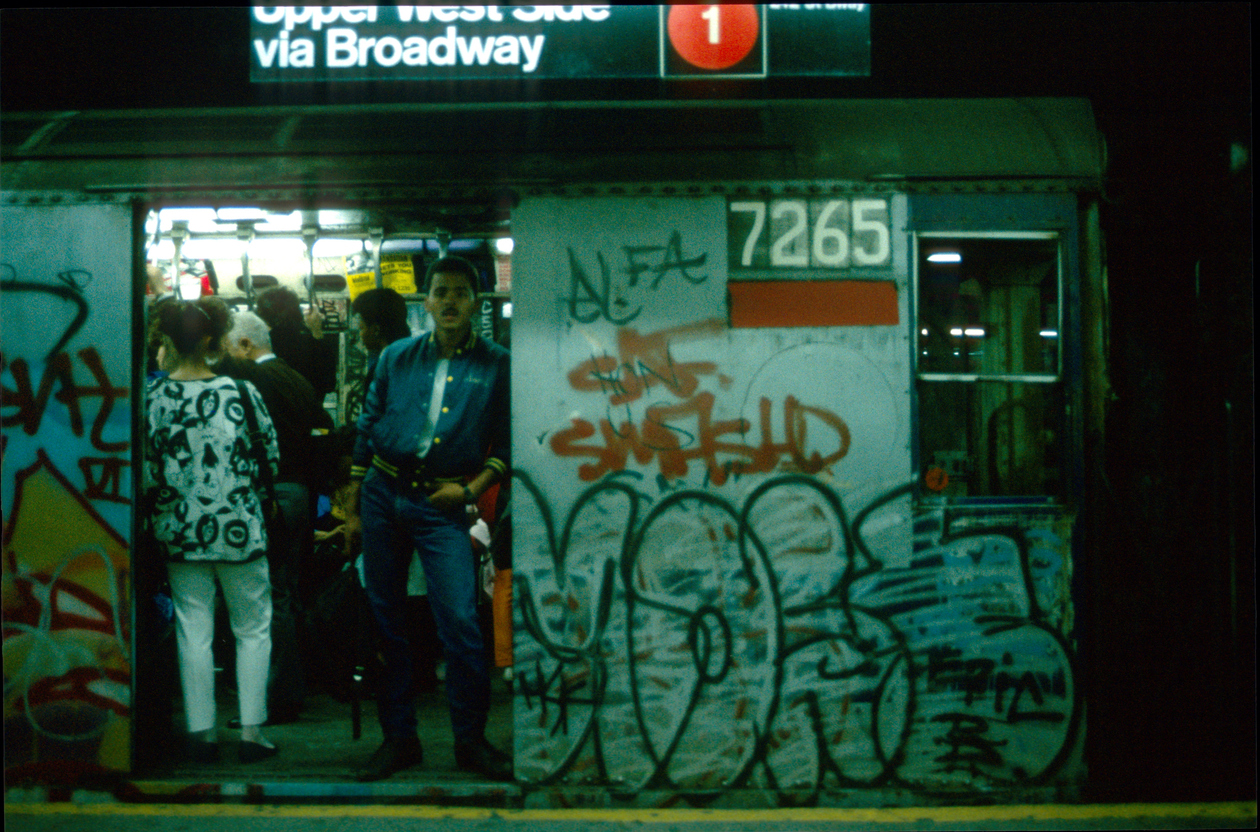
“It’s a tuff challenge, while innocent children get their beauty deep. We hop the train to the tuffest yards just to get our paint [across to the world,” says Vango, a former graffiti writer.
But the end result raises the thought-provoking question: Is graffiti the work of incredible talent, or; another example of deliberate destruction?
Graffiti: to most it’s just another dirty word, but are its followers just looking for acceptance?
As one calli-graffer (writer) said, “The writers are trying to uproot ghetto art from the ghetto, leaving out its location, yet leaving the art.”
But what is graffiti?
Well, that depends on who you are, and how you think. If you’re the public affairs director for the MTA, you’d feel like Bill Jones, who said, “Graffiti isn’t an art, it’s a crime. I feel better when I get a clean subway.”
Yet for the writers, it’s more than writing your name on a tree or wall; it’s putting your innermost thoughts, feelings, slogans, and phrases on the canvas of your choice.
But in what state does this colorful but illegal art leave the subways? The Transit Authority is the disgusted owner of a mobile art gallery. Raiders pillage the subways in the forms of designers, new wave artists and calli-graffers.
How?
Although the trains are locked away in the yard by a two-ply fence and barbed wire, writers gain access by clipping holes in them or by getting off at the station and running the tracks into the yard.
Once you’re inside the yard, it becomes an arena-a place where a horde of youths gather to get affiliated with each other and top crews, or just to watch as a well known artist puts imagination into practice by composing a color arrangement.
Krylon, Red Devil, Wet Look, and Rusto’s are all spray paints that are tools of the trade. Using only the finest colors, the artist’s logo will mark the sign of fame and brilliance, causing a stir throughout the city from both young critics and MTA officials.
The city’s attitude is, “It’s us against them,” while the writers say, “We ain’t givin’ up.”
Will graffiti ever stop? The city has done a lot to discourage the act. Last year, Mayor Koch banned the sale of spray paint and other art materials to teenagers. The ban is still in effect.
But the artists have figured a way to counteract the ban on large-tip markers by making their own. Using a roll-on tube for the body and a felt chalk eraser for the fat tip, they broaden the possibility of their work being seen.
Paint is racked (stolen) from stores in large quantities at a time.
One writer, Rae Wic, says, “We would go out to New Jersey just to come back with paint. Sometimes 65 cans between two people, ’cause the stores in Jersey sleep.”
Pipes, bats, razor-?some even carry guns. Shock 123 from The Vamp Sq. (TVS) would carry a shotgun to the layups (parked trains) to murf (rob) other writers. Vamping-assault-comes with the territory. The negativity of the ghetto has gone underground.
Due to the limited amount of space, tags (names) overlap each other, resulting in crew wars. Taking percentage (revenge) is necessary for respect. The competition is immense as well as hazardous. In the tunnels, might makes right. “Subway Art,” by Martha Cooper and Henry Chalfant, quotes Iz the Wiz, a top writer: “A king is a writer that everyone wants to either write with or fight with.”
As strange as it may seem, they’re achieving fame through destruction. This is the strong attraction, and they’ve willingly accepted all the challenges that stand in the way.
But as the underground caverns echo the sound of stalled trains, the cries of graffiti and its victims go unheard. So to shed some light on these dark issues, former graffiti writer Vango Polo has spoken with us about this secret society.
NYC: Describe what it was like when you used to do graffiti.
Vango: It was like being in the mob. A syndicate so strong and violent that you had to literally fight to survive. Living life as a fugitive, always looking over your shoulder in fear of informers, detectives, and other writers that got beef (trouble). A dangerous game that was a lot of fun.
NYC: What, in genera makes people do it?
Vango: The jazz, the thrill of being chased, along with seeing your tag or burner in neon colors. The chance to release frustration and stress with a daring outlet.
NYC: How did you start?
Vango: I was in the seventh grade when I was introduced to ghetto art by my crew as a form of recreation, and it developed into a way of life. I guess I was looking for trouble; now I know I found it.
NYC: What attracted you?
Vango: I always wanted to be a wise guy, a bigshot in the world of ruff” crews. As a child I was always pushed around by bullies, but the cruel ways of the world made me stronger. I adopted the role of a scribe so that a part of me can leave the ghetto by creating something with nothing.
NYC: What were the dangers?
Vango: We bombed (wrote) in the twilight where anyone can be waiting for you. Sometimes kids get murfed (robbed) for their crayons and paint. Getting chased by dogs and cops in the layups, and electrocuted by bareback third rails, Getting cut by the razors in the yard at the bottom of the fence was the most dangerous, ’cause when it was time to escape in a raid you couldn’t move fast, but you didn’t want to get caught, either.
NYC: Were you ever arrested?
Vango: You can’t catch what you can’t see. It’s very dark in those tunnels and there are just too many ways out. I wasn’t arrested, but I had to do community service at my school” cause I got caught bombin’.
NYC: Do you see yourself as a rebel or a phantom?
Vango: Neither fits my description; I’m a scribe and will always be. Although graffiti is a crime, there’s a message out there for whoever is listening…. In the darkness of the tunnel search for respect, but only the light shows the key of success.
NYC: Why and when did you stop?
Vango: I stopped when I realized that there were problems in writing: the trouble I caused my parents and the infamous name I made for myself. When I turned 18, I left the trains to further my abilities to write. I just got too old for graff; the fun of getting into trouble wasn’t that much fun any more. The best example for me was seeing my crew, one by one, being driven away in police cars. Word, graffiti truly messed up my life.
NYC: What can happen if you’re arrested?
Vango: If your name is on the blacklist (a list of constant writers), you’ll get the hardest sentence a vandal can get. If you’re a nu-jack (a beginner), you’ll be let off easier, depending on a clean record. In one case, a writer spent three nights in jail and still was sentenced to long hours doing community service. Now he can never work for transit and his name is known as an example for writers in the community. He’s always saying, “Dream the impossible, but do the necessary; make the law your friend, instead of your adversary.”
SIDEBAR: Layups and Nu-Jacks: Graffiti Slang Glossary By Kevin S. Haslam
Bare Back: No wood covering over the third rail.
The Bench: A place where writers get together to discuss what’s going on in graffiti.
Black Book: An art book to practice pieceing.
Black List: The police list of outlaws. The most wanted vandals.
Bombing: To write graffiti.
Buff: To clean or remove graffiti.
Burner: The hardest form of graphic design.
Burns Bright: A colorful burner.
Calli-graffers: Bombers with stylish handwriting.
Crayons: Various markers.
Clique: Your gang or crew to write or fight with.
Designers: Markers that are used for black books that blend with each other.
Ding-Dong: The silver A train, R-46.
Dis: Disrespect to anyone’s tag.
The El: An elevated layup.
Flats: The BMT or IRT trains.
Get Busy: Down to fight or ready to write.
Graffiti: Teens’ way to fame through written communication.
Home-made: A self-made marker using roll-on and eraser with ink.
Horde: A group.
Jazz: The thrill of something dangerous.
Krylon: A favorite brand of spray paint.
Layups: Parked trains on the express track that are not in use.
Marsh: A brand of pigment ink.
Mops: The pinning of a tip to fatten the marker.
Murf: To brutally beat up another writer.
Nu-Jack: A beginner.
Percentage: Payback; revenge.
Piece: To create art with paint.
Rack-Spot: A store that’s easy to steal from.
Red Devil: An old brand of spray paint.
Riggie: A ruffled train.
Riggie Bulldog: A train half ruffled and half flat.
Rustoleum: A rust-resistant paint. Sleep: Unaware.
Supermarket Ink: Price-marking ink.
Tag: Your adopted name, a phantom name.
Throw Up: A bubble letter logo.
Toy: An inexperienced writer.