Sitting on a carpet surrounded by children, the kindergarten teacher asked each student to introduce themselves and say where we were from.
Most of the kids named New York City neighborhoods. Then it was my turn.
“I’m Algerian!” I said, louder than I needed to.
My teacher smiled.
“Oh! So you speak Arabic, right?”
“No, Miss. I’m not Arab.” I knew the language my parents spoke at home was Tamazight, not Arabic.
She looked confused. “But Algeria is an Arab country.”
I felt like I was being corrected. That afternoon, I brought the question home to my mom.
“Why do people call us Arab?”
My mom, who immigrated to America two years before I was born, said, “Because they simply don’t know.”
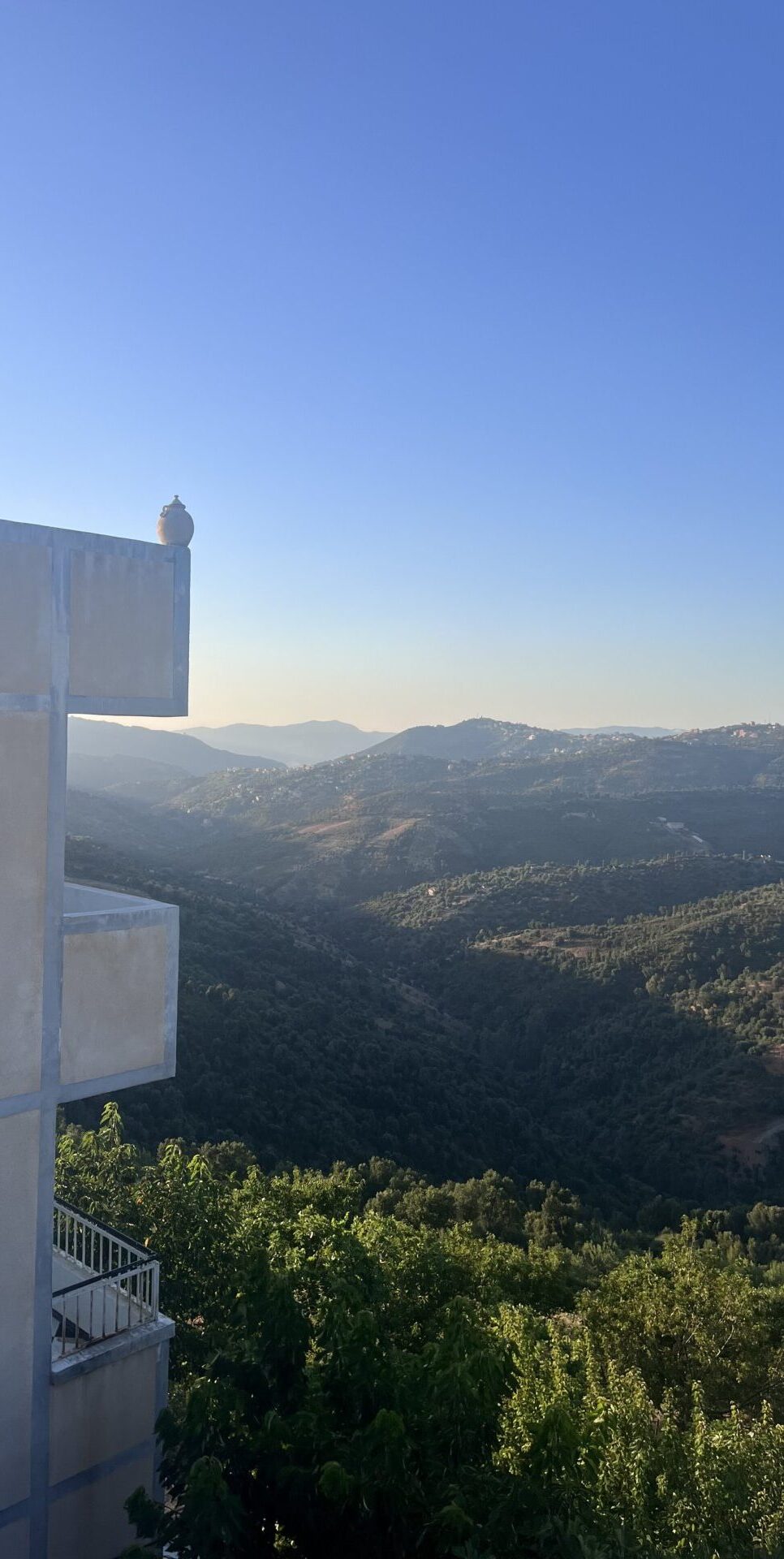
She explained that Algerian was our nationality. My family is from the Kabylie region, home to the Amazigh people of North Africa. My parents, little sister, and I travel every summer or two to Bejaia, the city my parents came from, which sits between beautiful green mountains and the Mediterranean Sea. Around my grandparents’ house are fig trees, pear trees, olive trees, and cacti. In contrast to the “concrete jungle” of New York, my mom describes Bejaia as “the heart of nature.”
My parents had moved to America from Bejaia to give my sister and me educational and other opportunities. Many of our relatives from different parts of the Kabylie region moved to different countries, mostly the US and Canada, for similar reasons.
My family made sure Algeria stayed a part of me even as I grew up “American”; Tamazight was the first language I spoke. But English was the language of books, teachers, and friends. Over time, I could understand words in Tamazight but could no longer say them as easily.
On the summer trips, relatives gathered around my grandparents. Nine of my aunts and uncles brought their kids, staying in my grandparents’ huge house and other houses nearby. Those houses are close enough that we can call out to each other from the doorway or the windows, but far enough apart that everyone has privacy.
The night air there was hot, but dry, not humid like New York. I could see more stars than I’ve seen anywhere else, while below my grandparents’ balcony, orange streetlights lit up the streets. After we were supposed to be asleep, my cousins and I would sit on the hard tile floor of the balcony with worn playing cards, whispering and laughing until we heard footsteps inside. Then we would freeze, wait for the footsteps to recede, and start laughing again.
My grandparents, uncles, aunts, and cousins all spoke Tamazight. I understood most of it. But even when I didn’t, I never questioned whether I belonged there. Both Bejaia and New York City felt like home.
Making Myself Easier for Others
Back in New York, questions and assumptions like my kindergarten teacher’s persisted over the years. One cold November afternoon in 6th grade, rain tapped against the classroom windows while my classmates finished their work. A girl turned to me and asked, “So, where are you from?”
“Algeria,” I said.
“I didn’t know you were Arab!”
I explained that Amazigh was my ethnic group and Kabylie is our home region. She still looked confused.
“So you’re not Arab?”
“No.”
“But Algeria is an Arab country.”
I told her that Amazigh people had been in North Africa for thousands of years. Over time, Arab migrations and the spread of Islam changed the region, and Arabic became widely spoken. But Amazigh people and their languages remained.
France ruled Algeria from 1830 until 1962, when Algeria gained independence after an eight-year war. The French language took over education and government during the long colonial period.
My classmate stared at me. “So Algeria was Arab, Amazigh, and French?”
“Not exactly. France colonized Algeria; that doesn’t make Algerians French. It’s complicated.”
Her eyes had glazed over, which seemed to happen every time I answered where I came from.
I had spent so much time trying to make my identity easy for other people that I hadn’t noticed how distant I was becoming from it until I finally went back last summer.
After that, when people asked if I was Arab, I just said yes. It was easier for other people to understand. But while I was trying to ease others’ confusion, the language that had once come naturally to me was becoming a struggle. I was speaking English everywhere, and slowly becoming less comfortable with Tamazight.
In the interval from 5th grade to 8th grade, my family didn’t travel to Algeria. During that break, I stopped asking my parents questions about why we did certain things or words I didn’t recognize. When I was 13, I completed my first full day of fasting during Ramadan. My family celebrated by eating on the balcony of an Algerian family friend’s house, and then prayed after. I didn’t bother to ask about the significance of those traditions.
Like many tweens, I got more into the culture of my peers. I listened to artists like The Neighborhood, Frank Ocean, Don Toliver, Bryson Tiller, and others that my friends introduced me to. I watched classic Disney movies, Gilmore Girls, Legally Blonde, Hocus Pocus, and Coraline. I did different holiday celebrations, like Secret Santa, and ate sliders while watching 4th of July fireworks.
I had spent so much time trying to make my identity easy for other people that I hadn’t noticed how distant I was becoming from it until I finally went back last summer, after 8th grade ended.
Who Gets to Decide?
On that visit, I was old enough to notice things I overlooked before. On my earlier visits, I wanted only to play with my cousins. This time, I paid more attention to the adults’ conversations and noticed differences between life there and in the US. My middle school gives students computers; my cousins in Bejaia use notebooks and pens in their school. The hospital there has fans, not AC, even in the summer. Bejaia even has shepherds watching sheep. Overall, everything feels less modern.
My parents and other family members had moved to America for educational and other opportunities, but not everyone in my family had been able to do the same. My mom’s older brother Jafar is a tan man of average height with sharp, dark eyes. At family gatherings, he was often reading about politics or bringing up what was happening in Algeria. For the first time I asked why he hadn’t emigrated, too, and he told me he couldn’t obtain a U.S. visa. He wanted opportunities like theirs, yet he remained in Algeria.
Toward the end of that last visit, Jafar and I were sitting outside while everyone else was inside. He was looking at something on his phone, shaking his head.
“Why are you always reading about politics? Why does it matter that much to you?” I asked him.
He put his phone down.
“Because if you don’t understand what is happening around you, other people get to decide what it means for you.”
I thought about that and then admitted to him, “Sometimes I just tell people I’m Arab.”
He looked at me.
“Why?”
“Because it’s easier. When I say I’m Amazigh, they ask questions. Sometimes I don’t know how to answer them.”
He was quiet for a moment.
“A war doesn’t kill culture or language,” he said. “The people do.” He explained that culture disappears when people stop speaking a language, stop teaching it to their children, stop telling stories, or decide that something from their past isn’t important enough to remember. “If you don’t learn where you came from, someone else will force their version of the truth on you.”
I thought about my teacher in kindergarten, the girl in 6th grade, and everyone else who confidently told me I’m Arab and that’s that.
A few months after we came back to New York, on the holiday of Yennayer, my mother and I FaceTimed Zina, my mother’s sister, from our kitchen. Aunt Zina has blonde hair and loves cooking, and in Bejaia, she makes big meals for the whole extended family at her parents’ house.
Sharing My Roots
She never seems to measure anything. Instead she pours and mixes everything by instinct, as if she had memorized every recipe.That day, she was teaching us how to make a traditional Kabyle dish called chakchouka out of tomatoes, peppers, onions, and spices.
“Add this much,” she said, holding her fingers apart to show us a measurement. My mother stirred the pot while my aunt watched through the screen, correcting us whenever we added too much or too little. She explained what each ingredient was called in Tamazight and why we used it in the recipe. I peppered her with questions: “What does that word mean?” “Why do we make it like that?” “Did Grandma make it this way too?”
By the time we finished, the kitchen smelled like the food my family had been making long before I was born. I wrote down the recipe, including the Kabyle words my aunt had taught me, because I wanted to remember more than just how to make the dish.
A few days later, I made it again and brought some chakchouka in a plastic container to school for my friends.
I explained what it was, where the recipe came from, and what my aunt had taught me. My friends liked it; one friend who’s Latina said her mom made something similar.
Not everyone will understand or remember every detail about my culture, but that does not make those details any less important. My Algerian heritage is a part of my family’s history and a part of who I am.
Before, when I heard a word in Tamazight I didn’t understand, I stayed quiet because I didn’t want anyone to know I didn’t know it. Now, I ask. I used to think that if I couldn’t fully explain to others the Tamazight language, the traditions my family kept in our home, and the 10,000-year history of the Amazigh people I come from, I should just say “I’m Arab.” Now I say that I am Algerian, Amazigh, and Kabyle, and explain it as much as people want to hear. There is still more to learn, and I will keep asking questions. Learning about where I come from is part of knowing myself.
- Family
- Immigration
- Race & Ethnicity