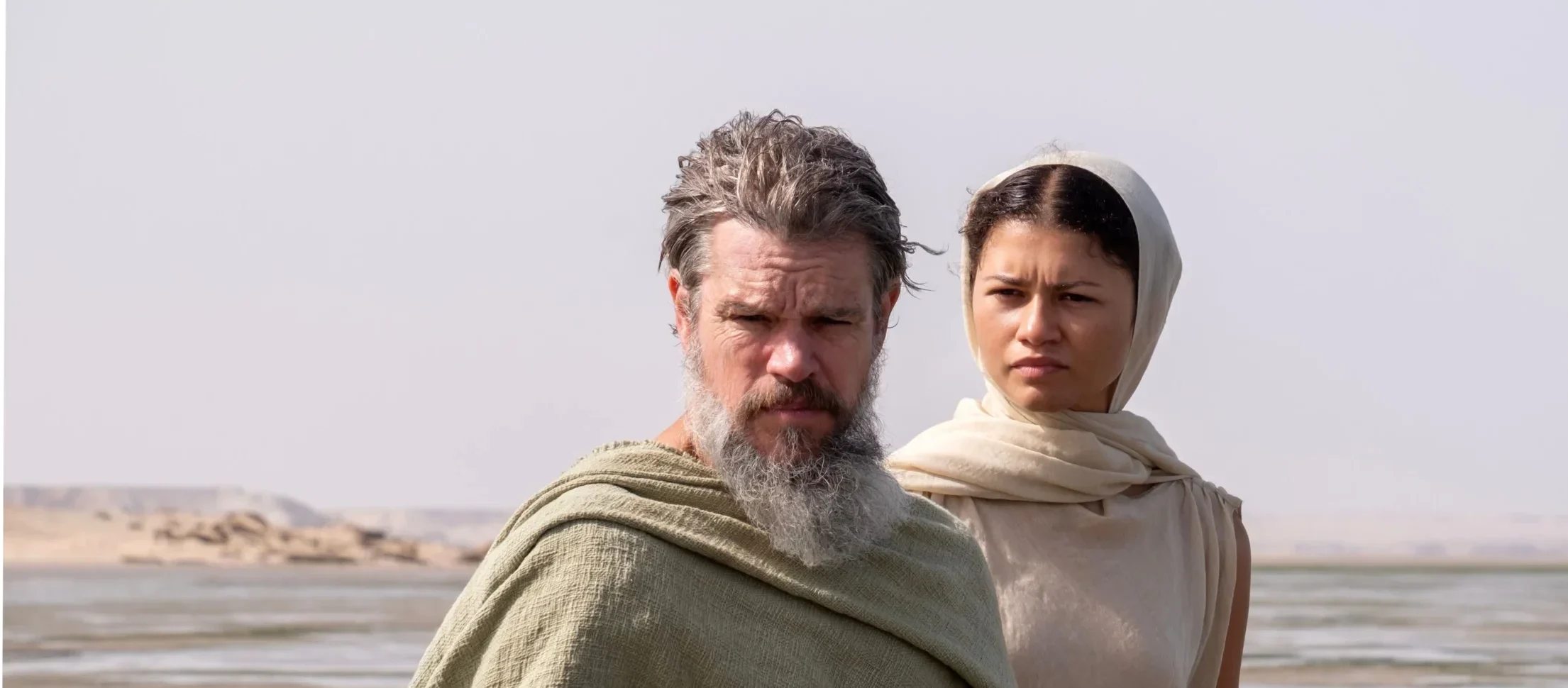
Before I saw Christopher Nolan’s new movie The Odyssey, my dad told me, “You either go in as a Homer fan, and get disappointed because it’s not a word-by-word retelling, or you go in as a Nolan fan and have a good time.”
But I went in as a fan of both; I’ve watched Interstellar, Batman v. Superman, Justice League, and The Dark Knight, so I knew of the director’s talent. And I am a huge fan of Greek mythology, so I yearned to see Homer’s epic through Nolan’s lens. I love the tales of Odysseus, who, after 10 years fighting the Trojan War (the horse being his idea), sails home to Ithaca, where his wife Penelope and son Telemachus are waiting. First, though, he has to navigate lots of mythical obstacles put in his way by capricious gods.
Odysseus longs to get home, and I can understand that feeling. As a Ukrainian refugee, I can’t return to my home. The poem shows how cruel the world can be, and I root for Odysseus to make it back to Ithaca.
I have read multiple translations of the long poem from the 8th or 7th century B.C.E., which is itself transcribed from ancient spoken tales. The latest one I’ve read is Samuel Butler’s from 1900—for fun, not a school assignment.
Two of my favorite aspects of the poem are the presence of the gods and Odysseus’s wit. Odysseus’s tricking of the Cyclops (a one-eyed giant named Polyphemus) is one of the best parts. In the poem the Cyclops, son of the sea god Poseidon, traps Odysseus and his crew in his cave with a rock too huge for the men to move.
Realizing they must blind him—not kill him—to escape, Odysseus gets the Cyclops drunk on lotus wine, then rams a sharpened log into his eye. But before this violent act, the drunk and drowsy Polyphemus asks Odysseus his name. Odysseus says, “Nobody,” so that later, when the offended Poseidon asks who blinded him, the giant answers, “Nobody blinded me!”
In Nolan’s film, the men never speak to Polyphemus; they just wait for him to sleep to stab his eye. Nobody–not Nobody but nobody–says “Nobody,” and I was quite devastated. Instead Odysseus (Matt Damon) does something stupid: he shoots him with an arrow as the men run away, enraging the giant.
New Visions, New Meanings
On the other hand, I have no complaints about Nolan’s design of the Cyclops. The eye being sideways added grotesqueness to the already mythical scale of the giant and deeply unsettled me. My imagination never created such a picture in my head. As much as my initial feelings were, “No, that’s not how it’s supposed to look!” I think surprises like that are the beauty of this adaptation. It was not possible for Nolan to appeal to everyone’s visions, so he created his own.
Many things did not look how I imagined them. For example, I’ve always pictured Circe’s abode as an extravagant castle made of stone. But I liked the movie version: a little hut that’s more a kitchen than a house, where the pigs wander in and out.
In my mind’s eye, the trip to Hades to speak with the dead is far eerier. I’ve always pictured a grand dimension filled with the dead walking around. The poem’s Hades harbors many figures from mythology who have died: Sisyphyus, Ariadne, Ajax, Leda, Jocasta, and Herakles. Nolan instead shows a few corpse-ghosts rising up from the sand on a beach, and only three speak.
The barren wasteland vibe and the fact that the actors actually had to be buried for that scene that was pretty cool. But I found it a bit underwhelming compared with the underworld I’d imagined.
Still, when comparing the poem to the movie, it’s important to remember that the film isn’t meant to be an accurate or historical depiction. The deviations offer a different way of reading the epic that makes me think.
In Nolan’s film, the men never speak to the Cyclops; they just wait for him to sleep to stab his eye. Nobody–not Nobody but nobody–says “Nobody,” and I was quite devastated.
For example, in the epic poem, the gods are the driving forces behind everything. It reflects how the ancient Greeks believed that the gods completely controlled their fate. But in the film, Nolan focuses more on mortals than on the gods. People in the movie talk a lot about “Zeus’s Law,” which prizes hospitality above all because any wandering mortal might be a god in disguise. Both the suitors who are after Penelope back in Ithaca, and Odysseus’s crew making their way across the sea, audaciously entering premises, claiming they deserve food and shelter under Zeus’s Law.
Mortals (especially the suitors) twisting and abusing a tenet of good behavior is an interesting insight into the human psyche. Nolan’s suggestion that people are only pretending to follow Zeus’s law made me think of how people often take something significant or sacred and distort it: the overcommercialization of holidays like Christmas or Valentine’s Day, or people online profiting off the hardships of others just to be relevant and trending.
Gods and Fate
I see why a modern director might focus on mortals’ psychology, yet I wanted more of the 12 gods and goddesses in the Greek pantheon to appear. While lightning and storms demonstrate the anger of Zeus and Poseidon, no actors play them. In the movie, the only one of the 12 Olympians we see is Athena.
I do like how Nolan portrayed Athena (Zendaya). Her presence was both solid yet ephemeral, which made her the right amount of Greek godly. She sits quietly, side by side, with Odysseus on the ship for just a fleeting moment and then is gone. Toward the end, she holds his hand as he tells Penelope about his guilt and shame over the Trojan war, then disappears as if she were never there. I especially loved the moment where she guides Odysseus to his men cooking the Sun God’s cows. She’s like a ghost, with her white robes billowing in the wind, just out of reach, appearing to show him where to go. This ethereality distinguished her from the mortal characters and reinforced her divine status.
In other instances, Nolan blends aspects of the mythic and the psychological. Homer’s text has Athena pleading with Zeus to free Odysseus from Calypso, an immortal nymph who’s been cursed to fall in love with men and keep them on her island with her. Nolan spun this into Calypso (Charlize Theron) drugging him with lotus flowers so he forgets his past and his desire to go home. After seven years, she starts to lower the dose, and he slowly remembers what he’s been through and who he is. Nolan makes Calypso essentially a PTSD therapist who helps Odysseus heal enough to face all the death he’s caused in the Trojan War and in the long journey home. (Calypso’s island is his last stop before he gets back to Ithaca.)
Their relationship in the poem is completely ruled by gods; Zeus orders Hermes to tell Calypso to release Odysseus. In Nolan’s version, Calypso just frees Odysseus. Given a choice, he then decides not to stay with her but to return to Penelope in Ithaca. I feel like Nolan is saying that we humans do have power and control over our lives and behavior–more, at least, than Homer allowed. It is not all completely up to fate; we can make our own decisions and try to make the best of things.
In the movie, Tierisias tells Odysseus that he will be the only one to make it home, as all of his crewmates will die. Odysseus responds: “Then I defy the gods.”
But in the poem (Fitzgerald translation, p. 212), it’s Circe who delivers the prophecy that either six of the men will be killed by the six-headed monster Scylla or everyone will die in the whirlpool Charybdis. Odysseus answers Circe with a plea rather than defiance. He asks, “Only instruct me goddess, if you will, how if possible, can I pass Charybdis, or fight off Scylla when she raids my crew?” Fate is fate, though, and he watches in horror as Scylla’s long tentacles pluck six of his crew from the deck into its hungry mouths.
The movie Odysseus, though more defiant, still stumbles. Yet his mistakes (like shooting the Cyclops as they were escaping, which needlessly provoked Cyclops into killing more of his men) make him human and reinforce the sadness of the story.
The final act of both poem and movie is Odysseus navigating how he will reveal himself once he’s back home in Ithaca. I enjoyed the tension of Telemachus and Penelope not knowing that their father and husband was among them. I liked the balance of deception and the longing on everyone’s part for a proper family reunion.
Pretending to be a beggar and speaking through an ornate screen, Odysseus asks Penelope if she can take Odysseus back after all he’s seen, especially in Troy. He worries that he has changed too much, that he is no longer the man she had married decades ago. How can Penelope cope with her husband being “different” after war and having survivor’s guilt? Did the trauma of war change Odysseus beyond recognition? I feel like Nolan creates a parallel between the ancient warrior of the poem and a veteran going through a mental health crisis today.
As in the poem, Odysseus cleverly chooses when to finally reveal himself to his son, and then to his wife. I have always loved Odysseus’s problem-solving, and Nolan let me experience his journey in a fresh way.
The ancient deities and mythological stories told people back then over and over that they could not control their fate, e.g., Oedipus. Today we want to feel agency–a sense that, in spite of others controlling aspects of our lives, we still have free will. The movie inspired me that there is hope for me to live a happy life despite all the obstacles in my way. Instead of wallowing in all that hurts me and treating it as “fate,” I can choose how to feel about the war in Ukraine and I can control certain aspects of my life: school, my writing, and my relationships. If Odysseus could outsmart and endure Cyclops, Circe, Scylla, Charybdis, and several shipwrecks, then I can survive senior year and college applications.
About the Author

- Arts/Culture