
I grew up in Haiti in a big house built in the middle of a huge grassy terrain. We were nine people in total-me, my father, my mother, my two brothers, my sister, the maid, and two men who worked at our home. I lived under complete surveillance. I couldn’t go to parties with friends or hang out. I had to ask for permission for anything I wanted to do. My bedroom had no lock, even when I became a teenager. My life was like a room with no doors; anyone could get in at any time.
Maybe my parents didn’t realize that I was growing older, not younger. But it made my life frustrating and boring. Having to ask permission for everything made me feel stupid and irresponsible. I wanted to be independent. I wanted to have more fun, but I also just enjoy making decisions for myself. I think letting someone else make your decisions for you is like letting someone transform you into another person.
I’m also pretty reserved and don’t like to show my emotions much, or to speak to other people-even my parents-about my problems. To me, privacy is essential. When my parents acted like they had to know everything going on in my life, it annoyed me. I understand that parents want to know whether their sons and daughters are doing something wrong, but teenagers need space to grow.
So when I was given the chance to begin a different, more independent life, I took it.
Big News at Breakfast
I was born in New York City, which means I am a U.S. citizen and never needed a visa to travel to the U.S. to visit my relatives here. My parents always used to talk about letting me move back so I could get a better education. But for many years, they didn’t act on these plans.
Then, one Sunday morning just after I turned 14, we were all at home having one of my favorite dishes for breakfast: green plantains with liver and sauce. After everyone was done eating, my parents told me to stay at the table so we could have a talk. I knew that there was something big going on. At first I thought I was in trouble.
My dad started, “Philippe, you know that we, as your parents, always want the best for you. We want to let you know that we’d like to send you to live in the U.S. next year. You will live and go to school there for as long as possible.”
I did not say a word. I was kind of in shock. I had always known that this might happen, but I expected my parents to keep me in Haiti because everything was going well for me at school.
An Emphatic Yes
My dad explained that I would get a better education in the U.S. and be safer (at this time, there were many kidnappings and other crimes going on in Haiti). As he continued speaking, I felt conflicting emotions moving through me. I felt unsure, and a little bit sad about leaving my country, my friends, and my family.
But mostly I felt positive, excited, and confident. My heart started beating faster. I imagined myself in my very own room where no one would disturb me. I pictured myself going out and having fun, and just standing on a street in New York City. All these images crossed my mind in a matter of seconds.
My dad asked, “Do you agree with the idea? If you do not, I will cancel it. But remember, it’s for your own good.”
I answered, “Yes, I don’t mind at all!”
From that moment, I knew that it was for real. But before I could go, I had to prove to my parents that I was responsible enough to live away from their supervision. Up to that point, I had fought often with my brothers, and I was lazy: I never cleaned up after myself.
Proving Myself
One Saturday morning, after I’d had an argument with my brother and left my room to be cleaned by the maid, my father told me, “So far, you haven’t proven that you are responsible and independent enough to live elsewhere by yourself. It looks to me like you depend on people and you can’t get along with them at the same time! I don’t think you should go to New York.”
I was alarmed. “What? I’ve got to go to New York!” I thought to myself. “I wanna chill and have fun. I am tired of living here; I need a change.”
I began to keep my room cleaner. I organized all my papers and school materials. I stopped arguing with my brothers and I did not let the maid do anything for me.
The hardest part in all this was taking on other people’s responsibilities, too. I sometimes had to clean up my brother or sister’s mess, otherwise my dad would tell me: “You were here and you let this happen?” My brother took advantage of this and used me as his personal servant. It was kind of funny, but it was hard on my pride because I’m older than my brother and sister and I felt like I was bringing myself down to wait on them.
Still, I kept up my good behavior. The maid noticed the change in me. One Sunday as she was walking toward my room, she saw me cleaning and began to question me with a suspicious smile on her face.
“Since when you got so responsible and neat, Philippe?”
“Since birth,” I answered, and we laughed. I kept it up for three months, from March to May. By the end of those three months, my parents noticed, too. They were satisfied that I could be responsible, and in July I moved to the U.S. to live with my brother, Jean, my cousin, and my grandparents.
On My Own
Though I imagined my life in New York would be energetic, the house was dull. Jean is almost totally different from me. I enjoy going out while he hates it, and he’s not as into soccer as me. We still have fun, and he helps me out with money when he receives his paycheck.
But he’s not much of a leader. He didn’t try to give me any pointers about getting by. My cousin could be bossy; we didn’t always get along. My grandparents, meanwhile, barely spoke English and didn’t seem to care about what I was doing with my life or in school.
In other words, I was on my own when I got to New York. I’d hoped to get a few pieces of advice or an example to follow, but I had to trace my own route through the forest. I felt a bit frustrated and unwelcome, and a lot more by myself than I’d felt in Haiti. I missed my family and my homeland.
At Home in NYC
However, while some immigrant teens I know hate being here because they’re homesick, I liked my long-awaited independence more than I missed Haiti. Being without guidance or advice made my life more interesting. I just went ahead and took advantage of everything New York had to offer.
I’d come to New York before during summer vacations and I liked visiting, but I’d always felt like a stranger here because I didn’t speak English, I didn’t meet a lot of people, and I barely went out. It was frustrating to be so close to the exciting place I’d seen often on TV, yet not feel like I was part of the excitement.
But after I moved to New York full-time, I began to feel right at home. I traveled to all five boroughs, met a lot of people, had a lot of fun, and felt like I was really part of the action. It was a whole new way of experiencing the city.
I also felt more important here than I did back in my country. Here, teachers and school administrators cared whether I went to school or not, and the things we did in class were more fun. It felt like schools here cared more about us as students, and I liked that.
Responsible Me
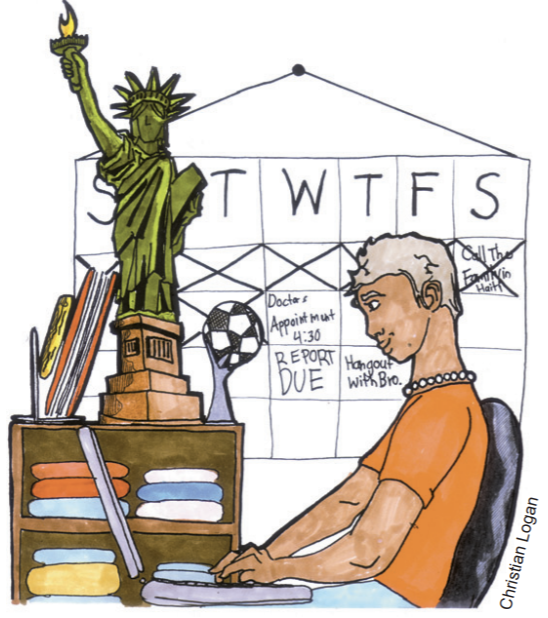
Most of all, I liked living in New York because I could be in control of my own life. I’ve always taken pride in finding solutions to problems-I think that’s why math has always been my favorite subject-and it’s been easier to solve problems on my own since I came here.
For example, when I wanted to go online and I had no Internet at home, I got myself a library card. Later, I got myself a laptop so I could do better at school. I went out and bought it myself. That wouldn’t have happened around my parents, since they were always looking over my shoulder. I felt good whenever I’d buy my own things, or arrange my own checkups with the doctor. No one else took care of things for me, and that’s the way I liked it.
Doing things for myself not only pleases me, it’s helped me become a better, more responsible person. Growing up, I never cooked and I thought that I couldn’t. It was either my mother or the maid who cooked for me. But when I moved here, I realized there was no one to cook for me, and no Mommy or Daddy to complain to. So I learned to cook, and realized I can depend on myself more than I knew.
By now, I feel so much like an adult that I think if I had a good job, I’d be able to live by myself. The process of making my own decisions and taking care of myself has been just as satisfying as I imagined it would be when I was living with my parents and wishing for more independence.
When I said yes to my parents’ offer to send me to New York, that was the best yes I’ve said in my life so far. I am at ease in New York. I speak and act my mind, and this makes me feel more “me.”
Independence Day
Being self-sufficient is everything I imagined
About These Stories
YC runs intensive nonfiction writing programs for teens in New York City, where they’re mentored by a professional editor to write personal stories about their lives and about issues that affect young people. Their stories are then published and read by thousands of teens, educators, policymakers, and other adults who work with and for young people.