
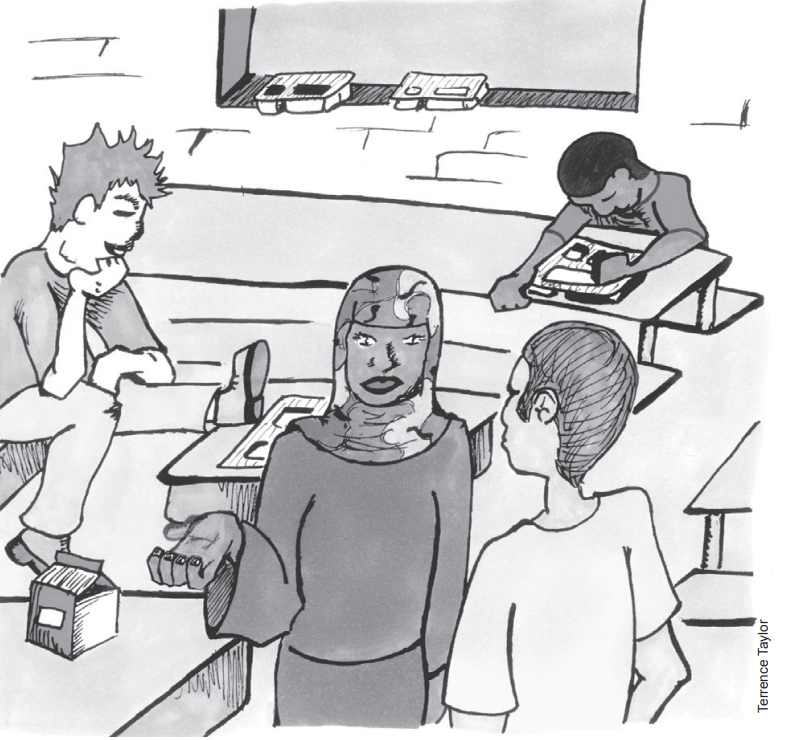
“Do you take a shower with that on?” I will never forget the boy pointing at my headscarf and asking me this question when I was in 9th grade. It was about two months after I moved from Yemen, in the Middle East, to New York. I started laughing, because to me it was a ridiculous question and I couldn’t believe he’d asked it.
“No, I don’t take a shower with it,” was my answer.
My religion, Islam, is the world’s largest religion next to Christianity. The first and most important step to becoming a Muslim is to believe that there is only one God (we call him Allah), and that the prophet Mohammed is his messenger. After this come all our other duties as Muslims. All the religions I know of have rules, but some of the rules we follow as Muslims are especially visible, and therefore people can tell that we are Muslims just by looking at us and noticing our clothing or our actions.
Explaining the Rules
Muslim girls like me wear the hijab, which is a scarf to cover our heads, and we cover our bodies, too. Muslims also pray five times a day and fast during one month of the year, which can spark people’s curiosity. I have been asked a lot of questions about my religion and I don’t mind answering them, as long as the people I’m talking to get what I’m saying about the reasons for our rules. I don’t get annoyed because I feel it’s my job to educate people about my religion when I’m asked to.
A lot of people ask me if I ever take the hijab off. My answer to that is, of course, yes. I explain that we cover ourselves for modesty around boys we’re not related to, but at home, we can take it off because we are only with our family and there are no outside boys. If there’s a party we dress up in dresses, skirts or jeans and do our hair. That’s because when we party, girls aren’t mixed with boys.
When I leave my home or when boys are around, I wear a long dress, usually black, and the hijab. In my country I’d cover my face, too, and the only part of me you’d see would be my eyes. Islam states that women don’t have to cover their hands and faces unless they are extremely beautiful and their beauty will draw attention to them, but in Yemen it’s a cultural tradition that all women cover their faces when they go out.
I like covering my face in my country, because it’s as normal to every girl there as wearing a coat when it’s winter. But here I don’t cover my face, because it makes me feel uncomfortable when I walk in the streets. People stare at me with strange expressions, and on some of their faces I see a look that tells me they are thinking, “Terrorist.”
don’t Mind Standing Out
I don’t mind standing out a little, though, because I’m proud of my religion. Sometimes people at school ask me to show them my hair or to go to school with clothes like they wear. I joke, “If you want to see me dressed up like you, come to my house.” I understand why they ask me. When you see something covered up every day, don’t you want to take off the cover and see what’s underneath? They want to see me the way they see everybody else. I don’t have a problem with their curiosity because it’s respectful.
But I’m against people who are so ignorant that they want to make you change the way you dress, even if it’s against your religion. In France, for example, in 2004, they came up with a law that forbids girls in public schools from wearing the hijab. I don’t see what learning has to do with what we are wearing. It’s not like we are teaching other kids to wear it. What you have in your head, not on your head, is all the schools should care about.
I believe we all have the right to follow the religion we choose, and following Islam means showing that we are Muslims in a visible way. So Muslim girls in school should be allowed to wear the hijab. When you see girls wearing the hijab, you know right away that they are Muslims, and I consider that a positive thing. Even though it leads to many questions from my classmates, it makes me feel connected to my religion.
When I fast during the month of Ramadan, that attracts curiosity, too. During Ramadan, Muslims fast from sunrise till sunset for 30 days in a row-to help our bodies digest stored food and to walk in the shoes of those who are hungry all their lives. During daylight hours we don’t eat or drink anything, not even water.
“You want gum?” a guy in my class asked me once during Ramadan.
“No, thanks,” I told him.
“Damn! You don’t even chew gum in class,” he said.
“Yes, I do. It’s just that I’m fasting today.”
“Man, you’re not hungry?” he asked.
My classmates are often shocked when I tell them I’m not eating. Another time a boy told me, “Oh my God, I can’t live without eating, I would die if I didn’t eat all day.” He was exaggerating, of course, but they seem to think it’s hard. In fact, anyone can do it, it just takes time to get used to it.
Connected to My Faith
Like wearing the hijab, fasting makes me feel more connected to Islam. It’s nice that there are other Muslim students in my school, and we have each other to hang out with at lunchtime during Ramadan. But I also like that when I’m fasting around people who aren’t, it makes me remember my religion more. And it reminds me that while I have so much food to choose from, there are people dying from hunger every day.
Fasting and wearing the hijab aren’t the only rules I follow as a Muslim. The five pillars of Islam also require me to give money to charity, pray certain prayers five times a day, and visit the House of God in Mecca, Saudi Arabia, at least once in my life if I can. I’m glad my religion requires certain visible acts of faith, because I think if you really believe in something you should be ready to show it.
Showing my faith makes me stronger and more comfortable with what I believe in as a Muslim girl. If I never had to show my religion openly, it would be easier to not think of it, or even to forget about it. But getting dressed in a certain way every day, and fasting for a whole month, reminds me over and over that I am a Muslim and the way I act should reflect that.
Wearing My Faith
About These Stories
YC runs intensive nonfiction writing programs for teens in New York City, where they’re mentored by a professional editor to write personal stories about their lives and about issues that affect young people. Their stories are then published and read by thousands of teens, educators, policymakers, and other adults who work with and for young people.