
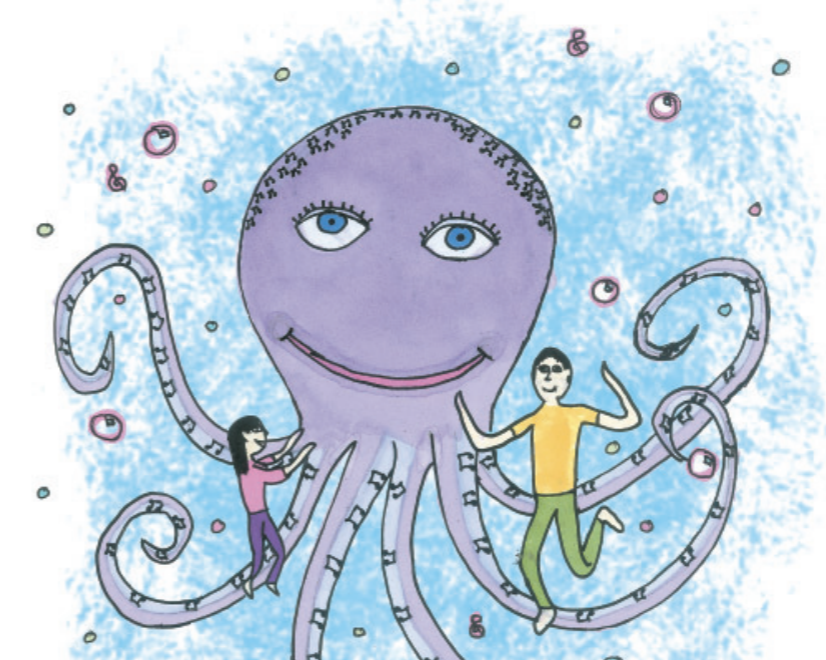
“I’d like to be under the sea in an octopus’s garden in the shade.” I was in the living room with my dad, listening to his original vinyl Beatles record playing the song “Octopus’s Garden.” I was about 6 years old, and that line troubled me. It wasn’t the idea of a person being under the sea and hanging out with an octopus that bothered me. The issue I had was with the shade.
“How can there be shade under the sea?” I asked my dad. “There aren’t shady spots and sunny spots under water!”
My father told me that it was make-believe, so it didn’t need to make sense. That opened up my eyes. Music and other types of art didn’t need to be realistic all the time. I embraced the idea of creativity, and I was drawn to the arts, especially music.
Listening Together
Music has always been a huge part of my life. I attribute that mostly to my father, who passed away three years ago. He loved music, and he instilled that love in me. We bonded through music, and I continue to connect to him through it.
Some of my earliest memories involve my father and music. We always listened together to the radio, CDs and his vinyl records. He chose the music, mostly classic rock, but sometimes he’d play classical music or smooth jazz when I couldn’t sleep.
As I grew older, I began to follow in the footsteps of my older sister and peers, listening to popular music of the day, like Christina Aguilera and *NSYNC.
But as I neared the end of middle school, something made me go back to my dad’s music. I don’t remember why, but one day I wanted to listen to the Ramones, an early pop-punk band from the ’70s and ’80s. I went to my father’s CD collection and found a solo album by Joey Ramone, the lead singer, from after the band broke up.
A Life Outside Mine
As I lay in bed listening to the bright pink CD in my Discman, I thought about my father and the connection he must have to the music. He could remember when the Ramones were popular, when they broke up, when these albums had come out. They were a part of his life outside of mine.
It made me realize that he wasn’t just my father, but a person who had his own life and everything that came along with it, including a childhood. We were both individuals with our own pasts and interests. We had this connection as people now, not just as father and daughter.
A few months later, soon after I began high school, my friend and I were walking in Central Park late one afternoon when I heard what sounded like guitars. We followed the sound and found ourselves in Strawberry Fields, surrounded by a group of people singing and playing Beatles songs.
Music Spoke for Us
It turned out it was John Lennon’s (one of the lead members of The Beatles) would-be 64th birthday, had he still been alive, which was significant because of The Beatles’ hit song “When I’m 64.” Fans had come to pay tribute to John Lennon in the area of Central Park dedicated to him. I thought the chords, rhythms, harmonies and lyrics were beautiful.
I went home that night and headed to my dad’s CD collection again, this time looking for Beatles albums. I listened to them repeatedly for the next few weeks, learning all the songs.
One evening, I sat down at the computer in my dad’s bedroom to do my homework. I put on The Beatles’ Rubber Soul album and sang along to the first song, “Drive My Car.” By the time the second track, “Norwegian Wood (This Bird Has Flown),” began, my dad had walked into the room and was standing near me, singing along as he often did.
We smiled and looked at each other as we sang harmonies and drummed our hands on our thighs with the beat. We didn’t speak because we didn’t have to. The music spoke for us.
My Singing Debut
Meanwhile, a new source of music had come into my life. I began to take voice lessons when I was 13. My voice teacher introduced me to songs from musicals, something my dad didn’t listen to often. My first performance was a school talent show, only months after I began voice lessons.
I walked on stage, so shaky I was afraid I’d fall over in my high heels. I breathed deeply and prepared for that first note as I brought the microphone up to my mouth. “I hope you never lose your sense of wonder,” I sang (from the song “I Hope You Dance,” by Lee Ann Womack). Before I knew it, the song was over.
Giving Something Back
I walked off the stage in a daze from the rush of performing in front of a large audience. When I found my father, he was beaming with pride. he’d heard me sing around the house, but this was the first time he’d heard me giving it my all the way I do in voice lessons and performances. We hugged and he told me how lucky he felt to be my father. For weeks afterwards he proudly told me about all the people who had complimented my performance to him.
Looking back, I think my singing deepened our musical relationship. Before, he would offer bands, songs and music-related facts, and I would receive them. It was my interest in a passion of his. Now I was sharing my own musical passion with him. I was giving something back to him: my voice, my musical creations.
My father passed away suddenly when I was 15 years old, not long after I rediscovered The Beatles. A few months later, I had a performance in a concert my voice teacher was organizing. I decided to sing “Papa Can You Hear Me,” a song that the main character in the musical Yentl sings to her father after he passes away.
I, too, sang the song for my father. I had a very bittersweet feeling on stage. It was extremely emotional-difficult because my father wasn’t with me physically, but also incredibly fulfilling to be doing something I loved that he’d inspired me to do and that I know he would have wanted me to pursue.
As Long as There’s Music
After the performance, lots of people came and complimented me. One woman I didn’t know said she could tell that I had lost a loved one. She told me I sang the song with the emotion that only someone who intimately knew loss could have. I told her that my father had passed away earlier that year and that he had inspired my passion for music and singing.
Listening to and singing music has helped me cope with my father’s death because of all the happiness it brings me, and because I know that he would be happy to see me continuing this love. He may not be with me physically, but as long as there is music, he will always be with me spiritually.
To this day, I always privately dedicate my performances to my father. And I always listen to music with him in mind. It is because of him that I love music, and his genetics gave me my musical ear. Because of him, music isn’t just a pastime for me. It is a passion, a reason to live, something that never fails to make me happy.
View the lessons based on this story
- Comfort After Grief Between You and Me Unit 2 | Session 13