
I recently came face to face with a 15-foot Burmese python, and I survived without being swallowed whole.
Thanks to the American Museum of Natural History’s new “Lizards and Snakes Alive!” exhibit, which runs until January, I saw the python and more than 60 other live lizards and snakes from around the world. Before you say that lizards and snakes are slimy and yucky, I should tell you that I used to think so, too. But I went to see them and found I’d been wrong. They were fascinating.
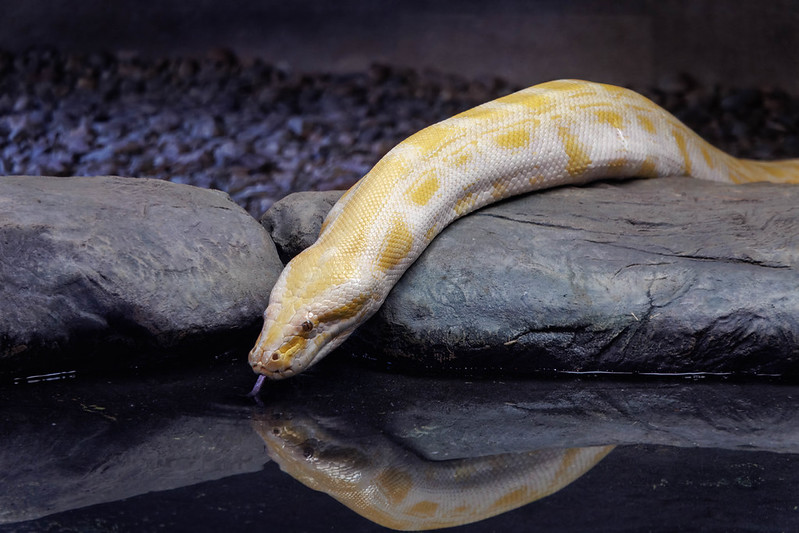
Walking up to a circular glass cage at the museum, I got my first look at the jet-black and brown patterned Burmese python. The snake’s eyes were so small compared to its gigantic girth. I could imagine it hiding out on a jungle floor and eating its prey-and it was chilling.
But I was also so excited to stand right next to something that seemed too big to be real. I watched it breathe in and out, and then I squatted on the floor for a long time-just staring at it, hoping it would move. I didn’t think it was something scary or evil, as it’s often depicted in pop culture.
Ready for Their Close Up
As I looked at one bright green and yellow gecko (a small tropical lizard that eat insects) plastered against the lens of a camera in its cage, I imagined it might have been dreaming of fame.
The reason for the camera in the cage? The camera box behind the cage allowed me to zoom in on the foot-long gecko for a closer look. Other geckos were hanging on the walls, the glass and everywhere else in the huge cage.
In the snake section, I was surprised to find that some of them were so beautiful, especially the white, black and pink Campbell’s milk snakes (they looked like necklaces to me). Although they’re harmless, they fool potential predators by imitating the colors of the venomous coral snake.
I could get up close and personal with the snakes and lizards because they were in beautiful glass display cases (one even included a mini waterfall). On the walls next to and above the cases, each animal was explained with easy to digest information, listing where the animal lives the wild, how big it is and what it likes to eat.
The animals even got a chance to talk back. I pushed a button by one of the gecko stations and heard a sound much like one of the guitars I made as a little kid-out of tissue boxes and rubber bands. But the sound was the recording of a gecko.
Lizards Talking Back
When I pressed other buttons, I got to hear recordings of different snake hisses, made when they force air out through their throats or breathe in deeply. In other displays, I could see and touch fossils and ancient squamates (the group of about 8,000 legged and legless lizard species, including snakes).
I was surprised that I started to admire these scaly creatures in such a short time. It was nice to see something alive at the museum and to get a good vibe from a group of animals that usually get a bad rap. Any animal lover should slither all over this exhibit.
The American Museum of Natural History is located at the corner of Central Park West and 81st Street in Manhattan.
Exhibit admission is $16 with student ID (ask your science teacher to take your class for free). For more information, call 212-769-5100 or visit www.amnh.org.
Lizards and Snakes Alive and Up Close
About These Stories
YC runs intensive nonfiction writing programs for teens in New York City, where they’re mentored by a professional editor to write personal stories about their lives and about issues that affect young people. Their stories are then published and read by thousands of teens, educators, policymakers, and other adults who work with and for young people.