
Sometimes, I feel my father is a close family member. Sometimes, I feel he’s a stranger. It’s hard for me to judge the role he plays in my life.
My father emigrated from China to New York City when I was 6. After he left China, my family broke apart the way a cup that falls on the ground breaks into pieces. It can be put back together, but it will never really be whole again.
Before my father went to America, we spent a lot of time together. No one in my family worked while we were in China since my grandparents and other American relatives sent us money from New York.
We went everywhere together and our favorite place was an amusement park similar to Coney Island, called Palace for Youth, in Tai Chang, China. There were always a lot of parents holding hands with their kids, running around the Palace for Youth to find activities and rides, like small airplane rides, merry-go-rounds, and bumper cars or, as the Chinese call them, “peng peng che.”
Amusement Parks and Bicycles
I spent the happiest moments of my childhood in Palace for Youth with my family. Once when I was 5, my father, sister and I sat on the small airplane ride and my father was scared because my sister and I pressed the buttons to make the plane go up and down every two seconds. He said to us, “Jane and May, release your hands! It’s too dangerous to fly that high up. Let it down!”
My mother stood below and watched us, laughing at my father being afraid. He closed his eyes and whispered, “Please, stop flying!” It was so fun I wanted time to stop passing so I could remain in that moment. I loved seeing my family laugh and I felt so close to them then, especially my father.
My father was also there for me during the not-so-fun times. When I was about 6, I went to the hospital almost every week. I often got colds and fevers and I can’t remember how many shots I got in my hands. But I didn’t cry out when the doctors gave me shots because my father was always right next to me.
He comforted me and said, “May, you are a brave girl, like a boy. If you cry, you won’t be pretty when you grow up. So don’t cry, be a good girl and I will buy a lot of things for you.” He worried about me and didn’t want me to feel depressed because of my sickness. He tried his best to make me happy, and even bought a small bicycle to comfort me.
Then He Was Gone
But the day I learned how to ride that bicycle, my father wasn’t there with me. He left for New York the day after he bought it. He told me he was going to America to earn lots of money, so my mother, siblings and I could go to America one day and have a better life.
I didn’t know where America was. Was it far away from my hometown, Guangdong, China? When would I see him again, tomorrow or never? I held my father’s hands tightly as if he would fly away if I released them. But finally, our hands were separated and he was gone.
That first year, I felt hopeless, because I didn’t know where America was or whether my father would return home. As time went on, I tried to get rid of the image of him in my head so I wouldn’t feel so sad, but I couldn’t. We talked on the phone and wrote letters to each other, and he came back to visit at least once a year, making it impossible to forget him.
We had fun being together again whenever he visited. We’d go to a park where we’d barbecue and play around in the river. We’d splash each other until we looked like wet chickens and I’d feel happy and comfortable with my family again.
‘Who’s That Guy?’
As the years went by, though, my father started to become a distant relative I saw once or twice a year. We always had fun when he came, but by the time his next visit rolled around almost a year later, I’d have almost forgotten what he looked like.
When I was still little, I often asked my mom, “Who’s the guy sitting in the living room surrounded by my relatives?” whenever he first arrived for a visit. My mother would stare at me and answer angrily, “That’s your father.”
I wouldn’t believe her at first. He became thinner, older and more unrecognizable every time I saw him. When he first left for America, he only had a few gray hairs. But soon, they were uncountable. I felt sorry and guilty. “Why did I let him go to America?” I thought. I was mad at myself that I couldn’t control the situation.
Each time when he left again, I locked myself in my bedroom. I couldn’t say good-bye to him. The word “good-bye” hit right into my heart. Good-bye separated my family and I wanted us all to live together.
So when I was 11, I was happy and surprised when I heard the good news from my father: “we’re all going to America.” I had been waiting for this day for a long time. I imagined my family was back together, sitting in the living room as we talked, played, laughed and watched TV together.
Together Again
My father told me there were a lot of parks near our apartment in New York. I pictured my whole family playing “owls catch chickens,” a popular game in China that kids play with their family and friends.
The first week we arrived in New York City was the best life I ever had here. My father had opened a factory with three of his best friends six years before, but he didn’t go to work that first week we were there. His friends understood my father needed time to be with his family since we’d just moved to America.
Everything was new to us. My father showed us around Chinatown (our new neighborhood) and lower Manhattan. Then we went to the park behind the Twin Towers.
When we saw the swings, my sister and I ran over quickly while my parents and my younger brother walked behind us slow as turtles. My sister and I swung up and down, forward and backward by ourselves. But I had to push hard on my parents’ backs so they could swing up to the sky too.
I pushed my father right, left, forward and backward. He kept turning around instead of swinging up and down and his hair changed shape in the breeze. We laughed at him and he didn’t mind.
An Angry Man
But after a week, my happy life suddenly became gloomy. My father had to go back to work. It became just like the life I’d had in China when my father was gone. He worked six days a week and during what little time he spent at home, he was always too tired to talk to us.
And when he did talk to us, sometimes he got angry and yelled or even hit us for coming home late or not working hard enough. I think he was stressed from working so hard and living with all of us in a small apartment. He had never yelled or hit us in China. I was shocked and scared by his change.
I thought I’d have more time with my father once we were living together again in New York. But instead, I didn’t feel my father existed, though he was sitting next to me, eating dinner, and living in the same apartment with me.
I felt neglected, alone and sad. I even thought about running away because I wanted attention from my father other than yelling and hitting. My father had changed from the fun and loving person I’d known in China to a tired, strict, distant and angry man.
We don’t Talk
Now, six years later, it’s still the same. His anger hurts me but what hurts even more is that we don’t share our feelings anymore. He doesn’t know when I get sick or sad.
The only time we talk is during dinner when we sit together and eat. Then I have to go back to my room to study while my father goes to his room to rest. On Sundays, the only day my father doesn’t work, he goes out and gambles with his friends instead of spending time with my siblings and me.
Sometimes I think he ignores me not only because he’s so busy and tired. Maybe he feels I am not a child anymore, but a 16-year-old who is smart enough to do things on my own.
When he does talk to me during dinner, it’s always about how he needs me to fill out a government form in English, or a fight about how late I’ve been out or about school. He says, “You have to study hard, go to a good university and get a high-salary job.”
We Want His Time and Love
I understand I have to work to achieve my father’s dream for me, but it’s hard for me to learn under such pressure. Plus, I do study hard, and get the highest grades in the class. But he doesn’t even ask me for my grades, so he never knows how well I do. It makes me feel like he doesn’t really care.
I tell my mother, who I’m still close to, that I dislike school because my father pressures me so much. I feel depressed and exhausted. My mother has asked him to stop pressuring me but he doesn’t listen.
If I felt brave enough to speak up to my father, I’d tell him that hiding my feelings for five years is enough. I’d tell him that he’s a good father, but also a bad father. He takes care of my family and gives us money for food and clothing.
But I’d tell him that’s not what my sister and I want. We want his time and his love. We don’t want to be left out, to stay home alone while he’s busy with his job. And we don’t want to be yelled at.
Closer From a Distance?
I try to have a life of my own. I’ve spent a summer studying at Yale University, traveled to Turkey and grown more independent from my family. I’ve made some close friends who comfort and support me. But I still miss my father.
Strangely enough, we seem to get closer when we’re apart. When I’m away, I think my father starts missing me and gets concerned about me.
Last summer when I was at Yale, my father called me once or twice a week to ask how everything was going. He asked about the campus, the food, my bedroom, my roommate and curfews. Even though I figured he was asking me all this so he’d feel in control of me like he is at home, I still liked it because it made me feel he cared about me.
It’s also easier for me to talk to him when I’m away. I don’t feel nervous the way I do at home because on the phone, he asks about my health and safety, which makes me happy. And if he does get angry, I can just hold the phone away from my ear.
Summer Phone calls
So I know I’ll be able to talk to him on the phone this summer when I attend a program at Phillips Exeter Academy in New Hampshire for six weeks.
I hope if I join more summer abroad programs or when I grow up and move out permanently, I’ll be able to have a closer relationship with my father since we both feel more comfortable with each other on the phone.
I’m not ready yet to talk to him about my feelingsâI think he’d just say I’m crazy and immature. So I’ll wait till I get older and when I’m ready I hope we’ll be able to talk more like adults. For now, I’m looking forward to his questions during our summertime phone calls. At least we’ll be having a conversation.
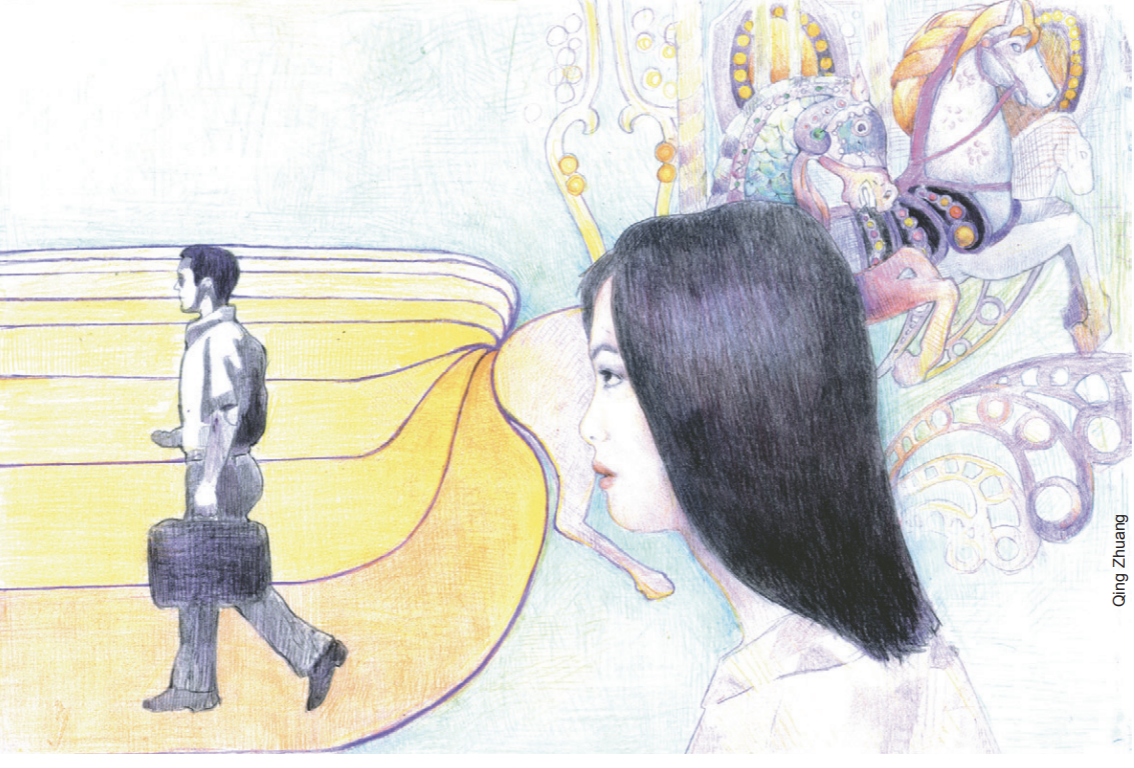
The Stranger in My House
Once Close in China, My Father and I Are Distant in America
About These Stories
YC runs intensive nonfiction writing programs for teens in New York City, where they’re mentored by a professional editor to write personal stories about their lives and about issues that affect young people. Their stories are then published and read by thousands of teens, educators, policymakers, and other adults who work with and for young people.