
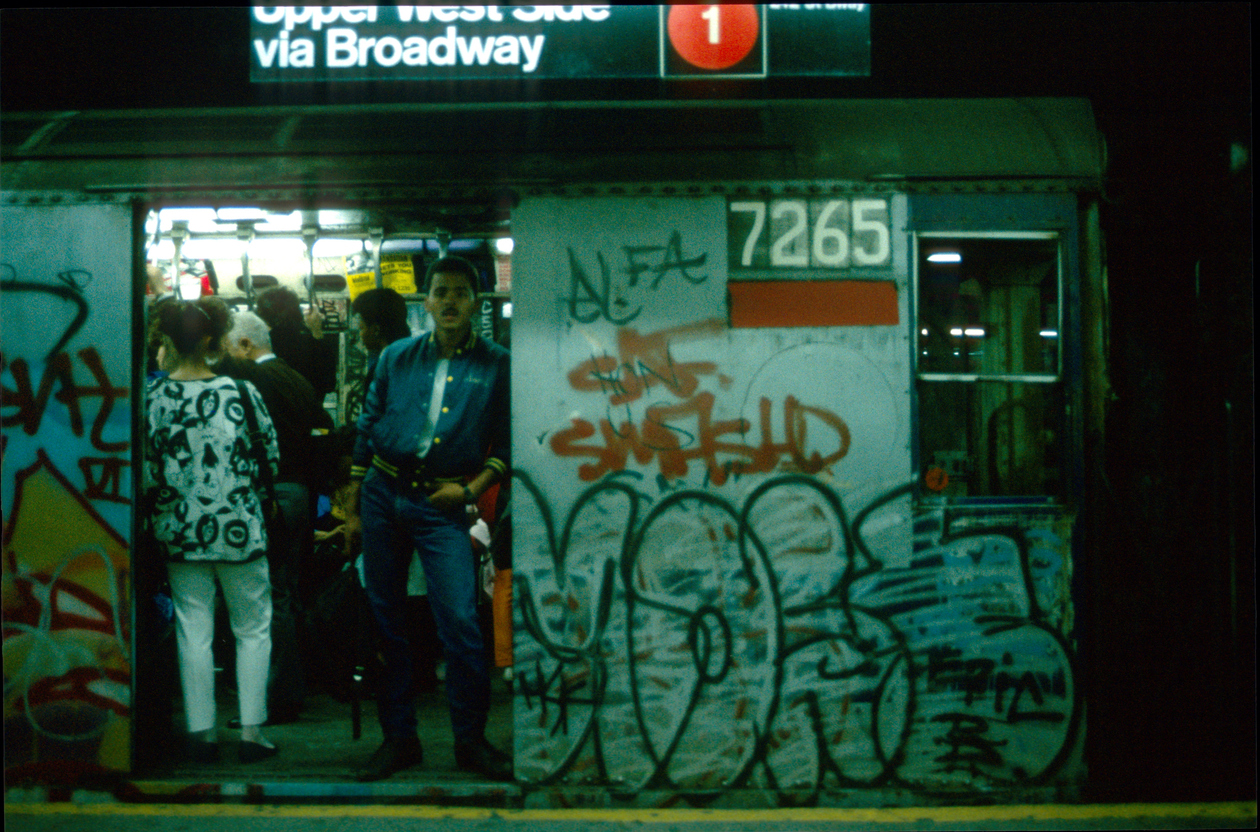
When I was growing up I saw graffiti all over the city. I always thought it was just there. Then, when I was around 10, I found out kids my own age from my neighborhood were doing it. They caught ups and got respect from other kids. About a year later, I found out even my best friend Richie had been writing.
Richie already had a tag, and he carried a blackbook on him to sketch “pieces” (well thought-out more artistic graffiti art, as opposed to tags). I thought he could teach me a little about it and we could start bombing together. He said that would be no problem.
One night when I was hanging out at Richie’s house, he showed me an underground tape called Videograf which showed guys drawing and talking about graffiti. He told me to watch it to learn more about graffiti.
It Looked So Easy
While the show was on I couldn’t stop thinking about how easy drawing graffiti looked. I really wasn’t impressed until I saw a teenager doing “a wildstyle.” He was drawing his tag and attaching arrows to his letters to make them look like they were moving. It was wild, elaborate, and nice to look at.
I also saw guys on the tape drawing pieces like Richie had in his blackbook, and they looked nice too. Watching them made me want to be good enough to do piecing and attract attention.
By the time I stopped watching the show it was after my 10 o’clock curfew, so when I got home I got the Spanish Inquisition from my mom. “Where were you? Why are you home so late? What were you doing?” she asked. I told her I was at Richie’s house and I lost track of time. She was mad at me, but I didn’t get into trouble.
Picking My Tag
The next day, Richie and I were in school and I told him I wanted to go out and do graf. When Richie heard this, he said I had to have a tag before I could go out. After school that day I went to Richie’s house and thought about it for a while. We came up with a lot of names but these made the final cut: Spin because we used to spin records; QD because it’s short for cutie; and GQ because we were into name brand clothes. Finally I chose one (I’m not telling which).
After deciding on a tag for me we had to decide on a couple of other things. First, where would we bomb on my first time out? We decided we should stay in our neighborhood because we knew it so well that we could lose anyone who might try to stop us or chase us. Next, when would be my first time? I didn’t want to wait, so we decided on that coming Friday night.
The first time out was an adventure from start to finish. First I told my mom I was going to spend the night at Richie’s house and she could call anytime. Sometimes when I stayed late at Richie’s, I’d end up sleepng over without even calling my mom. But she would always call Richie’s house to make sure that’s where I was, and to make sure that I was all right.
I waited for her call, which came at about midnight or one in the morning. Five minutes after she called we left. Richie’s parents were sleeping so we snuck outside through the basement without disturbing them.
My First Time Out
We went running around the streets in our neighborhood heading nowhere in particular. Whatever we saw that was dead enough to bomb, that’s what we’d hit-vans, trucks, garages, and storefronts. The most fun was hanging out so late. By the time we finally called it quits it was around 5 in the morning and the sun was starting to come up.
When we got back to Richie’s house, we had to clean our hands with turpentine to get the paint off so no one would know we were out. Then we went to bed and slept until about noon. We didn’t really talk about what we did, we just spent the day practicing styles for the next time.
After a few days some of my friends saw my tag up and they seemed impressed. Some of them asked me about going bombing sometime. After getting a little taste of attention, my goal was to bomb more so that even more people would notice.
I started bombing at least once a week, sometimes more if friends asked me to. And I made a lot of new friends while I was out bombing. I remember one night I was walking around by myself and I saw a guy about my age who I’d seen before but never spoken to. He waved to me and when I walked over to him he said, “Damn, you’re White and you’re always down here! You got balls.”
We both laughed and I found out his tag and told him mine. I also learned that he was part of a popular crew in my neighborhood called N.B.K. (Nothing But Kings). To this day I’m friends with him and a lot of other writers I met.
Running From the Cops
As I bombed more, I learned that besides looking out for cops you had to look out for other writers, too. Most writers ran with mobs and if you were caught going over someone else’s up you could bet on getting into a fight with the guy you ragged and his mob, too.
One of our best nights came a few months after I’d started. Some cops in our neighborhood pulled us over and were laughing at us because we were out on such a cold night. They knew what we were doing but they didn’t do anything to stop us. We knew they could’ve arrested us if they wanted to, but still we looked at it as if we had gotten over on our biggest enemy.
About a year into my life as a graffiti writer, three of my friends got caught bombing in my neighborhood over a period of about two months. Richie got caught once and was sentenced to cleaning trains and subway platforms. The other guys would come to school talking about how their parents wouldn’t stop yelling at them because they had to go to court and pay fines.
But I didn’t give much thought to the idea of getting caught or the consequences my friends experienced. I hadn’t gotten caught myself, and many of us really believed that the other kids just had bad luck. We took more precautions from then on, however. We decided to bomb in Manhattan instead of Brooklyn and Queens, and we had two guys looking out for 5-0s instead of one, while the rest of us caught our ups.
Local Heroes
I was becoming a good vandal. Although my piecing wasn’t improving, I got a lot of respect from people and was making a lot more friends.
Then one night, at about 11 o’clock, a kid named Aaron and I were about to bomb a supermarket. I had never bombed with him before, but we had been friends for a while and he told me he wanted to start writing. So I had agreed to go out bombing with him sometime.
Well, we were doing fill-ins on the side wall of the supermarket and things were going fine until I heard Aaron mumble something unclear. When I turned around to ask him what he said, he was gone. I saw him running away, looked over my shoulder and saw a car approaching me.
I knew it wasn’t a cop car, but I started running anyway. One guy got out of the car and was running after me, and the other was following both of us in the car. Next thing I knew, the guy on foot caught up to me, grabbed me, threw me into the car, lodged his knee in my chest and drove me back to the supermarket.
I was embarrassed to be caught by two heroes (citizens who think they’re cops). They took me inside the supermarket to the store manager and the manager called the police and my mom.
The grocery store manager, the two heroes and I stood in the store waiting for the cops and my mom to come. The manager ordered one of his workers, a guy who looked like a gorilla, to take me into the basement until they arrived.
As the gorilla-guy escorted me toward the basement door, he laughed at me and said, “Man, you got caught doing graffiti. Ha-ha-ha!” Then he shoved me, a skinny 8th grader, down the stairs. While I was sitting on the basement floor he asked, “You kids don’t know graffiti is illegal and you could get arrested?” Then he left.
They Wouldn’t Let Me Talk
About 20 minutes later, he came back and took me upstairs. Two cops, one male and one female, were waiting there. The female cop said, “Y’know, if that was my property I wouldn’t even call the cops, I would kick your ass.”
I was so upset about being mistreated by the heroes and the gorilla-guy that I felt like telling her, “Yeah. Go ahead!” I also wanted to explain that the graffiti wasn’t entirely my fault. But each time I tried to talk, someone would say, “Shut up.” That made me angrier.
The two heroes told the manager they wanted a reward for bringing me in. He thanked them and gave them a gift certificate for food in the store. I wondered, “Did these guys just grab me to get free-bees?” Some heroes.
My Mom Arrives
A few minutes later my mom entered and my heart stopped. She looked very confused and didn’t seem to know what I had done to get into this situation. The manager explained to her that I was doing graffiti and got caught. My mother snapped back, “Who was he with?” The manager answered, “Nobody.”
My mom didn’t want to believe that I was to blame. She had an idea even before this incident that I had friends who did graffiti. She knew that Richie had gotten into a lot of trouble because of it and she had told me not to hang out with him anymore. She had even found markers and books filled with graffiti in my room, but she didn’t seem to believe that I was actually going out and doing graffiti with those markers. I felt really bad that she was trying to defend me when I had been caught in the act.
I figured I should end the charade for both our sakes so we could go home. When I confessed, no one even batted an eyelash, except for the gorilla-guy who jumped up and said, “I told you he did it.” I also said that I was with someone else, but I didn’t say who.
My mother asked, “What happened to the other kid?” The two heroes replied, “He got away.”
$200 or Else
Then the male police officer asked the manager, “Do you want to press charges?” The manager said no, he just wanted money to repair his wall. He said if my mom would pay $200 to get the graffiti painted over, he’d be satisfied. Hearing that, I offered to paint the wall myself instead. But the manager said “no,” he wanted the money. My mom paid him and we left.
I was expecting Mom to scream at me as soon as I got in the car. I had never done anything as bad as getting arrested before. But there was total silence during the 20 minute ride home. I was expecting her to blow her top any minute. And, even though it rarely happened, I thought she might even hit me.
We walked into our house and hung up our coats. Finally, in a soft but serious voice, she said, “If you get caught again, I’m not coming down to bail you out.”
She had never said anything like that before, and I became a little worried. I thought she would never talk to me or help me again.
‘Next Time, They’ll Lock You Up’
She also said, “I’d better not find none of those markers or labels in your school bag. You better not spend my money to go and mark up the neighborhood. Next time they’ll lock you up.”
I went up to my room wondering what happened to Aaron. It wouldn’t have made me feel better if both of us had gotten caught, but I wished he could have been around to help me pay some of the fine. (I didn’t see Aaron ever again, but a couple of months later I found out from our friend Anthony that he had moved. I thought, “Good. I don’t have to worry about bombing with him again.”)
After getting caught at the supermarket, I abandoned any thoughts about the artistic part of graffiti. I began to bomb with a new attitude because of the way the cops, store manager, and the two heroes treated me. I did graffiti now as a way to get back at them. I wrote whenever and wherever I could, even when I was just walking to a friend’s house. I didn’t take any of my old precautions like going out with friends who could serve as look-outs.
I continued to do this until the summer after eighth grade. By then, many of my friends were starting to do other things on weekends, like go to clubs and parties. The club scene was a lot less risky than the bombing scene, and I discovered that many kids who hung out in the clubs also wrote graffiti. Somebody usually had a blackbook on them and we’d do pieces in each other’s books at the club.
My interests started to change. I was more focused on talking to girls, hanging out at friends’ houses and playing video games. At night and on weekends, I’d go to house parties or dances. I started making friends with kids who didn’t write. A few of my old friends still wanted to go bombing but I was like, “Knowing you guys, we’ll get caught,” or “With my luck, I’ll cause us to get caught myself.”
An Old Friend With a New Marker
I didn’t write again until early in my sophomore year. One day after homeroom I saw an old friend from my bombing days named Du walking around. He said, “Hey, Larry, do you remember this?” He held up a nice, thick Pilot marker and offered it to me.
My next class was biology and it was really boring. So I agreed to cut and go write with Du. We went into one of the stairways. I wrote my tag quickly and gave the marker to Du. He was taking his time, so I stood in the stairwell half a flight up, acting as a look-out. I saw the dean coming down the stairs and heard her say, “What’s that smell?”
I said, “Du, someone’s coming, let’s get out of here!” (I couldn’t leave Du hanging like my friend Aaron did to me.) He ran one way and I ran the other.
Bagged Again
I went to the cafeteria. I saw a girl I knew and started talking to her. Ten or 15 minutes passed, and I thought I was safe. Then two security guards crept up behind me, grabbed me, and said, “Come with us!” I said, “For what?” They told me they had a description of somebody who wrote on a wall, and that I fit it. I was bagged again.
The security guards took me to the dean’s office and I tried to play it off like I didn’t know anything about any graffiti. Then they described Du and asked if I knew him. I said that he was my friend-but that was all. They couldn’t find Du, and they let me go.
The next day I was called back to the dean’s office and Du was there. The dean took us to the assistant principal’s office and he threatened to expel us. He called our parents and said they had to come in for a conference the next day.
When I got home that night, my mother said, “What did you do now?” I told her what happened and she said, “When are you going to learn not to hang out with these kids?”
Taking My Punishment
The next day my mom and dad went with me to the conference. On the way there my mom didn’t really say much besides, “Whatever they give you as a punishment, you better learn from.”
I was surprised she was so calm about it because I knew she was mad. I think she felt that I was old enough to know right from wrong. Or maybe she was just tired of telling me the same thing over and over again.
During the conference, the assistant principal did one thing out of the ordinary: he asked me what I wanted as punishment.
I offered to clean up what I did, or to clean up some of the graffiti off the desks in the school. The AP said that the custodians did that. He asked my guidance counselor what would make me learn my lesson. My counselor said maybe I would think twice if I had to spend a week of summer vacation doing paperwork in the school office. I didn’t like that at all, but I figured I had to take some punishment. And at least they had asked me what I thought, instead of just yelling at me.
A Trip to the Paint Store
After what happened at school, I decided to try to stay out of trouble. So when my friend Jerry wanted to bomb that weekend, I said I would go with him to buy the paint, but that was it. With one other friend, we walked to a store which was about a mile away from where we lived.
After getting the paint, we didn’t feel like walking all the way back and I didn’t have money for a token. So we climbed the posts to the elevated train platform and then hopped over the wall and onto the station.
My Blood on the Tracks
We ended up on the downtown side but we needed to take the uptown train so we had to cross the tracks. This wasn’t anything new for me; I had done it many times before while bombing.
We didn’t want to get caught so we waited until we saw the train coming in before going down on the tracks. As I was jumping the third rail my friend yelled, “Watch out for the third rail.” He scared me and I ended up getting my foot caught between the wooden tracks.
I fell backwards, hard, scraping my back on the tracks. My friends couldn’t help me; Jerry just stood there hoping that I would get out. I was scared. I kept jiggling my foot trying to get it loose.
Finally I got free, and ran to the catwalk and up the stairs to the platform as the train whipped right by me.
I stopped and took a deep breath and thanked God that I did not get smooshed by the train.
Scared Straight
When I got home I looked at my back. It was pretty badly scraped up and still bleeding. I went into the bathroom and cleaned out the wounds with peroxide and tried not to scream as I felt them burn.
That’s the scariest thing that ever happened to me in relation to bombing. After that, I stopped doing graffiti altogether and I stopped hanging out with my friends who still did.
I never told anyone about this incident before because it was pretty scary and I’m not comfortable talking about it. I also knew my mom would flip out if she heard. She definitely would not show sympathy for me if I got hurt crossing the train tracks. She’d just say, “You could’ve died,” and would never want me to go out of the house again.
I have to admit that my graffiti experience was fun while it lasted. I enjoyed the risks and I made a lot of new friends.
Other Ways to Get Fame
But it didn’t do everything for me that I thought it would. It didn’t give me artistic talent and it didn’t help me get back at the cops for harassing me. Artistic talent, I now believe, can’t be acquired. It’s something that comes naturally. As for getting even with the cops, that can’t really be done unless other people stand up with you and rebel against being mistreated.
After all of these experiences, I’ve learned that the people telling me to stop writing weren’t just preaching. They were looking out for my best interests even if I didn’t realize it at the time. And I’ve found that there are other ways to make friends, get fame, or take risks (after all we live in New York City). I’ve been able to make friends very easily at school just by being friendly and I’ve found fame writing for NYC, instead of drawing on people’s houses and property.
Graffiti Glossary
writing: the act of doing graffiti.
writers: graffiti artists.
tag: The name a writer goes by and writes.
tagging, catching ups, bombing: the act of writing your tag on a wall.
piecer: a person who does elaborate works of graffiti and also has a lot of artistic talent.
piecing: drawing characters, scenery and/or lettering, as opposed to just tagging your name. It takes planning (and artistic talent).
fill-ins: to write your tag in two colors-one for outlining the letters and one for the inside (fill-in).
wildstyle: an elaborate way of drawing letters that usually consists of attaching arrows to your work to create the effect that it is moving.
blackbook: a book with a black cover filled with big white pages that’s used by graffiti artists to practice drawing pieces.
crew: friends who have the same interest as you (in this case, graffiti) and are usually there to help you if you get into a fight.
work bums: transit employees who usually work in train tunnels where graffiti artists like to bomb. They also watch out for any criminal activity like graffiti.
heroes: neighborhood adults who think they’re cops.
SIDEBAR: If You Can’t Beat ’em. . .
used to be a graffiti vandal who aspired to be a graffiti artist. But I never got really good at being either one, so I stopped bombing altogether. I recognized that many writers had a lot more talent than I did and I thought they should be the ones showing their skills across the city. Since I stopped bombing, I’ve come to understand that while graffiti is art, it’s also a problem. I’ve spent some time thinking about how everybody in the community-cops, citizens and bombers-can work together to find ways to emphasize the artistic side of graf and to find a solution to the problem of vandalism.
o Show the writers they have alternatives. A friend who is a graffiti writer told me, “I wanna get into clothes design. People don’t know that graf is the foundation for…mad art, know what I’m sayin’?” Another artist I interviewed said, “No doubt anybody would want to get loot from something they’d be doin’ anyway. I want to do storefronts, murals and sh-t.” Local store owners or business people involved in graphics and design should reach out to graffiti writers and show them that they could be doing things like designing clothes, decorating storefronts, or learning about advertising. Most graffiti writers would be astonished to learn that they could get a job doing something they enjoy. The writers already have artistic experience, and I’m sure they’d want to take advantage of job, internship or training opportunities in design-related fields.
o Make more (and better positioned) permission walls. Permission walls are community-sponsored, legal places that people set up for graffiti artists to draw on. There are at least eight that I know about, mainly in the Village and Chinatown. Many writers use permission walls so they can take as much time as they want to finish their pieces without having to watch over their shoulders for cops. However, some writers don’t have access to any in their neighborhoods. And some of the walls that already exist don’t face a direction where people can see the artwork. More permission walls should be created and they should be spread throughout the city, maybe one every half-mile. And they should be visible.
o Realize that jail doesn’t rehabilitate vandals…and probation, fines, and community service don’t either. It seems to me that the laws just make it so vandals don’t bomb the same place twice. A friend of mine named DESA was a well-known writer in Queens and now he is doing time for vandalism. During his graffiti career he received probation, fines, and community service but still continued writing until he got sent to prison. I’ve also got at least another dozen friends who have been caught and arrested and who continued bombing once they got out. These few examples strongly suggest that the penalties against vandals don’t reduce vandalism. I think convicted vandals should be required to participate in education programs. If they found out about other ways to express themselves and get recognition, I think repeat offenses would be drastically reduced.
o Cops should stop coming down so hard on graffiti writers. Right now the cops’ main response to graffiti artists is to put them down, harass them, and (afterwards) arrest them. People who commit crimes should receive punishment, but not punishment alone, and not illegal harassment ever. Many writers stereotype cops as people who constantly harass kids; maybe if the police worked on changing that image, writers would respect and listen to them more.
o Graffiti artists and ex-artists should speak up. One piecer who I interviewed said, “I ain’t tryin’ to ruin property, that would be a waste of time…That’s why cops and neighborhood b-ches hate graffiti-they see tags and fill-ins, not the real true art. The real message they don’t know.” I know graffiti writers want fame and they choose to bomb because it’s fun and it involves risk, but I think that writers these days are taking unnecessary risks to get their art exposed. Those who really are doing it to show their talent should speak out in a clear way and say what they want, whether it’s job training, different laws, or legal places to do their stuff. That’s got to happen if adults are ever going to even consider that graf is an art that ought to have some kind of forum for display. And for those who just want to be vandals: you should quit writing for the artists’ sakes.
Videograf, R.I.P.
Almost every month between 1993 and 1994, I would see a new volume of Videograf, a series of videotapes that showed graffiti writers from around the world tagging, piecing (doing really elaborate and artistic graffiti), or talking about the graffiti writing that they’d done. Videograf was an underground thing. Sometimes I was able to get copies of Videograf at my local video store, but it wasn’t something stores had on display because the tapes showed kids doing real property damage. I’d find it hidden away in the back somewhere. Other times I’d get copies of Videograf from my friends, who either ordered tapes by calling a number shown at the end of each volume, or else they got a copy from a friend, who got it from a friend, who got it from a friend…
Watching the Masters At Work
Back in the days when we were graffiti writers, my friends and I used to watch the tapes to learn about different styles of writing (wildstyle, box letters, bubble letters, etc.), different techniques for doing fill-ins, and to hear about the history of graffiti in different places from people who seemed to know. A few of my friends sent in tapes of themselves bombing and were put on a couple of volumes of Videograf. I have seen eight separate volumes of Videograf, and the footage on every tape was 100% real, not set up or scripted. For instance, in Videograf 3, two kids are shown bombing a train, and while they’re bombing they notice that a conductor has spotted them. So they run onto the tracks and into the tunnel to avoid getting caught. In another episode, a mob of graffiti writers are shown doing pieces in a tunnel, dodging trains that speed through and looking out for cops, work bums,or transit workers who might have tried to catch them in the act. None of the writers on the tapes are ever shown getting caught.
Nothing Else Like It
The creators of Videograf are three guys named Carl Weston, “Carlos,” and “Nikone.” They are usually featured in every tape interviewing bombers. I remember that in one episode Weston and Carlos say they’ve been in the studio for about a week and haven’t seen daylight for awhile. That made me think that they put a lot of work into putting out Videograf. Unfortunately, Weston got arrested over a year ago for participating in vandalism and I haven’t seen a new tape since then. (I recently tried to call the numbers for Videograf that I had gotten off the old tapes to see if there were any new volumes out, but the phone lines had been disconnected.) Although I no longer bomb, I like to watch old tapes and remember what it was like being a graffiti writer. I haven’t seen anything else on video, TV, or in the movies that talks about the talent it takes to be a good graffiti artist or that shows the dangers that graffiti writers have to face in the same way that Videograf did.