
The names and some of the details in this story have been changed.
When I was about 5 or 6 years old I used to love going shopping in Manhattan with my mom. I hated the shopping part. It was the subway ride I was interested in.
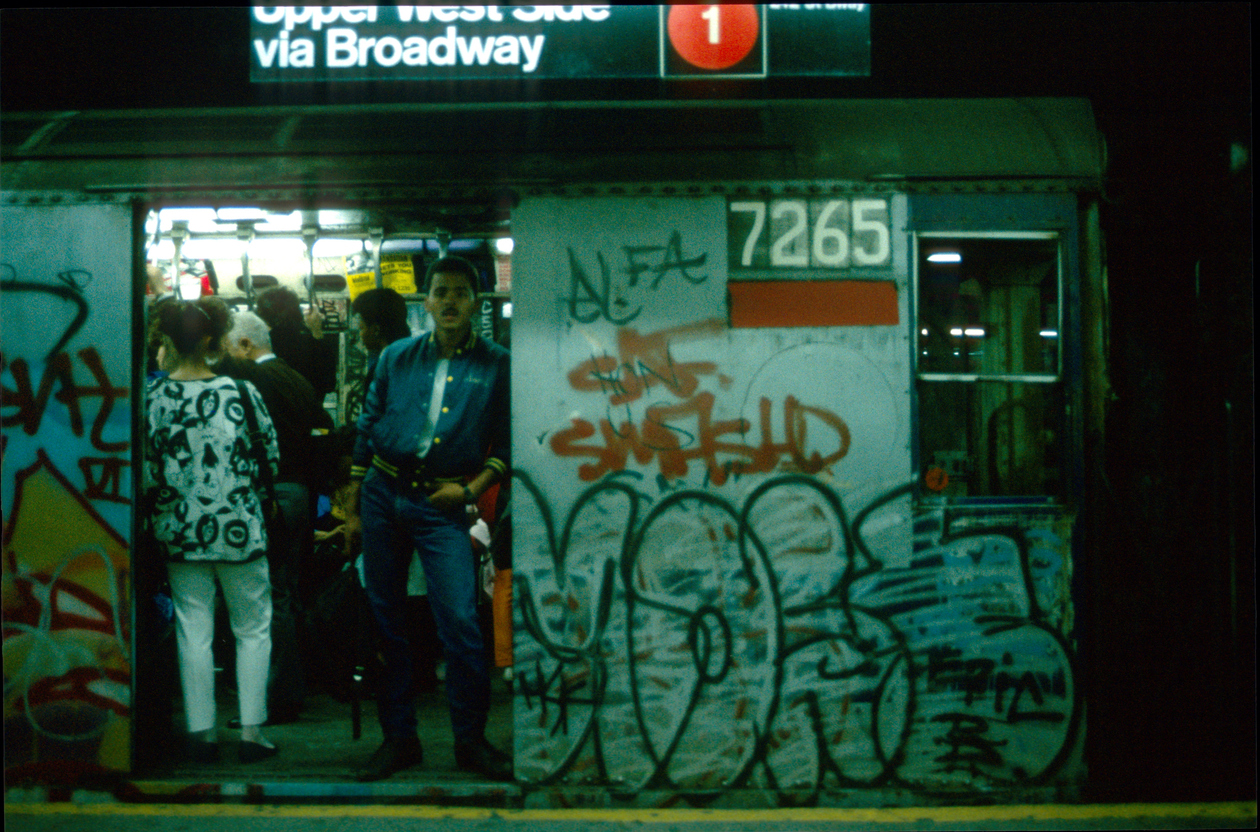
I would always ask my mom if I could ride the Mickey Mouse train. I loved that train. It was beautifully painted with huge colorful images of my favorite cartoon characters. I remember the Donkey Kong train, the Smurf train, and the train that had the naked lady with big breasts on it. In those days, whole subway cars were covered with amazingly detailed pictures that blended together with beautifully intricate writing. I had no idea who painted those pictures.
I started to find out when I was 9. I was playing ball in back of a school in my neighborhood when about 9 or 10 kids came into the schoolyard. Everyone else stopped what they were doing to see what was going to happen next. My boy Frankie, who was also known as Dash-Two because that’s what he used to write on the walls around the neighborhood, approached one of them angrily and proposed a fair fight-no boys involved, just one-on-one.
The Man Who Would Be King
Frankie got the beating of his life that day. I didn’t understand what the whole fight was about, so I asked him. “He dissed my sh-t,” Frankie said. The kid he fought was Dash-One. He went on to tell me that Dash-One had written over his tag on the walls and on the trains. “The 5 line isn’t big enough for two Dash’s,” he explained. Frankie wanted to be Dash-One, king of the 4 and the 5 trains.
That’s when I realized that graffiti was not just about Mickey Mouse characters and huge colorful pieces of art.
One day in junior high I went over to Frankie’s house and he showed me a book of photographs of paintings he and his friends had done on the trains. At last I saw the people behind these paintings. There were pictures of groups of kids in train yards and inside trains and they all had smiles on their faces as if they were getting away with something (which they were).
By this time the Transit Authority had a chemical that could wash off all of the paint or, if they couldn’t do that, they just wouldn’t let the trains run with graffiti on them. I asked Frankie why they did it. All he said was “fame.”
After that, I began to take a closer look at the writing around the neighborhood. Slowly I began to understand it. I began to recognize “tags” that I’d seen before. Some of them belonged to people I knew.
My Very Own Tag
When I turned 11, the older writers I knew gave me my own tag, “Ti-One.” The way I wrote it was pitiful compared to what other people were doing but I loved it. I used to write on the walls of abandoned buildings. I never left the safety of my neighborhood.
Seeing my tag all over the neighborhood was great but what was even better was one day in the seventh grade when some kid I didn’t even know came up to me and said, “I saw you up in Manhattan on a truck.” Who knows how many other people saw it wherever the truck went. I became a celebrity. Kids started calling me by my tag. Older kids who were once sending me to buy them sandwiches were giving me more respect, and I had not even left the neighborhood yet. Meanwhile I was getting better at using paint.
I also became better at stealing. Before the “bomb” came the “rack.” No one ever bought paint. We always stole it-along with just about anything else we could stuff down our pants. Stealing became a way of life. So did fighting.
My first graffiti-related fight was with this kid who wrote “Voke-One.” He lived in the neighborhood but he hung out in Manhattan. No one really liked him. His crew KT (Krylon Team) and my crew KDS (Kings Don’t Stop) had a lot of beef, meaning we hated each other and fought every time we saw each other.
Petty Rivalries
When I was with 20 or so other kids I would talk about how I wished Voke would come around the corner right now. I went over all of his stuff and his boys’ stuff. Come to think of it, I didn’t even know why I had beef with KT. I just saw their stuff and I went over it. My crew had beef; I had beef. That’s all I knew. I was young and dumb. Little did I know that I would not always have them to protect me.
One day I was in the train station on my way to school when Voke and Sez and his brother Chaner came in. One of them saw a KDS tag on my book bag and asked me what I wrote. I told them I didn’t write. I was so scared I was stuttering. They knew I was lying.
One of them hit me and they then proceeded to kick me when I was on the ground. People were in the station seeing all of this yet no one did a thing to stop it. I had to get six stitches in the backside of my head. After that, when I knew I would be alone I carried a lead pipe, and I would always watch my back.
The fights I would get in now and then didn’t stop me from writing. During the summer before eighth grade I started leaving the neighborhood, going to the trainyards and the layups (the tracks where they keep trains during the weekend and at night). I loved writing on trains and, for a while, that was all I did. Some trains were getting buffed (cleaned) and some were slipping through with graff (writing) on them. I didn’t really care. I just loved the tunnels, the yards, the layups, and the occasional fame.
For a while I was king of the double Cs. They layed the trains up within a few blocks of my house and I’d hit them practically every day. I was 13 then, and I was hanging out with older kids and doing a lot of stealing. I snuck out almost every night and if I wasn’t out writing, I was hanging out talking about it. But I always came home on time and played good with my parents. They never knew anything about me except my grades, which were average. They were so blind.
But pretty soon bombing trains got boring. Most of the time, the trains would get cleaned up and the world never got to see my artistic masterpieces. My friends and I still hit Transit now and then but only to take pictures and, more importantly, to piss off the TA (Transit Authority). Then it started getting risky.
The TA started leaving big, gaping holes in the fences to lure us in, and putting dogs in the trainyards. Toys (amateurs) who got caught would sometimes exchange information about other, better known writers to get themselves off. A friend of mine was picked up by the police at his house, arrested, and told to either pay the city $100,000 in damages or go to Spofford Juvenile Detention Center for six months. He got locked up.
After I heard that, I never told anyone my real name or where I lived. A lot of the time I didn’t even tell kids I met for the first time that I wrote at all. I felt the TA was finding more and more ways to thwart us writers and it just wasn’t worth going to jail.
Once in a while we’d hit up trains, though, just to remind them that we were still there. One night me and a friend went to the R layups at City Hall to do the insides of a train. We broke the window, went in, and started working.
The Longest Night of My Life
Five minutes later the doors opened up and in came the detectives. I spent 20 hours in a cage at Central Booking, six of them handcuffed to a bench. A kid in the cell happened to like my shirt and tried to take it. When I wouldn’t let him have it he hit my friend. After that experience, I became a little disillusioned with writing and stopped-for a while.
A lot of my older friends who had gotten me into it had already stopped writing because they felt graffiti was dead (a few of them were on the road to being dead themselves), because of beef they had with other writers, or just because they were getting too old for it.
Aside from the risks, it was also more of a hassle. We would have to go farther and farther out of the city to steal paint. There was a time when all I had to do was go to the Woolworth’s on 14th Street. Now I would find myself in West Bumblef-k, Connecticut hoping I hadn’t come all that way for nothing.
Taking To the Streets
I stopped writing for a month. That month all I talked about was writing. Finally, I got some paint and a friend and I walked down Flatbush Avenue hitting up gates and trucks and walls. It felt good to get back into the swing of things. Bombing on the streets was different, there were more things to do, to climb, and to write on. I started to hang out with kids my own age who wrote.
But writing on the street wasn’t risk free either. That summer (ninth grade) my friends Nero and Dusk and I were doing a rooftop when police rolled up, surrounded the building, and came up to the roof.
We tried to dip down the fire escape but a cop was waiting for us. They thought we were burglars and when they found out we were doing graffiti they laughed. They called us “Little f-king Picasso” all the way to the precinct where they called our moms and, after about four hours, let us go.
It Was an Addiction
I tried to make up some big lie about what happened but my parents didn’t want to hear it. Fortunately, the month-long punishment they threatened me with didn’t last a week and before I knew it I was writing again.
I couldn’t help it, I loved to go writing. It was like a sport; others would go to the courts to play ball, me and my friends would go writing. The difference was that on the court you were a basketball player and afterwards you could be whatever you wanted to be. After the bomb you were still a writer; it followed you wherever you went. The beef followed you, your tag followed you, just the urge or the need to write followed you.
I remember one time when I was out on Long Island at a family barbecue and I snuck away from the party, went into the garage, stole a can of paint, and went to the local schoolyard and did a huge outline. There was no graffiti around and I doubted anyone would see it but still the graff was in me wanting to come out.
I haven’t been bombing in about a year. I’ll write once in a while if someone hands me a can of paint but I get scared I’ll get hooked again.
Even now, after catching all those stitches over graffiti-related beef, even after spending what seemed like a lifetime in Central Booking fighting for the clothes on my back, even after all of that, the graffiti is still dying to come out.
Racking, Bombing, Tagging: My Career as a `Writer’
About These Stories
YC runs intensive nonfiction writing programs for teens in New York City, where they’re mentored by a professional editor to write personal stories about their lives and about issues that affect young people. Their stories are then published and read by thousands of teens, educators, policymakers, and other adults who work with and for young people.