
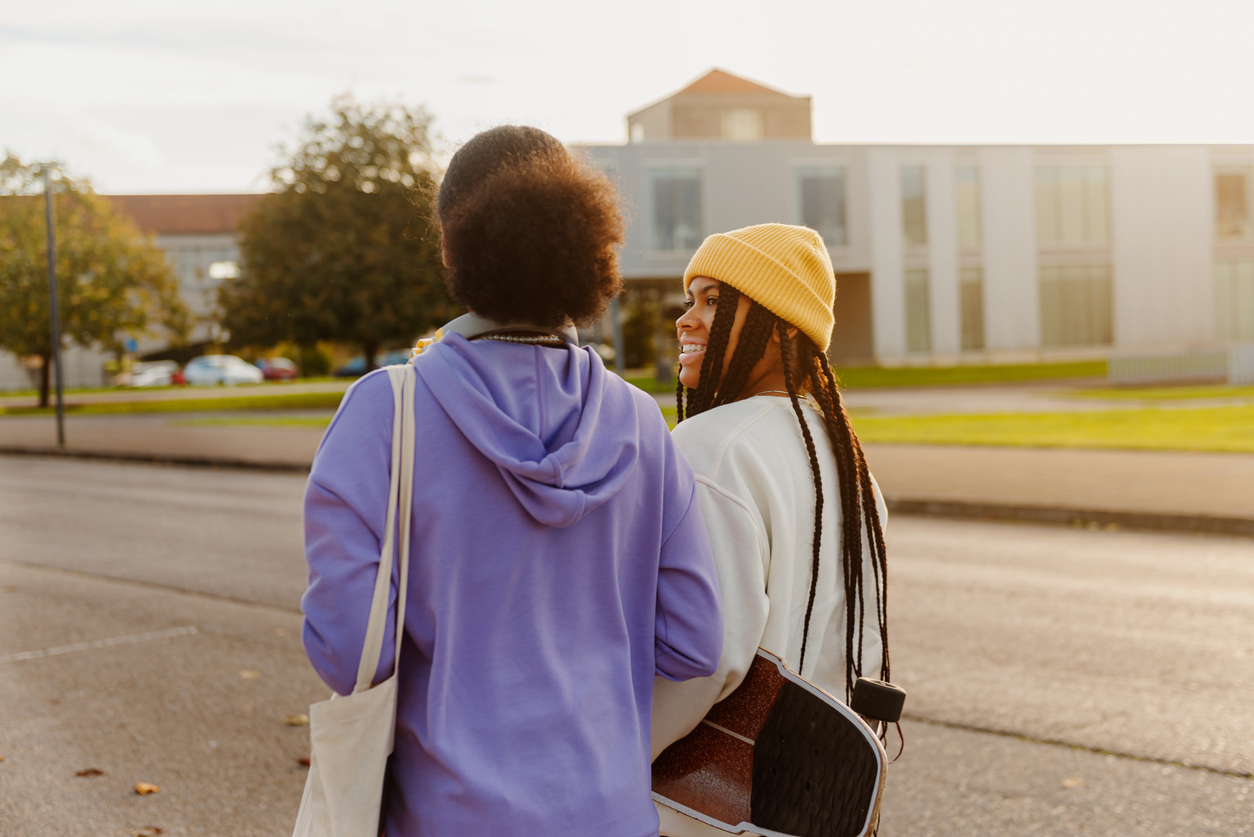
One Sunday a couple of members of the Multicultural Association (MCA) at my school were discussing interracial relationships. We started talking about one girl whose father was Australian and whose mother was Trinidadian. Someone said that this girl looked Hispanic. I disagreed. I said, “What does an Hispanic look like? I’m Hispanic.”
Looking at me, most people would assume that I am African-American, but I consider myself to be Panamanian. I was born in the United States, but both of my parents are from Panama. I speak English, but most of my relatives speak Spanish. In fact, when I visit my grandparents in Miami, their friends ask me, “Why don’t you speak Spanish?”
I lived in Panama for two years when I was younger and I was bilingual then. When I came back I didn’t use my Spanish and I lost it. My grandmother seems upset that I take French at school instead of Spanish. Even my mother gets annoyed at me sometimes because she thinks I’m not interested in her culture. Despite all that, I still think of myself as Latina.
Not All Hispanics Are Tan
At another one of those MCA meetings, we were discussing stereotypes-of people, their backgrounds, and what they are “supposed” to look like. Now, everyone knows that Black people are supposed to have a wide nose and big lips. So all eyes turned toward the one Black girl in the room with thin lips and a thin pointed nose. Everyone stared at this “specimen” who proved that the stereotype was false.
Then it was my turn to be the center of attention. Someone used me as an example to prove that not all Hispanics have a cafe con leche (tan) complexion. One girl said, “Look at Tyshawn, she’s Panamanian.” A “typical-looking” Puerto Rican guy said, “You are?” to me in a very surprised voice.
One of my good friends, Caroline, is of Puerto Rican descent. If someone saw her walking down the street, they would probably think she is Hispanic because her skin is tan. My skin is brown, so everyone automatically thinks I am Black. Most people don’t consider me Hispanic because I don’t look it or sound it.
Novelas and Frijoles Negros
Maybe if they came to my house they would feel differently. They would see that my family identifies with Latino culture. My mother speaks Spanish sometimes and she is addicted to the Spanish soap operas called “novelas.” Don’t call our house between 7 p.m. and 10:30 p.m., because she is busy watching her Spanish soaps. She also cooks Spanish food.
My great-grandmother moved to Panama from Jamaica, but you are more likely to find frijoles negros or arroz con pollo on our dinner table than beef patties or curried goat. The West Indian influence does come out sometimes-like when we make rice and beans with coconut milk and the beans already mixed into the rice.
This world has been molded in a way that you are not allowed to be both Black and Hispanic. You are either one or the other. Look at standardized tests. They ask you to categorize yourself as one type of person-Black, White, Asian, Mexican-American, Puerto Rican, or Other.
Even when I came to work at New Youth Connections I had to choose. There is a map in the office where all the staff writers must stick a pushpin to show where they live. The pins are color-coded by race and gender. Black females are silver and Hispanic females are green. I didn’t know which one I should use. Someone is always asking you to choose.
SIDEBAR: It’s Hard to Relate
Feeling comfortable at boarding school is especially hard for kids coming from city schools that were mostly Black and Hispanic. “There’s lots of whiteness” at boarding school, said Tesha Spann, a student at Miss Porter’s School in Connecticut. Wadiya Peterson, 16, of Suffield Academy in Connecticut, “never really dealt with White people other than on train rides to Manhattan” before going away to school and found it hard to adjust. Kendra Hill, 16, of MacDuffie School in Massachusetts, said being at a mostly White school “scared me. I didn’t know how to deal with them…what to do…what to say…at first I was pretty cautious.” Some students who never had much interaction with Whites have stereotypes about them. For example, Jose Gonzalez, 16, of Loomis Chaffee School in Connecticut, thought Caucasians were snobby. Tesha thought that no White people knew how to dance. Gevian Dargan, a recent graduate of Deerfield Academy in Massachusetts, thought that “you can’t trust White people.” But all three changed their minds after making friends with White students. “You start to like them,” Gevian said. He learned to “give White people a chance…look at people as people.” They Were Scared of Me Some minority students found that the White students wouldn’t give them a chance. Wadiya said that when she first got to Suffield, “everyone was scared of me. And because I was from the Bronx it made it all the worse…Everybody has the idea of what the Bronx is about. I guess they thought I was real mean.” Some city kids even find it hard to relate to other minority students at school-if they are from more affluent backgrounds. Marjorie Dumbreville, 17, a recent graduate of Phillips Andover Academy, was surprised to discover that some of her Black schoolmates were brought up expecting to attend fancy private schools. It sometimes seemed like they had more in common with the White students than with her. Because they have a hard time fitting in at predominately White, suburban schools, some minority students have started support groups for themselves. Wadiya said the Multicultural Association (MCA) at Suffield “was a group for minorities in the school to get together to share their difficulties.” She said the group gave her strength and made her realize she was not the only person having problems. Jose feels Prism, a similar organization at Loomis Chaffee, is a place where students can “bond, share culture…relax…feel free.” The African-Latino American Society (AFLATAM) at Andover is more of an activist group. Its members believe the contributions of Blacks and Latinos should be recognized by the school. The group staged a sit-in one year to protest the fact that there was no Martin Luther King Day celebration on campus. Teachers brought their classes over to support the group. Since then, AFLATAM has held anti-racism workshops and sponsored weekends devoted to Latino and Black arts.