
The thing I found hardest about leaving Senegal, in West Africa, was leaving much of my family behind. We lived in an extended family with my parents, my two brothers and four sisters, grandparents, aunts, uncles and cousins. Our big house in Dakar, Senegal’s capital, was where all our relatives stayed when they came to town.
I was closer to my family members than to my schoolmates. My older brother Moussa used to sit with me and talk. In Senegal, you’re not supposed to ask favors from people who are older than you, but Moussa was always kind, and if I needed anything from the grocery he’d go and buy it for me. He didn’t care that he was older than me.
My cousins were also my close friends. In the summer, we’d spend hours playing cards or games like hide and seek, or talking.
A Creole Classroom
I have a disease called rheumatoid arthritis and it was too expensive and difficult for me to be treated in Senegal. So in August 2001, I came to New York with my mother, father and little brother to get medical care. I was sad to be leaving the rest of my family. I knew that in the U.S., I’d be surrounded by people I didn’t know, and I’d never been close to anyone who wasn’t family. Plus, I didn’t know a word of English.
I spoke Fulani, my family language, Wolof, the dominant language in Dakar, and French, which I learned in school. So when I came to the U.S., when I was almost 14, I was put in an 8th grade ESL class at MS 246 in Brooklyn.
Everyone else in my class was Haitian. They spoke Creole (a language related to French, spoken in Haiti), which I found hard to follow. The teachers taught in Creole and English and sometimes they explained in French if I did not understand.
They Tried to Speak French With Me
Even though they spoke Creole rather than English, my classmates reminded me of students I’d seen in American movies like Sister Act, where the boys rapped and the girls put on their makeup in class. My classmates were wild like that, too.
When a teacher wasn’t there, they’d turn off the lights, start beating the tables to make music sounds and start dancing like fools. They’d fight or throw paper at each other. In Senegal, if students acted crazy like that, they’d get beaten.
But my Hatian-American classmates were also very nice people. Some of them tried to speak French with me even though they didn’t know how or they had forgotten. (Like Senegal, Haiti was once a French colony, so French is still taught in school.)
One boy was especially nice. I looked at him like my older brother Moussa. We had to put our chairs on our desks at the end of each day, and he would put mine up for me. We’d talk a lot in French even though he struggled with it.
I’m the Quiet One
The other students were also nice. They’d say that I was the best because I didn’t talk a lot or argue with anyone. I felt great being the quiet one because all the teachers appreciated my behavior. I didn’t give them a hard time like the other students did.
Even in Senegal, the teachers liked me because I was “the quiet one.” I didn’t make a lot of friends there, and I didn’t want to, because I had my family and I thought that other kids were too noisy. All my life, people have asked me why I’m so quiet. I tell them that it’s just the way I am.
As the months passed, I felt more comfortable being around my Haitian-American classmates. I became friends with them, though we didn’t become close, and I started understanding Creole.
My father had gone back to Senegal, and about four months after I started school my mother went back too, with my little brother, to take care of the rest of the family. I was feeling a little overwhelmed about it, and lonely without all my family around me. But three of my sisters had come to look out for me and start a life in New York, so I was happy about that.
‘Do You Speak Wolof?’
Then one day, about six months after I started school, I was sitting with my Haitian friends in the cafeteria. As usual they were talking in Creole and I was sitting quietly and eating when someone started calling me. She was a little taller than me, wearing a red shirt that said “Angel” and black pants.
“Me?” I pointed at myself. She nodded, so I went over to her.
“Where are you from?” she asked me.
“I am from Senegal,” I answered.
“What’s your name?” she asked. I told her my name and she said, “Do you speak Wolof?” I said yes. She was surprised and started smiling. Then she told me her name was Awa.
She said hi in Wolof and started talking a lot. I could tell that she was happy to meet me, and I was also happy to finally meet someone at school who could speak the same language as me. She was in another ESL class.
Maybe she’d called me over because we Africans can tell who’s African and who’s not just by looking at them. I don’t know how someone stands out as African but 90% of the time I can tell. And maybe Awa was like me.
Except that she was so much more excitable than I was. When I told her I was 14, she exclaimed, “Oh, my god! I’m also 14! This is great!”
“Yes,” I said calmly.
She talked the whole lunch period and I just sat there answering her questions. She asked so many questions. “This girl talks too much,” I thought.
Too Many Questions!
I was feeling happy because she was from Senegal but I don’t like when people ask too many questions, and I’d just met her. I can tolerate two or three questions but not a bunch of them, especially when I don’t know the person really well. It makes me think that the person is nosy.
“Why are you so quiet?” she asked. “You’re probably saying in your mind that I talk too much!”
I was surprised when she said this because she was right. And I realized that she knew she talked too much. It made me feel less annoyed and a little embarrassed. “No, no,” I said. “That’s the way I am. I don’t talk a lot. I’m very shy.”
“Oh, I just thought that I was bugging you.”
“What you talking about? I’m very happy. It’s just the way I am and if you want to be my friend you’re gonna have to get used to it.” Then we both laughed.
couldn’t Wait to Tell My Sisters
Five minutes later, the bell rang and the lunch period ended. While running to get to class, she shouted in Wolof, “Nanga ma seet suba, denga?”
Everybody turned and looked at her. They were probably wondering what she was saying, which was, “Look for me tomorrow, OK?”
As I ran to class I heard her voice in my head, “Look for me tomorrow, OK?” I was surprised and happy to meet someone from Senegal. I thought she was nice-and very talkative. I thought about her the whole day and couldn’t wait to get home and tell my sisters.
After that we looked for each other in school every day, and we ended up becoming good friends. I was happy to have a friend my age from the same country who spoke the same language.
We have different backgrounds: She’s Wolof and I’m Fulani, different West African ethnic groups with different languages. But that didn’t matter. The fact that she was from Senegal and we both spoke Wolof was good enough for me.
We Both Missed Our Mothers
Two weeks later, we were having lunch together and she was talking about her family and friends back home. When I asked her where her mother was, she said in Senegal.
“So is my mom,” I said.
Together we said, “We have so much in common!”
I was sad for both Awa and myself because our mothers were so far away. But I also felt a bond knowing that I was not the only one going through a hard time and missing my mother.
One day, when Awa came over to my apartment, I called my mother and we both spoke to her. My mom said she was happy that I had a friend, and that we should always support each other since we were in the same conditions.
My mom said that she wanted to meet Awa’s mother. So Awa gave my mom her mom’s number and my mom called her.
Two weeks later, my mom went and visited Awa’s mom in Thies, a two-hour drive from our house in Dakar. Now they’re friends. At first, all they talked about was us but now that they’re friends they have other things to talk about.
I Needed Her Excited Talking
Meeting Awa was so nice for both of us because we talked a lot about what was in our hearts and we gave each other advice about life, school and homesickness. We felt we were helpful to each other and that gave us courage to trust each other more.
At first, I thought Awa talked too much but as we became friends, I felt that hearing her speak so much was what I needed. When we had conversations she kept them going because I was kind of quiet and she was always excited. She was never unhappy on the outside, even though she may have been on the inside. Her excitement was great because it made me forget my sadness and be happier.
We had fun together, too. Sometimes her aunt would take us to the movies, and sometimes we’d go shopping together. We listened to music (mostly Senegalese) and danced like fools.
Here for Each Other
When we had to choose high schools, neither of us knew which schools to choose, and our counselor chose different schools for us. We weren’t happy about going to different schools but we knew that we’d see each other anyway.
Now though, we’re both busy and don’t see each other often. Mostly we talk on the phone, though whenever we have time we visit each other.
This past winter break, I went
over to Awa’s house. We were in the living room watching TV and I remembered that I needed to interview someone for my internship at New Youth Connections. “I have to interview someone and I don’t know who,” I said.
“don’t be silly!” she said. “Who else can you interview when I am here?”
It’s funny that when we met, I thought she asked too many questions and now I was the one asking her questions. And I felt really happy that she was there for me, and grateful to have her as a friend.
Like Part of My Family
Even though I have other friends in my school now who are from Guinea, Mali and other countries, my friendship with Awa is not comparable to any of those.
She was the first person I became close to outside my family, which was a new experience for me. I could talk to her about personal stuff that I wouldn’t talk about with my family members, and I got to hear new opinions from a different point of view from that of my family.
Having Awa as a close friend has made me feel less alone. With our moms being friends too, I feel like she’s almost a part of my extended family-some of us in Senegal, and some of us in the U.S.
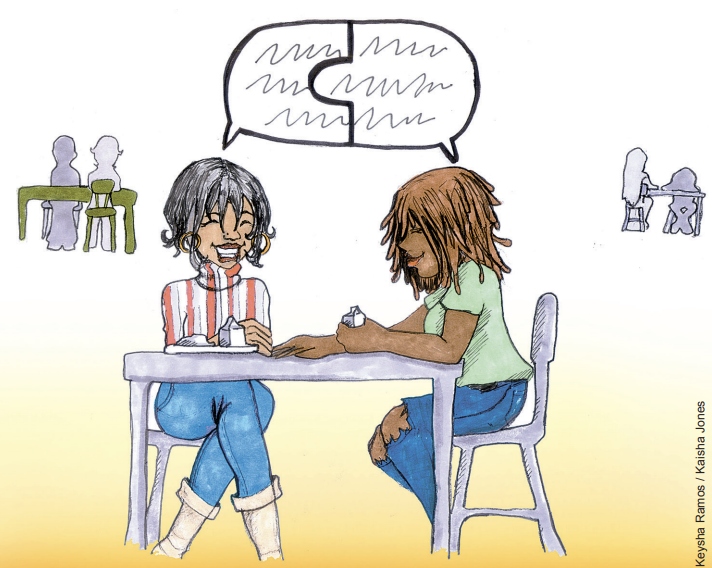
We Speak the Same Language
My friend and I share more than our homeland
About These Stories
YC runs intensive nonfiction writing programs for teens in New York City, where they’re mentored by a professional editor to write personal stories about their lives and about issues that affect young people. Their stories are then published and read by thousands of teens, educators, policymakers, and other adults who work with and for young people.