
There are over a million Jews currently living in New York City and their culture touches all of us. Whether we’re Jewish or not, every day we shop in Jewish stores and eat Jewish foods like kosher hot dogs and bagels. We get off from school for things like “Rosh Hashanah” and “Yom Kippur.”
But do we know what those holidays stand for? What is that weird looking candlestick that you always see in December? Do all Jewish men have beards? Are they all rich and stuck up like some people say? I’m going to try to answer some of these questions for you.
Even though most Jews in New York seem to have it pretty good these days, they didn’t always. Jews have had a very rough history. Most of New York’s Jews are descended from people fleeing oppression and massacres in places like Germany, Poland and Czarist Russia.
For thousands of years the Jews were oppressed and enslaved. The Passover holiday (celebrated in the spring) marks their escape from over two centuries of slavery in Egypt. (You remember, the story about Moses parting the Red Sea.) On this day the Jews eat matzo instead of bread. Matzo looks like a big cracker and commemorates the way the Jews had to get out of Egypt so quickly that the bread didn’t have time to rise.
Even when they weren’t slaves anymore, Jews were still persecuted. The word “ghetto” actually comes from the walled-in neighborhoods where Jews in European cities were forced to live during the Middle Ages.
It Just Isn’t Kosher
As one way of humiliating the Jews, their oppressors often tried to force them to do things that were against the laws of their religion, like eating pig meat. There were many martyrs who wouldn’t do it and were killed for their resistance.
Eating pig meat, like bacon, ham, or sausage, is definitely not kosher. Do you know what “kosher” means? In order for a food to be called kosher, it must receive a special blessing from a rabbi. Before that can happen, it has to meet certain requirements. It cannot contain pork, for instance, or mix milk and meat. You probably eat kosher foods or drink kosher drinks all the time without even knowing it.
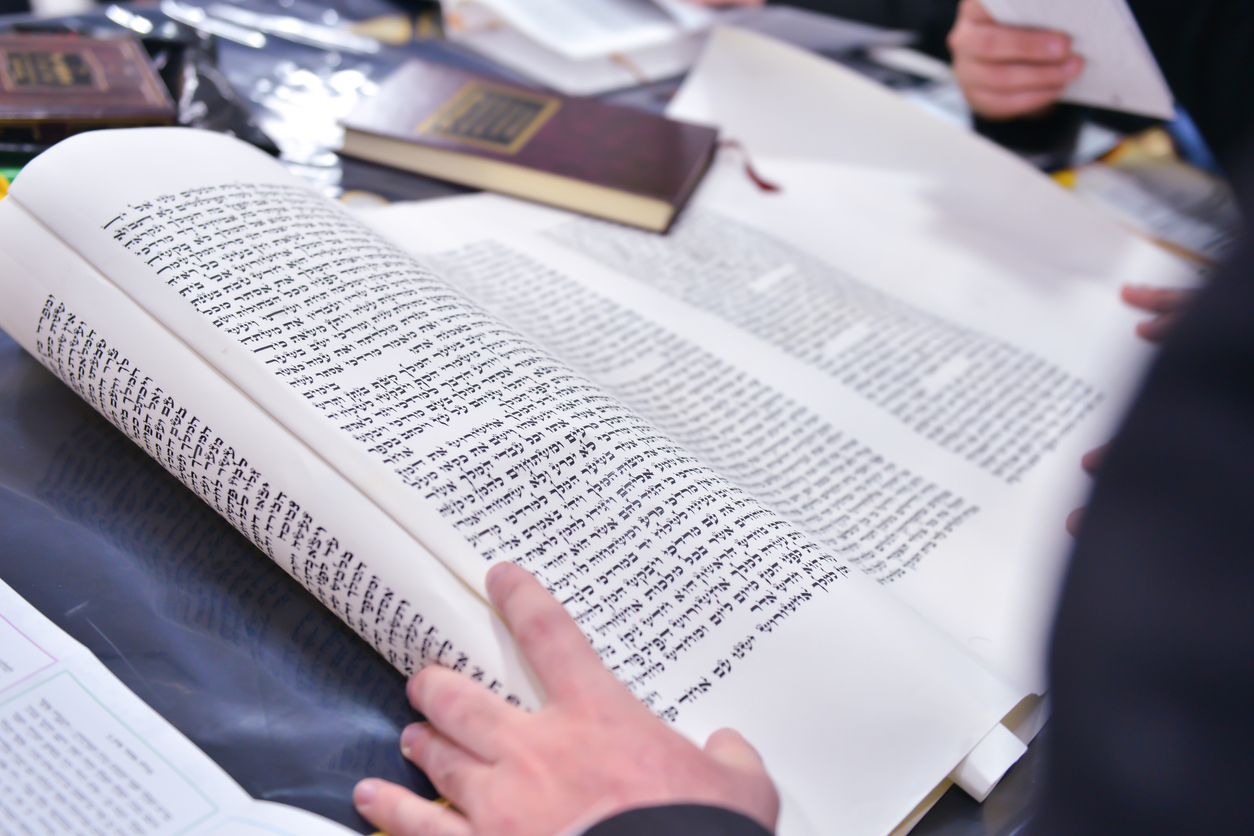
The Jewish religion has a whole set of laws. These laws are stated in the Torah. The Torah is a scroll which contains the terms of Moses’ covenant (agreement) with God.
But not all Jews obey the same laws. The Hasidim (the Jews always wearing black and white, with hats and long beards) interpret the Torah very literally, kind of like some fundamentalist Christians. There are many other types of Jews-Reformed, Conservative, Orthodox, and several other sects just like in Islam or Christianity. Some are more religious than others. Some have different beliefs altogether.
Hasidic Men allow their hair and beards to grow long because the Torah states, “You shall not round the corners of your head,” and, “You shall not…destroy the corners of your beard.” Another law forbids tattooing and other forms of self-mutilation. Technically, you can’t be buried in a Jewish cemetery if you have a tattoo.
The Jewish New Year
Like the Chinese, Jews have their own calendar. 1991 is really 1991 years after the birth of Christ. But since Jews don’t recognize Christ as the Messiah, this year is 5751 on their calendar. Rosh Hashanah, Hebrew for the “head of the year,” is the first day of the Jewish new year.
Ten days after Rosh Hashanah comes Yom Kippur, the Day of Atonement. It is observed by fasting (not eating) for 24 hours from sundown to sundown. It is also observed by the most solemn religious service of the year. The service includes prayers asking forgiveness for sins and for God’s guidance in righteous living for the year ahead.
Slavery, Ghettos, Homelessness, Massacres, Holocausts, Rosh Hashanah, Yom â
About These Stories
YC runs intensive nonfiction writing programs for teens in New York City, where they’re mentored by a professional editor to write personal stories about their lives and about issues that affect young people. Their stories are then published and read by thousands of teens, educators, policymakers, and other adults who work with and for young people.