
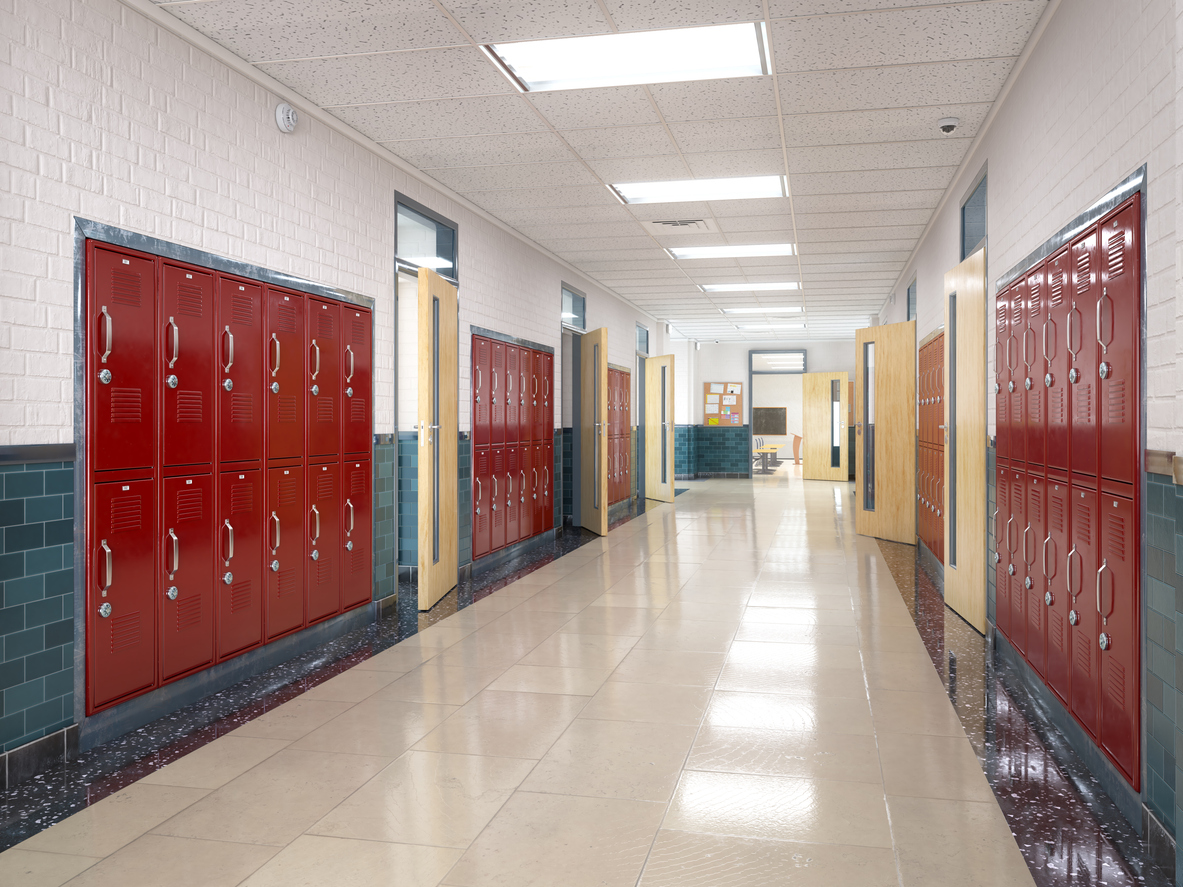
During junior high school I went to the New York Institute for Special Education, a school for the blind and visually impaired in the Bronx. It wasn’t quite like a regular school. As a blind person I had practically everything I needed: Braille writers, talking computers, Braille books…I was able to run errands for teachers, and help other kids get around school and understand their work.
At one point I even had the option of taking some “mainstream” classes across the street at Columbus HS.
But there were many things about the Institute that I didn’t like. A lot of the students had other problems besides being visually impaired or totally blind. Some of them were off in their own worlds and used to talk to themselves, laugh out loud, mimic other people or jump up and down and rock back and forth. (These weird habits are sometimes referred to as blindisms.)
And that wasn’t all. Teachers and staff had to follow you around or know exactly where you were at all times. I hated that. I also hated having to get picked up by a school bus at 6:40 every morning. It was an hour and a half each way between my house in Brooklyn and the Institute so there was no way I could hang out after school. If I wanted to go around my own neighborhood, I had to go with my father, mother, or sister.
“What kind of teenage life is this?” I thought. I felt like only half a person.
Cut Off From My Friends
I felt cut off from my friends from elementary school. I’d see some of them at the Lighthouse for the Blind on Saturdays. These were kids with little or no vision who were going to public school and taking mainstream classes.
My friend Billy was going to Edward R. Murrow HS. “You should come to Murrow, man. It’s cool,” he said. He talked about the girls there and the resource room where visually limited kids could go to have their work enlarged, put in Braille, or read out loud to them. Billy was making it in the real world and I wanted that for myself.
Another friend of mine, Mike, told me about the Christmas parties they had. It sounded like if I went to that school I’d have everything I ever wanted: girls, friends, parties, popularity, and people to help me with my print work.
One day after going to the Lighthouse I approached my mother about it. I told her I wanted to go to Murrow. I told her Billy went there along with other kids who were totally blind. “I want to broaden my social life,” I said. “And my grades are good so I know I can do good in a mainstream class.” The next day we took a bus ride just to see how far Murrow was from my house.
A New Life
After that I arranged a visit. When I got there, there were a million kids in the hallway. I went upstairs and met Mrs. Simon, the resource room teacher, and saw some of my old friends. Mrs. Simon asked my friend Chris to show me around. I’d never seen such a big school all in one building or met so many nice people. “You get around this big school without getting lost?” I asked Chris.
He just laughed and said, “You’ll get it down in no time.”
In one of the hallways I met a kid named Ricky who was totally blind. He had a guide dog and a lot of girls around him. “Just imagine that being me,” I thought.
For the first week or so, my mother brought me to school. Then I started taking a school bus. Because I already knew so many people, had a resource room where I could get extra help, and was taking special ed. classes at first, the change from the Institute to Murrow wasn’t too drastic.
In the resource room I had people dictate class notes, math problems, or whatever else I couldn’t read on my own. The teachers assigned kids to take me from class to class and if a kid couldn’t take me, the teacher or a paraprofessional would do it themselves.
My friend Chris helped me get acclimated to the school. My first year we were in the school production of The King and I together. Chris (who has a little vision) helped me get around the stage and interact with the rest of the cast. Chris was very sociable and knowing there was another person with limited vision getting along with the rest of the kids helped bring me out of my shell. It turned out to be a great experience.
Bye, Bye Special Ed
As time progressed I started to take mainstream classes. The first one I remember setting foot into was Spanish. I had taken a little Spanish at the Institute and wanted to see how I’d do so Mrs. Simon asked the teacher to let me sit in on the class. The work moved at a much faster pace than the special ed. classes I was taking. The kids didn’t stop the teacher quite as often either. They also behaved a little better.
The teacher gave us a list of new words. She’d say the word and then the whole class would repeat it. I could pretty much follow that. But when she started to give out handouts I really felt isolated. I took the handouts anyway and went over them later with someone in my resource room. A lot of the low vision kids had to do that or ask one of the kids next to them for help.
While I was working towards becoming mainstreamed, I also took “mobility training.” We made a tactual map (a raised map you can feel with your fingertips) of the school and I learned how the hallways and classrooms were set up numerically. I also found my way around using landmarks like cracks on the floor, pillars, and garbage cans.
Cleared To Travel
I worked on the bus trip to and from the school with Cindy, my mobility teacher. We practiced getting to the bus stop, then taking the bus home, and after that on the trip to school. It took a lot of work but on the morning that she told me I was finally “cleared” to travel by myself it was almost like getting a license to drive. That’s how free I felt. It was a big accomplishment.
But mainstreaming isn’t something that happens overnight and then you’re done. You have to work at it. The bus I had to take didn’t run very often and sometimes it would rush right past me without stopping. After a while I made friends with some of the drivers, though, and they would know to stop for me. One driver knew me so well that when I wasn’t on his bus in the morning the next day he’d ask me, “Playing hooky again, huh?”
Even after I worked my way out of special ed. and was taking regular classes with sighted kids, I still had obstacles to overcome. During one cycle I had gym class on the 4th floor. To get there you had to go through two different gyms and up a flight of stairs. After I changed out of my gym clothes I never had enough time to get to math class. The teacher told me he didn’t mind my being late but I felt uncomfortable about it. It made me appear disabled.
Risk Taking Skills
Without consulting my resource room teacher I went straight to my guidance counselor and requested a schedule change. When Mrs. Simon heard about it she was upset. She felt I was going over her head-and getting in over mine. She said the class I had requested had a teacher who once had a bad experience with a blind student and she was concerned about that. I took the class anyway and got an “excellent.”
With every success story there is a little hardship, however. People still shy away from me because I’m visually impaired. Sometimes instead of saying “Hi, Slade” they say, “Watch that stick.” Others feel embarrassed if I ask them to read something to me softly.
Going into a mainstream program was a big and scary decision but I’m still glad I made it. Life at the Institute was too sheltered. At Murrow I learned that I can’t always have a Braille book handed to me at the same time the print users get theirs. I learned that there is life outside the blind world and if I want to be a part of it, I have to go out and take some risks.
View the lessons based on this story
- Take a Risk Upgrade Unit 1 | Session 5