
I was an evil child.
By the time I was 8, I was playing hooky from school, pretending to be sick. I’d act all good and nice in front of the teachers, and all the time I’d be cheating on their tests.
I’d steal money from my mother’s change jar and from the cash box at the restaurant where I helped out sometimes. Then I’d go and play video games at a small arcade around my block and eat Wendy’s hamburgers and lemonheads. I’d lie to my mother about where I’d been. I’d say nasty, disrespectful things to women on the street. For a little while I was even part of a gang of about 10 kids who would beat up on the smaller kids in the boys’ room and in the yard. For 8 to 10-year-olds, we were pretty brutal.
Then, one day, my mother told me she wanted me to take classes at the karate school where she worked at the front desk. She wanted to keep an eye on me after school, and I didn’t mind the idea. My sister had been taking karate for about two months, and she loved it. Besides, I figured once I learned karate I could beat the hell out of anybody.
The Dojo
The school, or dojo, as it was called, was on the top floor of a three-story building over a movie theater and a restaurant. It had two locker rooms, an office for the master, a small workout area with weights and a punching bag, and a practice area about the size of two large classrooms.
On my first day they gave me a uniform and showed me to the locker room. I was nervous about meeting new people but tried to act nonchalant rather than let myself get so nervous that I threw up in front of everybody. By 3:30 or 4 p.m., there were 10 or 15 students in place and the class was ready to begin.
The master, a tall Black man named Shihan William Oliver, came out onto the floor and everybody snapped to attention. He had the kind of commanding presence that made you believe he could either mold you into a master yourself, or shatter you like glass.
He told everyone to stretch out while he and Laura, a student who had been there awhile, took all the newcomers aside and showed us how to fix our uniforms and tie our belts. We did sit-ups, jumping jacks, various stretching exercises and push-ups.
Learning the Moves
When we got to the push-ups, I wasn’t doing them right so the master put his foot on my back and added more pressure. When I wasn’t fast enough, he stood over me, grabbed my belt and lifted me up and down until I got the rhythm of it. At the time, he scared the hell out of me.
After we were all limbered up, he taught us different combinations of kicks and punches. First he demonstrated and then he let us practice on our own while he went around and showed us what we were doing wrong.
After that first class I didn’t want to go back. But while I was waiting for my mom to finish work, I got to see one of the advanced classes in action. It was exciting. I really wanted to be able to do what they were doing.
I started going to the dojo four times a week, staying anywhere from two to six hours. After my class was over, I’d watch another one or stretch in the little workout area. At times, I would even join one of the adult classes.
The Master Became My Idol
In the beginning, I felt like I had to draw attention to myself. I’d talk whenever the master’s back was turned. But after awhile, even though I should have hated him, I started to grow attached to him. I admired his strength and vigor. When everyone was collapsing around him he kept right on going.
My teacher at school was only nice to certain people. If you didn’t follow her rules to perfection, you would get kicked out. Unlike her, the master was patient and treated everyone fairly. I couldn’t help but be proud of the fact that he was my teacher.
Sometimes I would go to his office to help clean up or work on the computer, or I would just sit and talk to him about all kinds of stuff. Once there was a birthday party for him and I got to sit next to him and help him open his gifts. It may not sound like much but, for an 8-year-old, helping the man you idolize is like a dream come true.
At the dojo, I learned respect for people and objects. Whenever we entered we had to yell out “OSU!” and remove our shoes before setting foot in the practice area. We had to bow to the master, to each other, and to the ornaments that adorned the walls and the altar that stood in the middle of the practice area.
A New Me
Even though I didn’t notice it myself, my family could tell I was changing. Before, I would come home from school, lock myself in my room, and tell everyone to leave me alone. Now I was helping my mom with the grocery shopping and cleaning up my room. I’d help my sister with her math homework, and started doing my own homework more often. My grades went from “U’s” for “unsatisfactory” to “E’s” for “excellent.” I still played hooky, however. Karate may have changed my perspective on life but it didn’t change how I felt about school.
In karate, we also learned how to slow down and reflect on our lives through meditation. At the end of the day, the master would put on really strange music and we would kneel and close our eyes and cup our hands. The object was to concentrate our minds on our own actions and the higher truths of our lives. In the beginning, I would open my eyes and try to talk, but later on I went along with it. I learned how to relax my mind and reflect on what I had learned that day both at the dojo and in school.
Courage, Honor, Respect
I went through most of my life preoccupied-my mind would wander continuously. But thanks to meditation I became able to focus on one thing at a time and stick to it. Once while I was meditating, there was a lightning storm outside. Even though I was afraid of lightning, I felt so safe and secure at the dojo that it didn’t bother me at all. After that, I wasn’t afraid of lightning anymore (except when there was a lot of it).
Honor was another thing I learned at the dojo. We were taught never to give up: even if we couldn’t manage something, we learned to try our best and not just lay around getting frustrated about it. Once I had to do a book report and instead of getting mad about it like I would have before, I stayed up really late finishing the book and the report.
We also learned never to beat up on someone younger or smaller then we were. In karate, I made a lot of new friends I didn’t have to prove myself to. I just had to be me. A couple of weeks after starting karate, my old gang was planning to beat up on some boys who were about two years younger than us just because they looked at this guy the wrong way. I refused to go along with it, which was a first in our little group. It turned out that a lot of people agreed with me and they walked away too. Even though I later had to defend myself against two other gang members who wanted to fight those kids, I felt better about myself than I ever had before.
The Stress of Competition
Every time I learned and perfected a new combination, or passed the test to reach the next level in rank, which was really hard to do, I felt more confident. At my first competition, I had to show how much better I did a certain combination than my opponent from another karate school. I also had to break boards. I won a medal for that competition and I was really proud. I felt a tremendous sense of accomplishment because in a competition you had to make use of everything you had learned throughout your entire time at the dojo.
Unfortunately, I had never been able to handle stressful situations very well, and that was the reason why I stopped doing karate. Before a competition I’d get so nervous that I would get really sick or, even worse, cry. In my third year we went to a competition and when there were only three people left- my friend Louis, another boy, and me-I caved in to the pressure and let the other guy win even though I should have been able to beat him. After that I never went back to the dojo and I had nothing more to do with anyone or anything connected to karate.
I Just Stopped Going
Even now, six years later, I still regret leaving, and not just leaving but the way I left. I never actually resigned, I just never went back. Like a coward, I never had the courage to stand up and face my instructor who I idolized so much. I never found out how he felt about it. To this day, I wonder if I should go back and say my goodbyes the right way. Or should I just let it be?
Karate taught me a lot of things besides how to beat the hell out of people. It taught me the meaning of respect, honor, discipline, and friendship. But most of all it taught me that if there’s something you haven’t done that you regret, you might as well go out and take care of it because until you do you’ll never be rid of it.
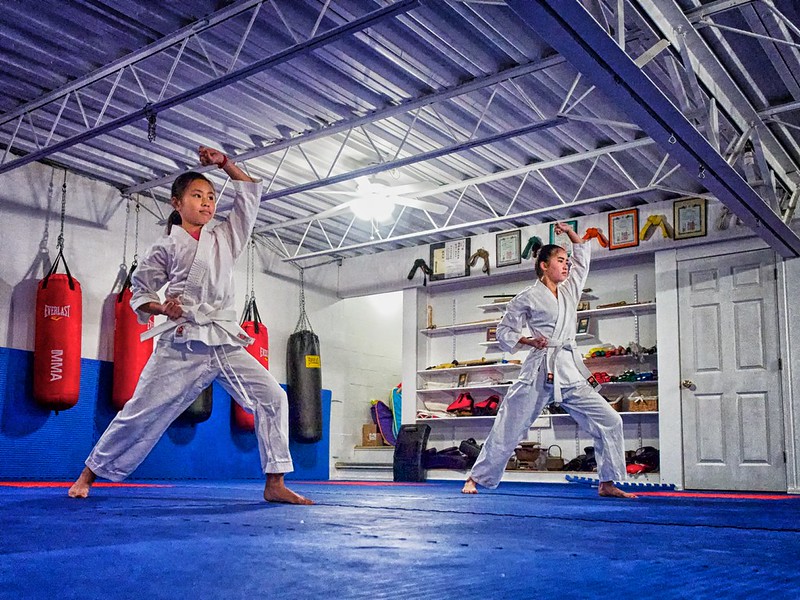
Karate Turned Me Around
About These Stories
YC runs intensive nonfiction writing programs for teens in New York City, where they’re mentored by a professional editor to write personal stories about their lives and about issues that affect young people. Their stories are then published and read by thousands of teens, educators, policymakers, and other adults who work with and for young people.