
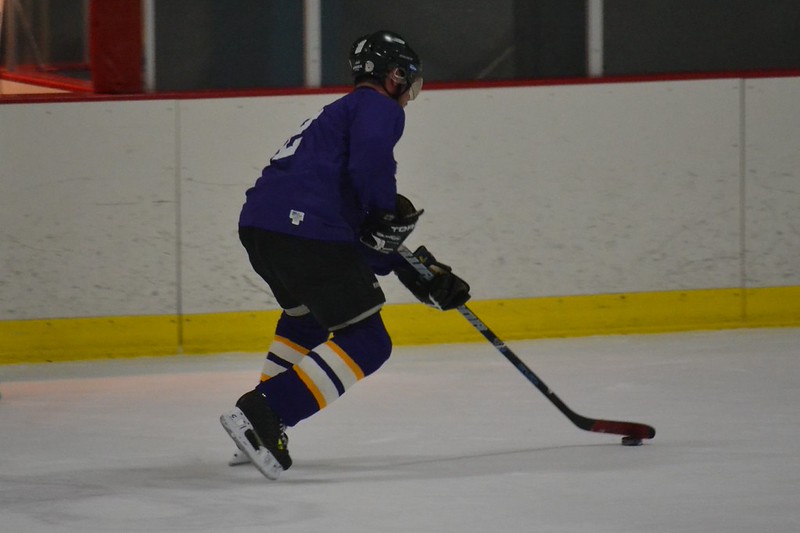
“Play the man,” you say to yourself, as the opposing player comes streaking into your zone. He tries twisting and turning to get past you so he’ll have a clear path to the net. As you think about what to do next, the relatively calm one-on-one becomes a two-on-one when the other team’s second forward skates into the play.
“Play the man without the puck, and let the goalie make the save” is the mantra you keep repeating in your mind as you notice a bad situation becoming worse.
Skating backwards as fast as you can to stay in front of your goalie, you challenge the opposing forwards, but in vain. All it takes is for one of them to make a quick, accurate pass to his teammate’s stick and it’s over. Before you know it, you’re lying flat on your face and the puck flies past your distracted goalie, ending up in your net.
Welcome to the exciting, fast-paced world of hockey.
When most non-fans think of hockey, they picture toothless goons with unpronounceable 12-letter names beating each other into a bloody mess. But this negative stereotype doesn’t tell the whole story. Hockey is actually a sport which combines skill and grace with physical and mental toughness. And you don’t have to be Russian or French-Canadian to enjoy watching and playing this amazing game.
Soccer on Ice?
Hockey originated in Canada in the 1800s. It was created by soccer players who wanted to be able to play something similar during the cold Canadian winters. Early games were played on frozen ponds with the skaters using canes as sticks and wearing colored sweaters instead of jerseys. As the game grew more popular, it moved into indoor arenas and professional teams were organized.
The sport started to catch on in the United States when some Canadians began settling in cities like New York, Boston, Chicago and Detroit. Interest grew strong enough so that, in 1917, the National Hockey League was formed.
There are 26 teams playing in the league today, with four in the New York/New Jersey area (the New York Rangers and Islanders, the New Jersey Devils, and the Buffalo Sabres. The Rangers, formed in 1926, is the oldest of the local teams).
Unlike football, which follows a series of complicated set plays, hockey is relatively simple. On the ice, each team has six players: three forwards, two defensemen, and a goalie.
Pucks, Penalties, and Power Plays
The role of the three forwards-the center and two wingers-is to score, while the defensemen protect their end of the ice (also known as the defensive zone). The goalie stands in front of the net trying to prevent the other team from scoring.
A team scores a goal when they shoot the puck into their opponent’s net-not an easy task, since it’s tough to skate around three opposing players who are trying to stop you by any means necessary!
If you trip, hold, or slash at anybody with your stick, you are sent to the penalty box, while the opposing team gets what is called a power play. That means your team plays without you for the duration of the penalty. Since your team is one player short during this period, the other team has a better chance of scoring. Often, games and even championships can be decided by a goal scored on a power play.
More serious penalties, like fighting or drawing blood, are called majors and are punishable by expulsion for the remainder of the game.
High Speed Action and Lots of Hitting
Because of its high speed action, hockey has millions of fans throughout North America and Europe. What attracts many to the game are the scoring methods and defensive maneuvers of such greats as Mark Messier, Mario Lemieux, Wayne Gretzky and Brian Leetch. And for the more aggressive among us, pro hockey has lots of hitting and crashing. Hockey is also the only sport in which player substitutions occur with the game in progress, eliminating the need for frequent time-outs during the more suspenseful parts of a close game.
Although the local pro teams have had great followings for years, playing hockey has not been very popular among New York City youth. One reason might be the fact that the overwhelming majority of hockey players we see on TV are White. There haven’t been a lot of role models for Black, Latino, and Asian kids interested in the game. But this has begun to change slowly. Now, more minority players are starting to push their way into the ranks of pro hockey-for example, Grant Fuhr of the St. Louis Blues is Black, while Jim Paek of the Ottawa Senators is Korean.
Then There’s Roller Hockey
Another reason might be that there aren’t a lot of places to play. There are basketball hoops in every park and playground, but how many rinks are there in New York City where young hockey fans can go to play on ice?
Luckily you don’t always need ice to play hockey. Although the game originated on ice, roller hockey-with the conventional two wheels on each side type of skate-has been around for years, with most of the rules and tactics being the same as for ice hockey. And now, with the recent inline skate revolution, many people on Rollerblades are experiencing the game in playgrounds and parks.
There are also after-school programs such as Hockey in Harlem which help kids with their wristshots as well as their homework. And the new Chelsea Piers Sports Complex, near 23rd Street on the west side of Manhattan, has leagues for both ice and roller hockey.
Keep Your Head Up and Your Stick Down
To get started on your way to neighborhood hockey glory, all you need are skates and a stick. Gloves are also advised, since they give you better control of your stick as well as protection for your hands. As you move up in skill and start to compete more, you may want to get a helmet, mask, shinguards, and other protective gear.
When starting out, players usually concentrate on their shot. However, it is better to perfect the skating first, and then work on the other skills involved. I have seen players who shoot well and believe they’re the second coming of Wayne Gretzky, who never manage to score. Why? Because they’re never in a position to do so due to their inability to skate properly. Keep this in mind when you play for the first time.
Hockey is an exciting sport where anything can happen. It’s a game that can be played by young and old, small or big, guy or girl. So keep your head up (very important), your stick down (likewise), give your best effort and enjoy! See ya in the face-off circle.
SIDEBAR: Ice Dreams
Ever since I was 9 years old, I’ve loved hockey. I became a fan by watching the Rangers, Islanders and Devils on cable TV. Other sports were either too slow or too boring for me, and fast players like Paul Coffey (who has played for the Edmonton Oilers, Pittsburgh Penguins, Los Angeles Kings and Detroit Red Wings) and the Islanders’ Mike Bossy would bring me out of my seat when they would streak towards the enemy net, perform an amazing 360 degree spin and slam the puck in, scoring the overtime goal. To me, NHL hockey is a sport played by the most elite skaters and puckhandlers in the world. During my youth, I would often dream of being on the ice. Alas, equipment in those days was expensive and difficult to find in local sporting goods stores. At one point, I believed that you had to go to the farthest reaches of Canada to find decent gear. “And besides,” my friends would say, “you’re too small and too American anyway.”
My Chance to Play
Granted, I may be too small and inexperienced for a shot at the professional ranks, but I knew that I could one day be the envy of my peers at the local rink. Last summer, the day finally arrived when I was able to participate in my favorite sport-although not on ice. I started by playing roller hockey in a local park. Hockey’s recent rise in popularity (due to the airing of more games on television, increased merchandising, rap stars wearing jerseys, etc.) has led to wider availability of affordably-priced gear. I got suited up and headed for Tompkins Square Park in the East Village where regular players meet on Saturday afternoons for pick-up games. Thanks to the recent opening of the Chelsea Piers Sports Complex, I have also been able to improve my game on the ice. I go there frequently to practice ice skating and learn other basic skills by watching and talking to some of the more experienced players who participate in leagues there.
Rookie Mediocrity
I’m not all that great-yet! The first game I played in Tompkins Square left much to be desired-I tired out early and my team was defeated several times- but it was a thrilling learning experience nonetheless. The first thing I found out was that it’s not as easy as it looks when the pros play. I discovered this the hard way when the ball (a puck doesn’t slide very well on cement) rolled toward me and everyone was watching to see what I would do next. Panicking, I dumped the ball all the way down the court. This led to the other team grabbing it (which is known as a turnover) and scoring. After that disappointing turn of events, some of the older players gave me pointers on how to pass. But my rookie mediocrity did not end there. I ended up being knocked down hard by some sweaty gorilla-sized defenseman that I was trying to skate around. It was then that I, the great one that my teammates looked toward to provide offense, was humbled. Despite all that, I was having the time of my life, playing the game I love.
I Shoot, I Score
Things got better the second time I played. I didn’t fall (as much), and I was making more intelligent decisions, like watching the plays develop and passing at the correct moments. I even got a point on the goal that was scored by my team to win the game. Not bad, considering the fact that I was still covered with the bruises I got during the last game. I’ve learned that constant practice does make for better play (although I still can’t seem to get past that gorilla on skates I play against). With further work, I would like to play in the league at Chelsea Piers, which holds clinics and tryouts for anyone interested in joining. Then maybe I can finally realize my dreams of glory!
Watch That Puck
One complaint by many who don’t like hockey is that they can’t keep track of the puck. It’s a fair point; after all, it is difficult to see that little round disk on your average-sized television screen, especially during very fast games. It often seems the puck gets to the other end of the ice in the blink of an eye! However, Fox TV has developed a new way to televise games that makes it easier for us to follow the puck. The system is known as FoxTrax. The concept is very basic: the puck glows blue when it moves around the ice, allowing the average hockey fan to follow it even when it enters hard-to-see places like the corners. Whenever a player takes a really hard shot (commonly referred to as a slapshot), the puck glows red with a “comet tail.” The effect is like a video game laser beam or a rocket taking off. Meanwhile, a radar gun reading of the puck’s speed in miles-per-hour appears on the corner of the screen.
Emitters, Sensors, and Computers
The system is very high tech. Built into the puck are infra-red emitters which allow sensors hanging over the ice to pick up its speed and angle of movement. The signal then gets processed in a computer located in a van parked outside the arena. The computer adds all the graphics and sounds that are seen and heard on your television set. The system is in limited use and is exclusive to the Fox network (which plans on using the puck only for special games and championships). But other networks are working on similar systems. FoxTrax, which was successfully used in the January 21st All-Star Game, has one disadvantage: because the technology is so expensive, a fan who catches a puck that has flown into the stands has to give it back. After security reclaims the puck, they offer the audience member a standard rubber puck or another souvenir of some sort. The innovations in hockey broadcasting aren’t stopping there. Helmet mounted cameras, goal net cameras, and enhanced low angle graphics are already in use or in various stages of development. The result? A game more pleasing to the eye.