
“We declare our race on this earth to be a man, to be a human being, to be respected as a human being, in this society, on this earth, in this day-which we intend to bring into existence by any means necessary.”
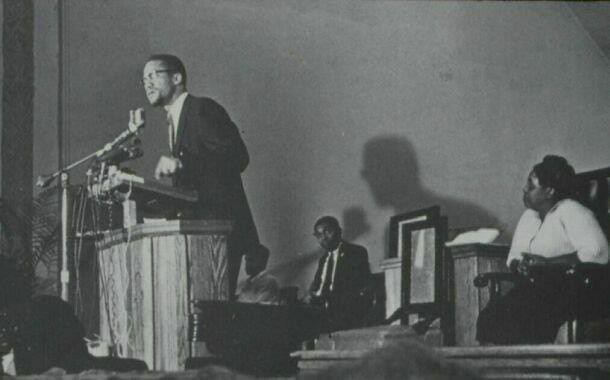
Perhaps the most daring and controversial four words the great civil rights leader Malcolm X ever spoke were “by any means necessary.” They brought fear to people in power, hope and resolution to the oppressed. But what was he really saying when he spoke those words? And how do teenagers understand those words today?
Some of the teens I spoke to take it in the extreme sense of stealing from the government or taking other people’s lives to get what you want. “If you have to kill the White man to get freedom, kill him,” said Weedy P., 19, of Long Island University when asked what the slogan meant to him.
But other people think that Malcolm was talking about more than that.
“Malcolm was really saying to educate yourself and fight back with the truth,” said Latisha Renee Burgos, 17, of St. Raymond Academy. “Use whatever you have to…but most of all use your intelligence first to solve any problems and if it’s [still] necessary to use force, then use it.”
Sizing Up the Situation
Malcolm X and other civil rights leaders used different means to get their point across. Desta Dennis, 16, of Christopher Columbus HS said that other means include non-violent protests, marches and boycotts. James Hardy, a freelance writer who has written about teen perceptions of Malcolm X, said that the means you use to fight for equal rights depends on the situation you’re in.
He gave the example of Thurgood Marshall, who argued the case of Brown v. Board of Education before the Supreme Court. He won that case, which made the Court declare racial segregation of public schools unconstitutional. He later became the first African-American Supreme Court justice. “Marshall saw that challenging racial segregation through the court system would be a catalyst to move the nation toward a more integrated one,” said Hardy. “All it takes is one person with a vision.”
Compared to someone like Marshall or Dr. Martin Luther King Jr., Malcolm X was more aggressive. “Malcolm was confrontational,” said Hardy. “He was up in White people’s faces.” Because of that and because, unlike King, he never ruled out the use of force, Malcolm has often been accused of advocating violence.
If you look at what he said overall, however, you see he wasn’t talking about killing anyone but about Black people defending themselves. “This doesn’t mean that we should buy rifles and go out and initiate attacks,” he said on a talk show in 1964. “But it does mean that we should do whatever is necessary to protect ourselves.”
Self Defense
Malcolm X didn’t believe in turning the other cheek or that we should just stand there and take it when we are beaten down. “It is the duty of every Afro-American to protect himself against mass murderers, bombers, lynchers, floggers, brutalizers and exploiters,” he told Ebony magazine. “If the government is unable or unwilling to protect us, we reserve our rights as citizens to defend ourselves by whatever means necessary.”
In a 1990 interview with New Youth Connections, Malcolm’s widow Dr. Betty Shabazz said that this wasn’t a violent statement. ” ‘By any means necessary’ means just that,” she said. “It could be education, it could be religious, could be political, it could be a number of things… you attempt to employ a variety of measures…[to] make sure that the outcome is successful…that’s mainly what Malcolm meant.”
It seems nobody can lay down a single definition for what “by any means necessary” really means. The phrase is very open and can be interpreted in many ways. The important thing to remember is that the man who said it did what he felt was necessary (which, by the way, didn’t include violence) to ensure that Blacks received equal rights in this society. For that, many of us consider Malcolm X a role model.
As Erica Rose, 19, of Borough of Manhattan Community College (BMCC), put it: “People who fight for what they believe in as passionately as he did are heroes.”
By Any Means Necessary
About These Stories
YC runs intensive nonfiction writing programs for teens in New York City, where they’re mentored by a professional editor to write personal stories about their lives and about issues that affect young people. Their stories are then published and read by thousands of teens, educators, policymakers, and other adults who work with and for young people.