
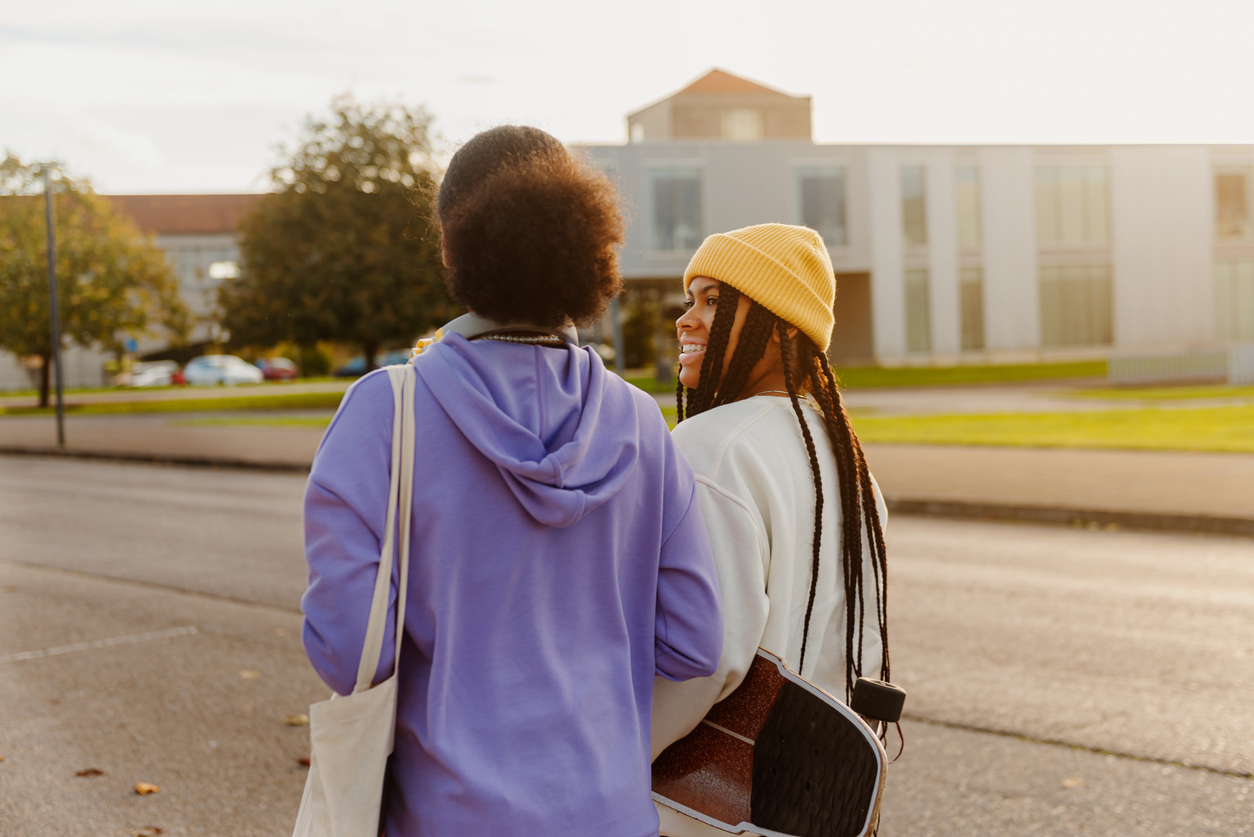
When we walk together on the streets of downtown Brooklyn, on our way to the stores or the icy shop, people look at us with curiosity. The reaction is stronger when she takes me to the hospital to get my allergy shots.
“Who are you here with?” the nurses asked me the first couple of times we went.
I pointed to the African-American lady about my father’s age, wearing baggy jeans, a hoodie, and a hat. I could see the surprise on the nurses’ faces. Then the lady and I started talking in Arabic and the nurses asked her, in shock: “You speak Arabic? Wow! Who taught you?”
Layla has been with me through the best and worst days of my life. She’s been a family friend since she worked with my dad at a store in Brooklyn 30 years ago. She’s always worked around Arabic-speaking people and over time, word by word, she’s learned pretty good Arabic from her co-workers.
But I consider Layla much more than a friend of my family. Though we have no genetic connection, I introduce her as my aunt. She calls me her favorite and “best friend.” To me she is a sister, a friend, and a second mother all rolled into one.
Mama Layla
I first met Layla when I was 5 and moved from Yemen to America with my family. (My dad had already lived in New York on and off for years at that time.) I was so young that I don’t recall the first time we met, so it’s like she has always been there. She and I used to go shopping together, visit the park, or go to get her hair braided.
Since she worked in my dad’s store at the time and his store is one block away from my home, I used to visit her at work almost every day. Our relationship grew until she was closer to me than she was to any of my other family members. I think part of what brought us together was that we both love to talk.
Layla began to look after me like a mom does. Because my mom doesn’t speak English, she was never involved in my life in New York outside the house. That’s where Mama Layla would come into action. Her arms were the ones to hold me tight when I ran out of class on my first day of school. Her soft hands were the ones wiping away my tears when I got chicken pox the day of my kindergarten graduation.
When I was 10, my family and I moved back to Yemen for four years. During that time I talked to Layla only twice and everything between us was silence, but her love didn’t die. When I returned in 2006, my eyes met hers and even though the rest of my face was covered with a headscarf, she knew that it was me. As she hugged me tightly a familiar feeling of warmth resurfaced. Even though I was almost her height by now, I felt like I was still a kid when I was in her arms.
My Confidante
By that time I was enrolled in high school, and had many stories of teenage drama to tell. You don’t really tell your mom everything, but with Mama Layla I knew that I wouldn’t get in trouble: She would appreciate stories about the funny jokes I heard in class, the trips I took, and the latest activities and arguments I’d been involved in at school.
Because she knows my culture well, and knows how different it is from American culture, Layla would sometimes tell me, “You’re really getting Americanized.” If my parents said this, it would feel like a judgment; I would feel as if I was doing something wrong. But coming from Layla, the statement always feels light. She understands what teens face in America because she grew up here; at the same time, she knows what I am like and trusts me.
I’m also able to tell her about arguments I have with my family. Since she knows my family well, she can read between the lines and know why we say certain things or have certain fights. Sometimes I have conflicts with my dad over things I want to do, and though everyone else takes my dad’s side because he’s in charge, Layla sides with me. For these reasons, I have become even closer to Layla since I returned to the U.S.
Telephone Conferences
We talk over the phone for hours and laugh out loud. Sometimes she doesn’t understand everything her Arabic-speaking co-workers are saying, so she calls me from work. “Orubba, stay quiet, I’m going to put it on speaker and you listen to what they’re saying and then tell me. OK?”
“OK,” I say. It’s funny because it’s like a top secret operation. I don’t usually get everything they say, but I translate what I can.
Other times we are more serious, and I’ll tell her about things that are bothering me. A few months ago I wanted to go to a performance with my friends. I told her I was afraid my dad wouldn’t let me go. She advised me to offer to let him come with me.
A couple of days later I called Layla and almost right away, she said, “He didn’t let you go, did he?” Maybe from my tone of voice, she guessed what was bothering me without me telling her. She tried to make me feel better, joking around and saying, “Next year, you have to think of a plan beforehand.” Even though I was still upset, talking to her made me smile.
Link Between Worlds
Whether we’re joking or not, I feel relaxed around Layla because she is like a link between my two worlds. When I’m around my family I watch my actions and what I say, because sometimes I’m afraid they’ll say disapprovingly that I have the ideas of an American girl. When I’m with friends who aren’t from my culture, I have to explain why I have to follow certain rules, like having a curfew before dark. They don’t always appreciate what it’s like to live with these rules.
But when I’m with Layla I feel free to say whatever I want. She knows what I’m allowed and not allowed to do. She knows that I no longer think the same way my family does-that I have mixed Arab and American culture, and by now it’s too late for my family to interfere and change it. With her I don’t have to act or feel weird, uncomfortable, or weak, and that brings out the best in me.
I won’t say that Layla is a role model for me in every way. Once she told me, “I don’t want you ever to end up like me,” and the truth is I don’t want to, either. She finished high school but never went to college, and she works at a lottery booth in a grocery store. She is single, with no kids. None of these things are what I want for myself.
But in other ways I do see her as a role model. I admire her big heart that allows her to deal with many things. Her health has been bad since she had surgery five years ago. At times I call her and she is so out of energy that she can barely talk, but she never says that. She never shows her weakness, and she always keeps her word. The way she thinks of herself and the way she speaks reflect confidence.
Strength and Guidance
Layla’s confidence and support strengthen me. For example, because of my family’s traditions when it comes to educating girls, I worried that I wouldn’t be allowed to finish high school. But Layla said once, “You will finish high school, Orubba, that part I can tell you.” She said it in the same way she’d say, “Today is Sunday.” She sounded so sure, and that gave me hope. (And she was right.)
I also look to her for moral guidance. Some time ago, I wrote an article about my political opinions for an Arabic newspaper. She heard some of her co-workers-who knew my dad, but not me-talking about my picture being printed with the article, and asking how my dad could have let that happen. “God knows what she did, to be put in the newspaper,” they were saying in Arabic.
Layla told them off, saying, “If you were humans and knew how to read, then you’d be impressed that a young girl like her writes about important things like these.” She was angry when she told me what happened. She said that I shouldn’t be ashamed of what I wrote, because it was great.
I felt grateful that I had her on my side to defend me when others spoke behind my back. At the same time, she told me that she felt it was a mistake for me to allow the newspaper to use my picture, since it’s my culture’s tradition for girls not to appear in newspapers. She said she doesn’t want me to give anyone the chance to criticize me, and she also doesn’t want me to lose my traditions.
When she said that, I decided I had made a mistake, because I trust Layla’s judgment so much. I felt grateful also for her honesty in telling me to my face what she thought.
Like a Jewel
I don’t always tell Layla how I feel about her, because we usually express our affection by joking around. Recently she came to my house and brought me perfume. I took it, smelled it, and said, “Thank you.”
“Is something wrong with you today?” she asked.
“No; why?” I replied.
“The Orubba that I know would never just take something with no comment.”
I laughed. “Well, then,” I said, “where is this perfume from? Did you buy it from that guy in front of the subway downtown?”
“Here we go, and she’s back again,” Layla said.
“You asked for it, my friend.”
The truth is that Layla means so much to me. These days, because of her health problems, she can’t sit on low chairs, she can’t walk too far, and she can’t stand too long. But when she hears that I need something, Layla still does all she can to help.
I treat her like she’s special, because she is. I cook for her when she comes over to the house, and I joke with her more than with other people. She’s like a rare, true jewel-and even more valuable, because you could never buy her.
I can still close my eyes and see her carrying me around her neck when I was 6 years old. I always thank her and tell her I love her, but I still feel that we are not even. She has given me so much, and I hope one day I will return even a small piece of what I owe her.
View the lessons based on this story
- That One Person Real As Me Unit 2 | Session 15