
This story was written in the summer of 2023
“Is my family ok? Are they alive?” Panic swelled in me as image after image of the devastation of Hurricane Maria washed over me in September 2017. As I refreshed my phone over and over, it seemed like the world had stopped.
An army couldn’t have caused that kind of destruction in Puerto Rico. There were trees barren of leaves, houses reduced to nothing, cars strewn around as if someone had dropped them from the sky, and complete darkness at night, as the entire power grid had been destroyed.
My immediate family and I live in New York City, but my abuela still lived in Puerto Rico. She was diabetic, had severe back problems, and lived on the top floor of a building with an elevator that was now defunct. She survived by hauling her groceries up 21 floors. With only a week’s worth of insulin, she had to travelto New York City to live with my family before her supply ran out.
During this time, my teachers in Brooklyn gave us a schoolwide project to create a presentation on a cause we cared about. The initial government response to the hurricane was lacking and I desperately wanted to help, but I was a kid without resources or guidance. So, I decided to make my presentation about the need for aid in Puerto Rico. In my research I learned about more than just the government’s neglect; I also learned about the Puerto Rican independence movement.
Tengo Puerto Rico en mi Corazón
In my research, I learned that Puerto Rico’s relationship with the United States is a colonial and extractive one. Over the last 120 years of American rule, beginning with the 1898 annexation of Puerto Rico from Spain, the U.S. has coordinated with the colonial Puerto Rican government to export our people as cheap workers for various industries, while American corporations have feasted on our land left behind. While there have been some benefits in our relationship, it has been deeply exploitative. Today the status quo remains the same as it has since 1898. The sugar plantations and drug companies have been replaced with resorts and AirBnB’s, but the inequality remains the same.
I also learned of the sterilization of a third of all Puerto Rican women of my grandmother’s generation, the radiation experiments conducted on Puerto Rican prisoners, the 22,000 acres stolen and used as a bombing range by the US Navy, the massacre that security forces committed against 19 unarmed Puerto Rican peaceful protestors, the banning of our flag and other national symbols, and other examples of violence used to oppress our people and suppress our resistance movements.
The assassination of Filiberto Ojeda Ríos especially stood out to me. Ojeda Ríos. a former leader of FALN and later the Macheteros (EPB), two anti-colonial militant groups active between the 1970s and ’90s, was shot during a raid by the FBI in 2005, when he was 70 years old. Over the course of 22 hours, he was left to bleed out in his home from an easily treatable wound. Calling for an investigation, Amnesty International suggested that the killing had the makings of an “extra-judicial execution.”
Around this time, my father took me to a rally in the Bronx calling for Puerto to become its own independent country. A former FALN militant, Oscar Lopez Rivera, and other speakers galvanized the crowd. By the end of the rally we all stood up and raised our fists in the air to the revolutionary anthem, shouting the indigenous Taino warcry of guasabara! at the top of our lungs.
Tengo Puerto Rico en mi Corazón, I Have Puerto Rico in My Heart. Though separated from my nation, it remains my homeland, something I carry with me.
I remember feeling empowered and part of something larger. I wanted nothing more than to be a warrior in our righteous struggle to be a free country. The horror I felt earlier had disappeared, replaced by a fire to fight for our liberation. But as a member of the diaspora I felt helpless. I was disconnected from the island by migration, and the issues we faced seemed impossible to fix from afar.
I poured myself into research and learned that people in the diaspora had always been part of the struggle for independence. The Puerto Rican flag was created in New York City and, later, the Young Lords Party, a pro-independence group active in New York, would adopt the slogan of Tengo Puerto Rico en mi Corazón, I Have Puerto Rico in My Heart. Though separated from my nation, it remains my homeland, something I carry with me.
Carolina Linda
The first time I visited Puerto Rico after the hurricane was in December 2019 as part of a service mission organized by hurricane relief groups and a local synagogue. I had held onto the Young Lords’ mantra and now had the opportunity to do good.
My group went to Carolina, the next town over from the capital, San Juan. We worked with an elderly couple and their two young granddaughters who had been living without a roof for 15 months. A tarp was their only shelter from rain.
We met with a local group that was making repairs. One of the workers, Julio, briefed us on the situation and our jobs. While the local workers had been assisting this family since the hurricane, we would only be there for one day. For now, our tasks were to build the support structures for a new roof and to scrape the warped paint from the walls.
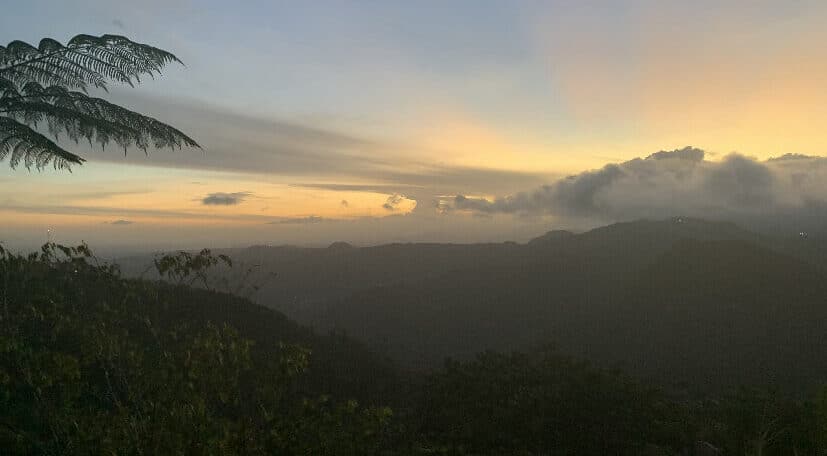
Despite the destruction, the property remained beautiful. Situated on top of a lush hill, the backyard was shaded by almond, plantain, and mango trees. Chickens pecked at fallen fruit, and the children played with their adopted dog as the Puerto Rican winter mist kept them cool, shadowed by the tall mountains of the island’s interior. The Taino, Puerto Rico’s indigenous inhabitants, knew this land as Haimonia and recognized the land for its fertility, growing yuca and other crops in its rolling hills, while directing their worship to the mountains they viewed as sacred.
“No-Go Zone”
Taking a break from our work, the grandfather poured drinks for Julio and me. His alcohol was strong yet sweet, and flavored with wild tamarind, giving it a unique smoky finish.
He told me that the Federal Emergency Management Association (FEMA) had designated the area a “no-go zone,” meaning they had received next to no assistance from the government. FEMA’s excuse was that the roads were too poor to drive on, but Julio told me that he made the trip from the capital to Carolina three days after the hurricane in a minivan.
Without FEMA supplies, the community struggled to get back on its feet. As power and gas had been taken out by the hurricane, sourcing food became a serious issue. Not to mention medication that many in the community needed.
Julio went on to tell me that across the island FEMA designated many working class, Black, or rural communities as unreachable. “Strangely,” FEMA supplies seemed over abundant in wealthy or American expat communities which had their own generators. The pitorro in my cup became sour. From my grandmother’s experience, I knew of FEMA’s ineptitude, but this level of corruption and racism shocked and enraged me.
If my grandmother wasn’t able to come live with us, then who would’ve given her insulin? If Julio had never gone to Carolina, then who would’ve built this family’s roof? The responsibilities of our local and federal government—to protect the people in a time of emergency—had not been met. While these authorities reported an official death toll from the hurricane of 64, a 2018 study published in the New England Review of Medicine estimated an actual death toll of 4,645.
When I returned, I grieved for the thousands killed by the hurricane and the thousands more killed by neglect. Like Filiberto Ojeda Ríos, our people were left to bleed out from treatable wounds.
Beaches Belong to the People
A year and a half passed before I returned to Puerto Rico in the summer of 2021. I was excited to see family and get away from the isolation of quarantining in New York. In that time, the people had rebuilt what they could, but the long-term, structural damage remained. Blackouts were frequent, and many buildings were still unsafe. The COVID-19 pandemic raged across the world, devastating the supply chain that the island depended on and driving up food prices (Puerto Rico imports more than 85% of its food).
I stayed in the coastal town of Rincón, where developers were building expensive beachfront houses and cabanas on beaches that had been designated as breeding grounds for the Carey turtle, which is protected under the Endangered Species Act. The Careys were also viewed by the Taino as sacred, and their shells were prized as important symbols to the island’s caciques (indigenous chieftains).
Moreover, Puerto Rican law stipulates that all beaches in Puerto Rico are public property and access to them is a right. In response to the threats to the turtles and free access to the beaches, many young Puerto Ricans gathered in protest to tear down the concrete sea wall put up by the millionaires appropriating and blocking full access to the public beach.
The protestors set up camp near the new construction. On social media, I watched as they took their sledgehammers to a construction site.
I didn’t realize how close I was to the site of the protest. As I walked on the beach, I heard singing and shouting from a distance. As I approached, the singing stopped and the shouting became louder, transforming into cries of anguish. Rounding the corner, I saw 100 or so protestors surrounded and outnumbered by at least twice as many riot police.
Armed with batons and armor, the police advanced on the protesters, beating anyone within their reach. I saw an officer grab a woman by the hair, pushing her to her knees, and striking her head with his baton. Even from a couple hundred feet away her blood shined bright red in the sun. The majority of the crowd ran back to their camp and those that stayed were beaten into submission and arrested.
I froze, unsure whether to help or run away. I was a boxer, and my hands were good weapons. I wanted to grab one of those officers, rip off his helmet and beat him, but I was paralyzed. I was outmanned and outgunned; their armor would protect them from even my best hits and their baton strikes were much harder than my fists. My sense of self-preservation outweighed my will to fight, and I ran.
I couldn’t sleep that night. I felt angry, guilty, and cowardly. I looked up to the revolutionary past of my people, and I had believed that I could match their fervor, that I could be a martyr. Instead, I felt like a traitor, no better than the police.
My anger subsided and the feeling of defeat consumed me. What were chants, slogans, and flags to armor and batons? What was one 15-year-old boxer to an entire municipal police force? What else could I have done in the face of such overwhelming force?
Having come face to face with the colonial violence that repressed our resistance, I grieved for my people, our ancestors and our descendants. I grieved for our land.
Incomplete Healing
My grief persisted when I returned to the states, and I again turned to radical literature. I read Wretched of the Earth by Franz Fanon and The Vanquished by César Andreu Iglesias, which are about struggles for Algerian and Puerto Rican independence, respectively. The similarities across these books taught me that the Puerto Rican struggle was not unique. Across Latin America and beyond, many nations and peoples were subject to the same brutality we were.
When in-person school resumed that September, I wanted to do something tangible. So, I co-founded a Latino student union with a friend. We organized a safe space for our community, running toy drives and leading lessons on topics ranging from immigration to police brutality.
Over time, the club became a healing experience for me. It was healing to be heard and to listen to others from all over this hemisphere. It was healing to be in community with those that carry that same grief.
I realized something important. For me, Tengo Puerto Rico en mi corazon wasn’t a warcry. It meant that I physically embody my love for Puerto Rico as a land and a people in everything that I do. And because of that love, I hurt and I grieve for our subjugation and those who have suffered similar injustices.
In truth the healing remains incomplete. This is the reality of colonial existence: endless bleeding, endless scarring, endless grief—until we are free.