
“Would you like to live in America?” my mother asked when I got home from school one day in September. I was only 12 and I didn’t know how to respond. I’d lived in Mexico my whole life, but I knew why she wanted to run away.
Two months earlier, my mother found out that my father had another wife and daughter. On top of the pain of being betrayed by my father, she felt criticized by people in our town. Our neighbors were saying that she wasn’t a good wife and that’s why my father had looked elsewhere. My mom wanted to escape.
Moving to another town in Mexico was an option, but she had saved enough money to get us to America, where she said my older sister and I could get a better education. My 16-year-old sister also said that immigrating was an opportunity for a more peaceful life without our parents’ fighting or hearing hurtful gossip. I could see how much my mother wanted me to say “yes,” so I agreed even though it meant leaving my father behind in Mexico.
Leaving Everything I Knew
Somehow, my mother planned everything in a single day. While my dad was at work, my sister and I wrote a letter to him telling him how much we loved him and apologizing for what we were doing. Then, as fast as we could, we packed one bag with some pictures, a CD player, a Barbie doll, a small Bible, three shirts, and one bottle of water. I felt depressed. I didn’t know when-or if-I would see my relatives or my house again.
First, we traveled to Mexico City, where my mother, sister, and I met with three of my mother’s friends who were also attempting to cross the border illegally. They offered to help us during the journey. There were many terrible risks, especially for a woman and two young girls without the protection of a male relative. We’d heard that many girls are raped, taken by force into prostitution, robbed, kidnapped, or killed when they try to illegally cross the border, often by the smugglers who are supposed to be helping them. We decided to help and protect each other by pretending we were one big family. They were my “uncle,” “aunt,” and “cousin.”
From Mexico City, we all took an airplane to a town called Hermosillo and went to a hotel where we were supposed to wait until the coyote gave us instructions. Coyote is what we call the smugglers we pay to help us cross illegally into America. They help immigrants navigate the border because it’s very dangerous. Hiring a coyote is the surest way to successfully get to America, but it still has risks. In addition to the stories we’d heard about what some of them do to girls and women, we’d also heard that sometimes coyotes leave immigrants to get arrested by border police-or even worse, they lose people as they cross the border through the desert, and those people die from dehydration or heatstroke.
After one night at the hotel, the coyote called and gave my mother a secret code word-“El Dorado” (which means “The Golden”). She was supposed to use the code word to recognize him and the group of fellow immigrants we’d be crossing the border with. We were told to meet everyone in a small town nearby at a gas station.
‘don’t Separate’
It was about noon on a very hot day when we arrived at the gas station. My skin was getting so red that I had to wear a light coat to protect myself from the sun. At the gas station, many people asked us if we were “Las Estrellas” (“The Stars”) or “Los Reyes” (“The Kings”) which were code words like “El Dorado.” Apparently, several groups were getting ready to illegally cross the border that day.
We slowly found our group. There were about 20 of us. Everyone looked fearful and worried. Most were adults, but there were a few other teenagers and one child who looked about 8 years old.
After waiting a few hours, the coyote arrived in a van. He made all of us squeeze in. Some adults sat in the rear seats and carried others in their laps. The coyote drove a little while and then made us walk through a field to wait for another coyote who would take us on the next leg of the journey. We waited at the only tree we saw.
When the new coyote arrived, he gave us instructions. We sat on the ground, some on small pieces of cloth, with the tree’s shadow protecting us from the sunshine, listening in complete silence.
The coyote spoke quickly and quietly. “No se separen, no tomen otros caminos que no sea donde yo diga, y cuidado con la migra,” he told us. (“Do not separate, do not take routes other than what I tell you, and be careful of the immigration police.”) Then we followed the coyote deeper into the wilderness. The ground was just dry dirt with small rocks, one small hill after another.
Suddenly, we heard the coyote scream “La Migra!” (“Immigration police!”). he’d seen two immigration police cars on a nearby road. Everyone got scared and hid wherever they could. My mother grabbed my sister and me very hard by our hands and made us run to a small hole in the ground. My heart beat so fast that I lost my breath. Everyone seemed to disappear. We waited until we heard something.
After about 10 or 15 minutes, the coyote called out, “Ya salgan” (“Come out”). Everyone seemed fearful, but we continued. The same thing happened once more, and again we all hid at the same place we hid the first time. Then, we walked just five more minutes and the coyote said, “Aqu” (“here”). We had reached the border!
The Slightest Mistake
The border wasn’t anything like we expected. There was a long chain-link fence stretching across the desert with barbed wire across the top. In the fence was an opening made out of very old pipes about the size of a door, except that it was divided into two horizontal parts, one bigger than the other. We were supposed to squeeze through the bottom opening, one by one, to cross into America.
I thought it would be easy to cross through when I first saw it, until I heard the coyote saying, “No lo toquen, es una alarma” (“Do not touch it, it is an alarm”). Then he said, “Vamos” (“Let’s go”).
The females went first, starting with the oldest. We had to squeeze through the metal opening with our hands very tight against our legs so we wouldn’t touch the alarm. When it was my turn, I held my breath because I was scared of making a mistake. I tried to control my fear by thinking of it as a game, as if I were a fish wriggling through a narrow space. I got through without a problem.
When all the members of the group crossed the alarm without setting it off, we all thanked God. But we weren’t happy for long. We still had to be careful to not be seen by the immigration police on this side of the border.
Panic
We walked into the forest ahead. I heard the coyote saying, “Tengan cuidado con eso” (“Be careful with that”), pointing to the ground. There was a long cable-another alarm!-hidden by dirt and dead leaves. After about 20 more minutes of walking, the coyote told us to hurry up.
We left the forest and saw a white-bricked building without a single person or plant around. When we smelled a peculiar, dirty scent, we realized we were outside a chicken factory. The coyote told us we had to stay near the building, without moving, while he looked for a car to take us to some safe houses.
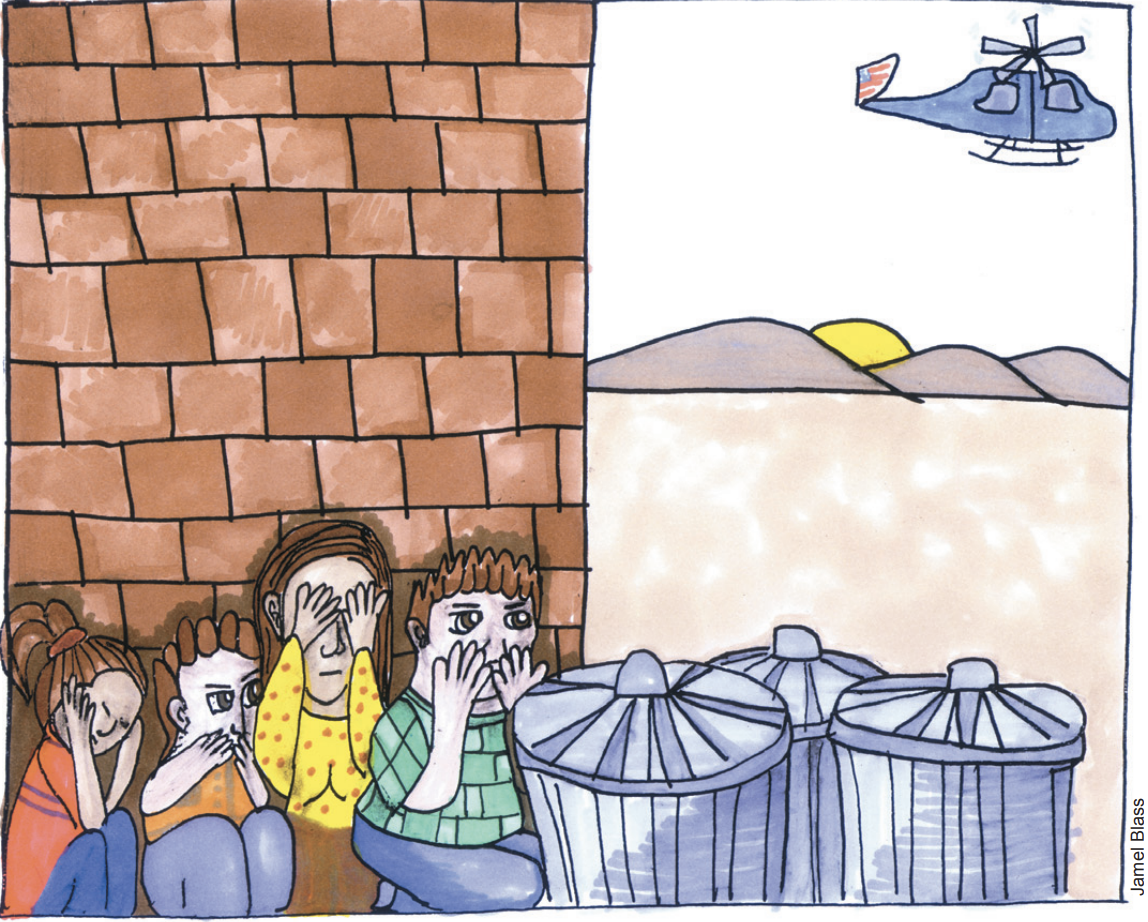
As the coyote left, my anxiety became even stronger. At any moment, immigration agents could find us. We waited while the sun set, surrounded by the smell of dirty feathers, garbage, and the sound of machines. Suddenly, we heard a helicopter. I felt panic rising in my chest. The helicopter was searching the area for immigrants like us. We all stayed calm; no one ran or screamed. Everyone just huddled together, trying to hide near the trash cans, and covered themselves with their coats.
The lights of the helicopter surrounded the area, and the sound got louder. The helicopter circled the area three times. Each time it went away, I heard the whisperings of prayers all around me. And each time the helicopter returned, we all stayed immobile. It was a miracle that the helicopter didn’t see us, even when we were directly beneath it.
When the helicopter left for good, I calmed down, but some people continued praying with low voices. Some people began to worry that the coyote had abandoned us. I asked my mom if everything was OK, and she said, “Si, todo está bien, no tengas miedo” (“Yes, it’s all right, don’t be afraid”). I didn’t believe her, but I pretended I did.
Safe Haven
Hungry, cold, and exhausted, we waited for hours. Finally, I saw a black car. My mother took my hand and my sister’s and told us to run. Along with several other members of the group, we got into the car and it started moving. I looked out the window and saw the other members of our group being left behind.
The car stopped at a house to drop off the other people in the car with us, then stopped at a second house where we would be staying. A tall, fat man opened the door and kindly welcomed us. Inside, dishes were all over the floor and the house smelled like Pampers and beer. A young lady with a baby in her arms showed us to a room with one large bed, three white pillows, a small quilt, and an old TV. She also showed us a small, dusty bathroom with a yellowed tub. The house wasn’t nice at all, but the couple was very humble.
For the next three days we stayed there. All we did was eat, watch TV, look out the window carefully, pray, and try to laugh about some things we had experienced during the journey so far. Finally, we were told to get ready for the last leg of our journey-a flight from Las Vegas to New York City. We were still wearing the same clothes we’d worn as we hid and crawled through the dirt at the border. We knew that if we didn’t change our dirty clothes and jeans, which were now damaged at the knees, people would know we had crossed the border illegally. We needed to disguise ourselves.
A driver took us to a store to buy some clothes, and then dropped us off at a different house. We were surprised to see our “family” there-the friends we had started the journey with. We all hugged each other happily and asked about the past three days.
That afternoon, my mother cooked for the entire group: eggs with tomatoes, beans, and rice with some fried peppers, and tortillas. Happy and full, we started to get ready for bed, assuming we had to stay there overnight. But then a car arrived and the driver came looking for my sister, mother, and me. We were surprised, but we got ready to go. We said goodbye to our friends, and began the long car ride to Las Vegas.
Starting Over
When we got into Las Vegas, I marveled at the sights: the limousines, casinos covered in lights, a small Statue of Liberty, and a lot of young people. It made me feel incredible.
After buying tickets and waiting for a while at the airport, the announcement that we were boarding made me even happier. We departed for New York City in the middle of the night. I couldn’t sleep at all during the flight. I thought of everything I wanted to do, like visit Times Square, and tried to ignore my fears about attending a new school where I wouldn’t know anyone, or even speak the language.
Around 7:30 a.m., the flight arrived in New York City. I was so happy and fascinated by the new sights that all my fears melted away. I assumed that, since this was America, I would only see white people with blond hair, so I was surprised when I saw Indian people who wore white turbans, and then noticed that there were people of all different colors and cultures. It was something I never expected.
As we left the airport, I touched the bangle bracelets I was wearing, which my cousin had given me one week before. I remembered how we’d promised we would be friends forever. I realized that I had left everything I knew behind. I still had my mom and my sister, and my small bag full of stuff that was now being placed in a yellow taxi, but life was going to be very different from here on out. There was so much to process; all my emotions swirled together.
That was six years ago. Now that I live in New York City, I am grateful that we moved to this fantastic city. I’ve had many great experiences, fallen in love with school, and grown as a person. I also learned how the world really is-it’s not as beautiful or peaceful as I imagined when I was a child. I know that as an undocumented immigrant, it will be very difficult to go to college or get a job, and I have thought about returning to Mexico.
However, if my mother asked me to do it all over again, I would say yes because I love her and I want to make her happy, no matter what. In a way, crossing the border was a lesson for me that life is made of adventures that we did not plan. The journey with the coyote is something that will always be in my memory.
Read more stories like this one in American Me: Teens Write About the Immigrant Experience .
Related Stories:
The Rags to Riches Myth : For Marco’s immigrant dad, hard work wasn’t enough.
American Ambitions : Shahlo must convince her parents that a U.S. education is worthwhile.
How I Became an Illegal Immigrant
About These Stories
YC runs intensive nonfiction writing programs for teens in New York City, where they’re mentored by a professional editor to write personal stories about their lives and about issues that affect young people. Their stories are then published and read by thousands of teens, educators, policymakers, and other adults who work with and for young people.