
I had just started junior high at a diverse school where the cliques were based on ethnicity and coolness. I didn’t really belong to a clique, and considered myself a normal preteen who didn’t care much about the social ladder. That is, until one day in homeroom when we started talking about where everyone came from.
“OK, class, now that we’ve finished our unit on different heritages, we’re going to speak about your cultures and how they differ from each other,” said my 6th grade homeroom teacher, Ms. Rose. I was excited. I loved hearing about other cultures. And I was eager to speak about my rich Haitian-American culture, especially the food. Picture a plate piled with red beans so piping hot that you’re afraid you’ll burn your tongue, a fried beef dish called taso and, on the side, corn, baby carrots, string beans and broccoli all sauteed together.
Everyone started talking about their heritage-Trinidadian, Jamaican, African-American, Middle Eastern, Jewish, Italian and Asian. Finally it was my turn. I was excited and nervous, hoping I didn’t butcher the Kreyl words that I was about to sprinkle into my talk.
“I am Haitian-American-” I said. And that’s about as far as I got.
The comments started coming fast and furious. “Whoa, you don’t even look like you Haitian!” and, “Your hair isn’t nappy like the other Haitians’!” I was speechless. Why were my classmates reacting this way? They acted like being Haitian was a disease or something.
The Haitian Me
To me, being Haitian was like breathing air or drinking water. It was the smell of cornmeal and fish in the morning at my grandmother’s house, the sweet sound of Haitian kompa music. Being Haitian was something I had never really thought about, but I knew it made me who I was.
“Are you sure you’re not mixed with something?” one classmate asked. In the end, I said I was, because no way did I want to be associated with the negative ideas my classmates seemed to have about Haitians. Junior high was a jungle and I wasn’t going to become prey.
Most of my Haitian friends were born here like me, and though we grew up with Haitian culture, we were also American. When I first saw the immigrant kids in junior high, I felt a little jealous that they got the richness and the culture of Haiti firsthand. I’d only been to Haiti myself a few times. I remembered during one visit when I was 7, I went to a friend’s farm where she picked me a mango off one of her many fruit trees. When I finished eating it all, my hands were sticky and my belly was satisfied. That’s what Haiti did for me-filled me with its sweet culture and made me feel content.
A New Perspective
But after the kids’ comments in homeroom that day, I saw the Haitian kids through my classmates’ eyes for the first time. Different-colored clothes, nappy hair and the thickness of their accent on their tongues. They sat in a corner of the lunchroom, looking like they had just come off the boat. They were so foreign and new andâcountrified. One girl particularly fit the stereotype. She wore worn-out Converse sneakers and a lime green shirt, and her hair was in huge twists and barrettes. She looked like a big 2-year-old.
They looked happy, speaking in their native tongue, Kreyl, which I understood and spoke. But I felt distant from them, even a bit superior. Although I didn’t look stereotypically Haitian, after that day I started to change my appearance even more to secure a decent spot on the social ladder. It was survival of the coolest.
The Makeover Begins
The first thing that had to change was my hair. My hair wasn’t coarse-it was soft and curly and incredibly long, almost down to the middle of my back. But I felt I still needed to change it because straight was “In.”
When I got home from the beauty salon, I stood in front of the mirror in my room. I took my head tie off and slowly unwrapped my hair, letting it cascade down my shoulders. It felt weird, as if the puffy cloud of hair that used to be there had been replaced with a silky, straight wig. When I stared at my reflection in the mirror, I felt pleased but empty, as if I’d eaten a piece of chocolate cake too fast. I didn’t look Haitian, that’s for sure, but I didn’t look like Marsha either.
Then I began to care more about my clothing. Everything in my closet was from the Gap, which was OK. But Rocawear and Baby Phat were considered the “best of the best,” and something Haitians would never wear. So I began to wear a few articles of clothing from urban clothing stores like Baby Phat, Rocawear and Lot 29.
Completing My Transformation
I changed at home, too. When my parents and grandparents spoke to me in Kreyl or French, I would answer in English. They were frustrated with me, especially my grandmother. They felt that I was being arrogant with my refusal to speak anything but English.
With the “Improvement” of the fresh Nike kicks on my feet and permed hair that framed my face, none of my peers suspected I was even partly Haitian anymore. When anyone asked me what I was, I would say that I was American, which was half truth and half lie.
And for the rest of junior high, I was accepted. But in the end, my new image left me ashamed. I was covering up who I really was, the part of me that loved the Haitian music I listened to in my dad’s car and the food that made my stomach feel so content. But I continued to ignore my Haitian heritage because it felt more important to be accepted by my peers than for me to identify who I actually was.
Words That Brought Me Back
After 8th grade, I started attending a high school where there seemed to be no Haitian immigrants to embarrass me. Then, the summer after freshman year, I stumbled upon a poem on my cousin’s MySpace page.
The poem was called “I don’t Look Haitian?” by Prosper Sylvain Jr., a Haitian poet. It was about the stereotypes that people have about Haitians and how we are much smarter, stronger and wiser than many people think. After I read it, I felt empowered, as if Sylvain’s poem was an elixir that had revived and restored the balance of my two heritages.
The lines that inspired me the most were: “I don’t look, sound or act Haitian?/ Why?/ Is it because I do not have the seawater of Biscayne Bay/ dripping from my tattered clothes,/ or is it because I am not always dark as you perceived me to be,/ did I mess up your entire theory of relativity,/ that all relatives of Haitians must be dark and/ comely, like the tents of your media’s Kedar?” (“The tents of Kedar” are mentioned in the Bible’s Song of Solomon; the people who lived in them were considered dark-skinned outsiders.)
A few days later, after reading this part over and over again, I began to reevaluate my position in the Haitian-American community. Was I to sit back and let the views of ignorant people about Haitians keep going? Prosper Sylvain put himself out there with his poem, refusing to let stereotypes define him. He showed that a Haitian is capable of creating powerful poems like Maya Angelou’s. He defended and protected his heritage. I wanted to be like him, someone who wasn’t afraid to say, “Yeah, I am Haitian and I am proud!”
Holding My Flag High
What better way to prove myself than on Flag Day, a day when you can represent and embrace your culture to the fullest? Flag Day was first started to celebrate the American flag, but many people in Brooklyn, especially those who come from immigrant families like I do, use this day to show where their ancestors came from.
I came to school decked out in three Haitian flags; one around my waist and two on my wrists. The flags bled the colors red, white and blue (ironically American colors, too) onto my body. On my head I wore a Haitian flag bandanna. I looked great and everyone complimented my outfit. I was beaming and extremely proud. It was my first step toward acknowledging who I was and defending my ancestral country.
That day, it was as if God was putting me to the test to see if I had truly embraced my heritage and was not bluffing. I was the only one at school who was wearing the Haitian flag. There were many other Haitian-American students, but many were mixed with something else and had chosen to represent the more “presentable” side of their ethnicity.
A Trinidadian girl came up to me and asked me where all the rest of my “people” were. I told her that I didn’t know, but I was going to represent Haiti even if I didn’t have anyone to celebrate with me.
She laughed and said, “Maybe they’re hiding.”
Had I heard right? Had she just blatantly disrespected my heritage? “Um, no one’s hiding. Obviously you see that I am here. Just because I don’t have a number of people with me representing Haiti doesn’t mean anything,” I said. I felt like a rebel, speaking out to those who felt the need to stomp my culture to the ground. The girl walked away, having nothing more to say.
I know I’m not the only Haitian who went through this phase of hiding my heritage; many of my friends did the same thing in junior high school. It’s hard to embrace a heritage that gets bagged on by everyone. But it’s also important to never forget who you are and where your ancestors came from.
The Real Me
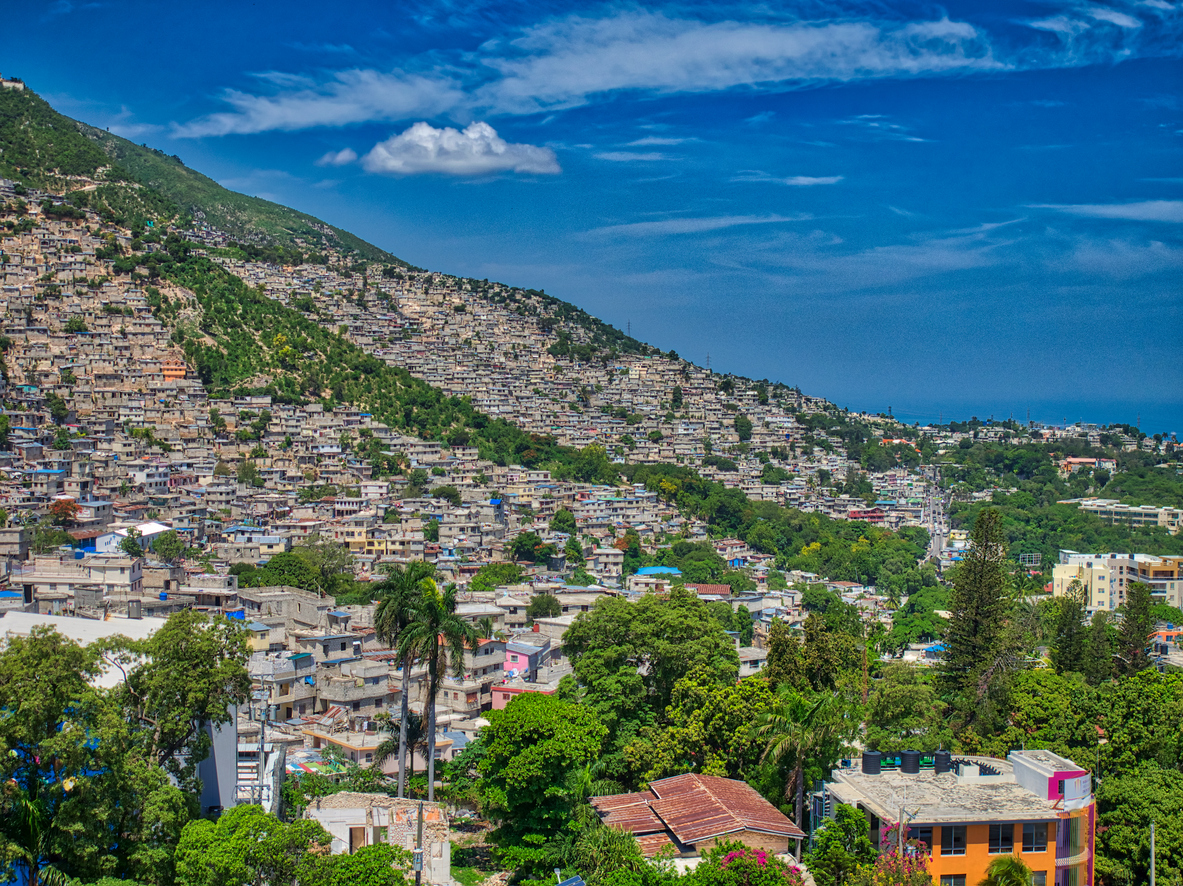
Today, I hang with a rainbow of ethnicities. I try to learn about other people’s cultures and make sure that they get the right representation of my culture. I tell them about my childhood trips to Haiti and about the good stuff-Haiti’s sandy beaches and blue-green water, its hospitality and generosity and the vibrancy of the country as a whole. I tell them Haiti was the first independent black republic in the world. I ask them to remove the stereotypical images from their minds, things like us eating sugar cane morning, noon and night, because it is hurting our real image as a people.
Now when I think about the first time I saw the Haitian kids in my school, I think about their smiles and how comfortable they seemed, switching between English and Kreyl. I realize now that because they were so comfortable in their own skins, it made me uncomfortable in mine. They didn’t seem to see that people were talking about them, or they just didn’t care.
In the end, I guess I learned a lesson. Not embracing my heritage is impossible now, even if it’s sometimes hard to balance it with my American upbringing. It’s engraved in my mind and it’s there to stay. As the poet Sylvain wrote, “My only nationality IS defined in three letters. I E T! (Ay-I-ti).” Even though I am an American-born citizen, I know I will never disown the “Haitian” in me.
Finding My Haitian Pride
About These Stories
YC runs intensive nonfiction writing programs for teens in New York City, where they’re mentored by a professional editor to write personal stories about their lives and about issues that affect young people. Their stories are then published and read by thousands of teens, educators, policymakers, and other adults who work with and for young people.