
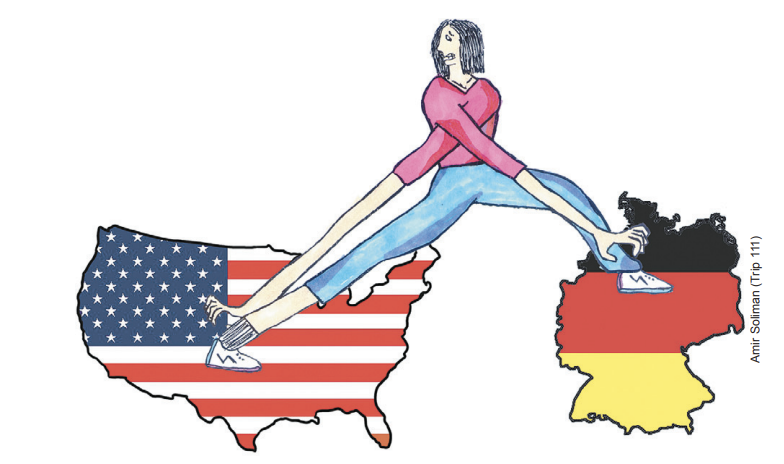
As a little kid, if someone had asked me what my nationality was, I might have said, “German,” because I lived in Germany. But my father is from Austria and my mother is originally from New York City. I have Austrian and American citizenship. I’ve grown up in Germany and still live there, but as I got older, I began to think of myself as more American than German.
In part, it was my way of explaining to myself why I just didn’t fit in with my German peers. I often felt out of place in my small German town of Bielefeld and sometimes dreamed about living in the United States. To me, America represented not just my favorite books and TV shows, but my family and a culture of acceptance.
Two Parents, Two Languages
When I was born, it was clear that I was going to have a multi-cultural life. My mom had met my dad at the University of Edinburgh in Scotland. Then my father found a job in Germany, teaching German to foreign students. My mother found a job there teaching English to German students, and that’s where I was born.
For my first three years, I spoke only English with my parents. I learned German when I entered kindergarten at age 3. According to my mom, my first German words were “Gummistiefel ausziehen,” which means, “Take your boots off.”
After that, I spoke English with my mother and German with my father. Even now I feel oddly uncomfortable if one of my parents addresses me in the “wrong” language.
I Felt at Home in New York
From early on my mom made sure I was exposed to American culture. She read American books to me-The Little Engine That Could was one of my favorites.
On our twice-yearly visits to New York City to see our relatives, I fell in love with The Lion King and watched TV shows like Barney, Mister Rogers’ Neighborhood and Sesame Street. (I watched the German version of Sesame Street too.) We’d spend hours at Barnes & Noble stocking up on American books.
I always looked forward to seeing my New York family. In the spring, we’d get together in New York to celebrate the Jewish holiday of Passover. On those occasions I always felt at home and comfortable in a way I didn’t feel with anybody I knew in Germany. I understood my New York relatives’ sense of humor.
In Germany, I had friends, but we weren’t close. It was never easy for me socially. I stuck out in gym class because I was bad at catching and throwing balls and doing cartwheels. And in art class, especially in elementary school, I was worse than the other kids at cutting straight with scissors and drawing pretty pictures.
I Felt Apart in Germany
My classmates teased me because of my weaknesses, and the fact that I was not “really” German made it easier for them to exclude me. I’d get funny looks when I read books in English on the bus. And when I’d invite people to my house, I’d feel awkward if my mom was there. It was weird talking in English to her in front of my friends, but I’d feel strange talking to my mom in German.
I also felt apart from the other kids because my mom is Jewish. In 8th grade everyone else was going to lessons every week to prepare for their communion, a Christian coming-of-age ceremony. I wasn’t.
I felt uncomfortable trying to explain my unique situation, especially because of Germany’s history with World War II, when the Nazis killed six million Jews throughout Europe. Today there are hardly any Jews in Germany except for Russian immigrants. So I usually didn’t mention to people that I was Jewish.
Americans Said,’Be Yourself’
Sometimes being an outsider made me feel very desperate and I wished I had a good friend who understood me. My parents supported me, though, and at home I could relax and gather strength.
I realized that even though I was different from my classmates, I didn’t want to change because that would just make me miserable in another way, since I would be going against my own personal instincts and preferences.
The American kids’ books and TV shows I loved sent the message that it’s OK to be yourself. But that wasn’t the message I got from personal experience in Germany. By 7th or 8th grade I began to think sometimes that if I’d grown up in the United States, my problems might have been less serious.
I became intensely interested in knowing more about American culture. For example, through a magazine for girls, New Moon, I got many pen pals in the U.S. I’m still in contact with some of my pen pals and I’ve even met one of them [See “Pen Pals Across the Ocean,” right.]
Then, last year, I finally had the chance to live in New York City for a year. My mom wanted me to have the experience of going to an American high school, especially before I decided where I might go to college. I saw it as a chance to start over, in a way, and to find out what it might have been like to have lived here all along.
Finding Fellow Harry Potter Lovers
When I came to New York with my mom in the summer of 2003, I was so excited because I’d looked forward to it for so long. And overall, living here made me very happy. My positive opinions of America as a place where I felt culturally at home were only reinforced.
I met teens with a similar sense of humor to mine, who’d read all the Harry Potter books and even the entire Lord of the Rings trilogy. They’d heard of (and sometimes watched) shows like The West Wing (which I watched on satellite TV in Germany). In Bielefeld, I couldn’t talk to anyone about these things.
It was also a relief to be living in a city and going to a school, NYC Lab School, where being Jewish is common. I didn’t feel like I had to keep my being Jewish a secret. I felt like I was probably more aware of the Jewish aspects of New York than some kids who have grown up here.
It was cool getting off from school for holidays like Yom Kippur and Rosh Hashanah, being able to go to Jewish delis, having teachers use Yiddish expressions and meeting people who’d heard of Seinfeld. It was also interesting to meet kids my age who are much more religious than I am.
I Learned to Appreciate Germany
But my year in New York wasn’t everything I’d fantasized it would be. Coming into a school where people have known each other for years wasn’t easy. They already had good friends. Plus, it’s hard for me to make conversation when I don’t know anything about the person. It’s probably a mixture of my personality and my disappointing experiences in Germany, but I’m shy about approaching other people.
Living in the U.S. for a year also helped me appreciate the good things about Germany. I like my school in Germany because I was able to study languages like Latin and French, which my high school here didn’t offer. And Bielefeld has a city-supported music school so most children can afford to learn an instrument if they want to.
I also appreciate the German government’s support of things like health care and public transportation. Germany has a national health care system, where almost everyone can afford some sort of health insurance, and medical care is so much cheaper than in the U.S.
Germany’s fast, modern trains go to more stations and are less crowded than the U.S. trains on Amtrak. When visiting friends and relatives in Boston and Washington D.C., I often experienced hour-long delays. Once, our train broke down half an hour before we reached Washington and we had to change trains between stations.
I didn’t make many close American friends when I was here, but I still felt more accepted in the U.S. Nobody thought I was especially weird or unusual. Nobody made fun of me or gave me funny looks. I think New York City residents especially are more used to people from all kinds of different backgrounds and those who might be a little unusual in one way or another.
I Accept That I’m Bicultural
Before I lived in the U.S., I sometimes used to think it was the only place I belonged. Now I realize that the truth of my identity is that I’m bicultural. While I think I will always feel more socially and culturally at home in the U.S., I feel comfortable in Germany because it’s familiar to me.
While I think I might have been happier socially if I had grown up in the U.S., I no longer regret growing up in Germany, since it has presented me with so many unique opportunities. Still, I’m taking my SATs so that I can go to college in the U.S. when I graduate next year.
Sometimes I wish the divide between the two countries wasn’t so great, that perhaps there was no Atlantic Ocean and we lived in a house on the border between the two countries. One door would lead to one country and one door would lead to the other country. Even then, though, if someone asked me, “Where are you from?” there would be no easy answer.
SIDEBAR: Pen Pals Across the Ocean Meeting My Pen Pal in Person
When I was in the 5th grade, living in Germany, I subscribed to an American magazine for girls, New Moon. Readers who wanted pen pals sent in their names, addresses and a list of hobbies. I listed Òreading and swimmingÓ and soon I was receiving letters from a lot of American girls who wanted to be my pen pal. My first pen pal actually lived on an American army base in Frankfurt, Germany, though she later moved to Kansas. At one point, I had about 10 pen pals who lived across America, including Minnesota, Michigan and Washington State, and I had one from Canada.
Getting a Letter Cheered Me Up
I wrote to them about American books, movies, what I was doing in school, and how my life in Germany compared with theirs in the U.S. They all enjoyed writing to someone who shared their interests, but they were also curious about writing to someone from another country. I realized how little some of them knew about Germany when one girl asked me what alphabet is used in Germany. (ItÕs the same alphabet as in English.) When I first started writing to pen pals, IÕd get very excited each time I received a letter and it always cheered me up. WeÕd exchange letters at least once or twice every three months. Later, I switched to e-mail with some of my pen pals, though not all. Culturally, I felt like I had a little more in common with the American pen pals than with my classmates, since theyÕd often read and seen the same English-language books and movies as I had. It was also just fun communicating with other English-speaking girls my age, since in Bielefeld the few other American kids I knew were boys.
Meeting My Pen Pal in Person
Three summers ago, I met one of my pen pals, Jordan (not her real name) for the first time. She was from New Jersey and she visited us when we were in New York. I was pretty nervous because meeting someone in person is so different from writing letters, where you have time to think about and plan what youÕre going to say. It felt awkward when we met at Penn Station. We both said, ÒHi,Ó but then didnÕt know what to say. But I asked her about her trip and told her what we were doing in New York City. And since she was friendly and easy to talk to, the ice was soon broken. Jordan seemed older and perhaps a little more grown-up than how IÕd imagined her from her letters. But we got along well, and had fun all three times we met. We went to musicals in New York City and I visited her house in New Jersey. I think meeting each other strengthened our friendship for a while, and we continued to communicate for at least a year after our last meeting.
Too Busy to Write
Sadly, though, weÕve lost touch in the past year. Over the years IÕve also lost other pen pals who stopped writing for some reason. Perhaps they got bored, lost interest, or were just too busy. Lately, I myself have been so busy with school and preparation for college that I havenÕt had as much time as IÕd like to write to the pen pals I still have. But during my stay in America, I found another type of written communication-chatting with like-minded fans of Harry Potter and The West Wing on Internet forums. ItÕs another great way IÕve found to keep in touch with my American roots from the other side of the ocean.