
Instead of my mom’s usual chatter, all I heard in the car on the way to school that October morning was the dj. “You are listening to Z100, on top of the world. Now some more hit songs!”
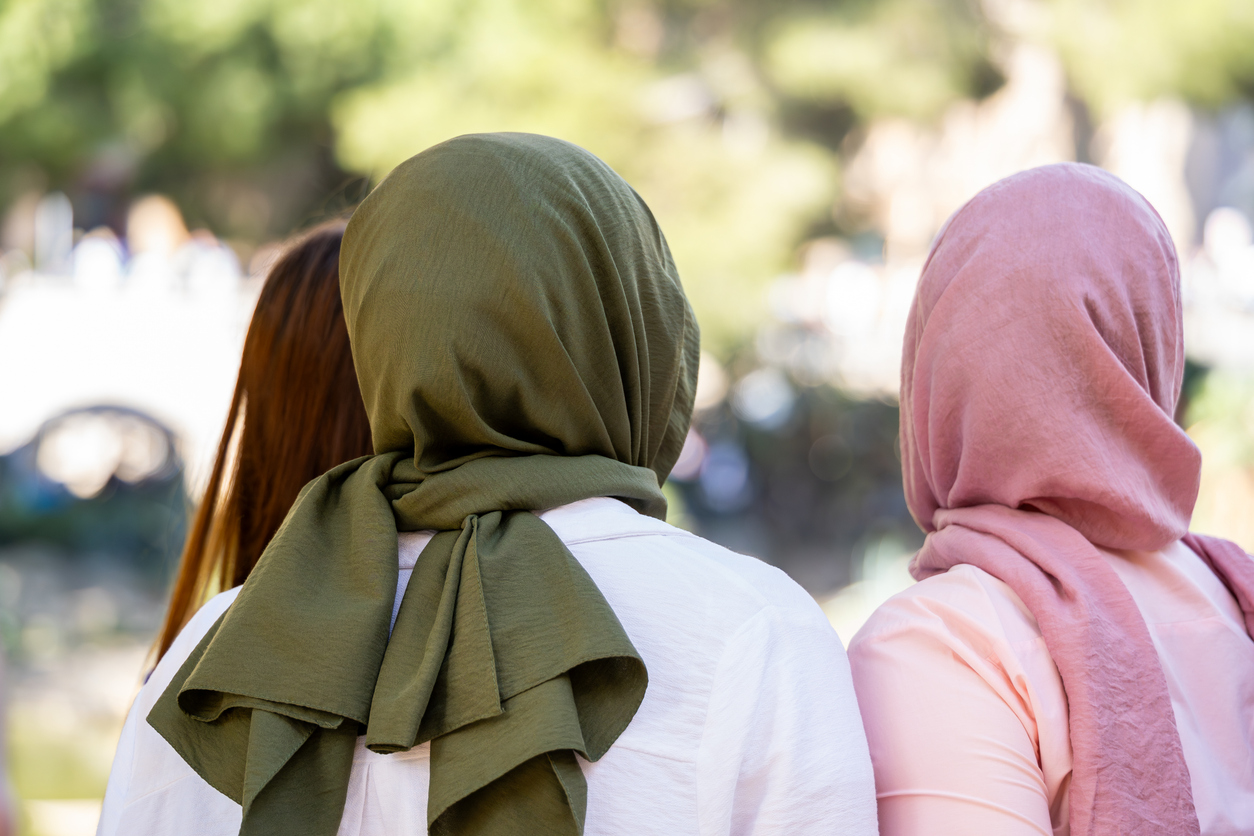
I could just feel the tension in the air. I was in the 6th grade at Christa McAuliffe IS in Brooklyn, and for the first time, I was wearing the hijaab to school. It’s a headscarf that covers the hair, neck, ears and shoulders of Muslim girls and women.
When we arrived at the schoolyard, Mom said, “Maria, you’re making a big decision here. I really don’t want you going ahead with this. I know you’re going to be treated as an outcast. No one’s going to want you to be their friend. Come on, no one’s forcing you to do this.” I could hear the pleading in her voice.
My school was mostly white. Out of 24 students in my class there were four Asians, one Hispanic and one Pakistani-me. The rest were white.
My mom was worried that I would stand out by wearing the hijaab.
Alone but Determined
With a heavy heart, I said, “Mom, I know there’s no pressure. I’m doing this for Allah [God] and for him only.”
Her face fell, and she went quiet for a moment. I felt guilty. I’d never wanted to make her so upset.
“What can I say to that?” she said in a flat, defeated tone. Her comment stung because I wanted her support. And she wasn’t the only one who disapproved. I’d talked to my older cousins Salma and Uzma in England, and they said that I was too young to wear the hijaab, that I didn’t know what I was getting into.
I felt alone in my decision but determined. I got out of the car and walked into school, thinking I could handle whatever happened with Allah’s help. I didn’t know how hard it would be.
Going Further Than My Family
When I was growing up, my family wasn’t too religious. My mom had never worn the hijaab, nor had anyone in my immediate family, nor my first cousins. (Mom told me that she’d been raised in a sheltered community of Muslims in England, where the hijaab wasn’t needed because everyone respected each other and modesty was the norm.)
My family and I did the basic Muslim things, like fasting during Ramadan, giving zakaat (charity) and celebrating Eid. We also ate halal meat (meat from animals that have been killed according to the rules of Islam). Yet we didn’t do other important things, such as praying the five daily prayers.
Like other Muslim parents, my mom and dad sent me to Sunday school at our mosque and to duhrst, discussion groups held at people’s houses where girls talked about Islam and society. I loved learning about Islam and Allah-I wanted to know everything about my faith and live by it.
As was customary, I wore the hijaab to Sunday school and to duhrst. Then when I’d just started 6th grade, my Sunday school teacher, who was around 18 and wore the hijaab, gave this amazingly inspirational speech about it. She said that the hijaab would allow people to see our iman (faith), that it would please Allah. I hung on to her every word.
Coming home that day, I realized how comfortable I felt wearing the hijaab. I felt more connected to Allah, more pure and religious. I wanted to get even closer to Allah, so I decided to wear the hijaab all the time.
My Friends Betray Me
Before I started wearing the hijaab to school, I was treated like everyone else. I’d made a few friends in my 6th grade class. Although we didn’t hang out outside of school, we were always talking in class about homework or giggling about silly things, like what the lunch ladies put in our food. And the other kids in my class were generally nice, asking me normal things like, “What did you get for that answer?”
That all changed when I walked into class wearing the hijaab. I felt so self-conscious, as if all eyes were on me. I was expecting my friends to come over to me, asking why I was wearing it. Yet they said nothing.
My friends gave me these shocked faces, as if they couldn’t believe it was me, Maria. I felt betrayed, angry and sad. I wanted to explain to them why I was wearing the hijaab, but they didn’t even talk to me.
Lunchtime was completely different. I always sat with a group of close friends from another class. We were an ethnic mix, unlike my class. These friends were curious about my hijaab but not turned off by it.
It made me feel good that they cared enough to ask me about it, and they thought it was cool that I wanted to take my faith to the next level. I wished we were in the same class.
Turned to Allah
After a few days, my classmates acted like I didn’t exist. I felt like some sort of an alien, a being that was totally different from everyone else, including my so-called friends.
They made no move to talk to me, which made me afraid to talk to them. I didn’t want to risk being made fun of. One of them was one of the most popular girls in school, and I’d seen her and her friends from other classes tease other girls publicly and meanly.
Feeling like I didn’t belong really hurt because I wasn’t used to being isolated. But I knew I could turn to Allah.
After I began wearing the hijaab, I started doing the five daily prayers. Kneeling down in prostration, I felt as if Allah were truly listening. When I prayed, total peace filled my soul. I confided in Allah, accepted him as my friend. I could feel as if each and everything I did and said counted, and was important enough to be recognized. After praying, I knew that wearing the hijaab was right for me and my relationship with Allah.
Tempted to Give Up
But in class it was hard to stay focused on my reasons for wearing the hijaab. When they weren’t ignoring me completely, my classmates whispered about me or gave me strange looks. Sometimes I was tempted to take off the hijaab and show everyone that I had hair, too. I could look and be like each and every one of them.
The weeks wore on without a change. Once when I was feeling like giving up, I called my cousin Uzma. I was hoping she would tell me it was OK to stop wearing the hijaab. She didn’t.
“Well, we told you it wasn’t going to be easy,” she said. “But now that you wear the hijaab, you have to stick to it. I can just tell you to be strong and to not give up.” I hung up feeling more depressed, hopeless and lonely than ever.
But right then I knew that even if she had told me to take off the hijaab, I wouldn’t have been able to. I realized that I wanted to test myself and my faith, to prove to myself how strong I could be.
Mom on My Side
I’d been crying and praying alone at home for about a month when my mom changed her attitude towards me and the hijaab. She said she could see what I was going through, my pain and determination.
By accepting my decision, she gave me so much comfort and support. When I wasn’t able to hold myself up after a hard day at school, she would hold me, saying soothing and encouraging words.
A few months after I started wearing the hijaab, I arranged to pray Zuhr, the second daily prayer, in the assistant principal’s office at lunchtime. (Two 8th grade girls I knew from duhrst told me she let them pray there.)
I’d spend the morning as the outcast in my class, but when the bell rang, I’d grab my prayer rug and leave it all behind. Praying helped me meditate on my inner self and relieve the stress from school. It made me feel as if it were only me and Allah in the same room, old buddies catching up on the day, on life.
Stronger and Stronger
When I finished with my prayer, almost half the period would be over. I’d head to the lunchroom and to my friends from another class. We’d chat about regular stuff, like what was going on in the news, and who got what on the math test.
They accepted me as I was, and I felt like the true me. Then I’d go back to class and back to being ignored.
As time passed, I felt stronger and stronger about my faith, and I stopped feeling hurt when my classmates behaved like I didn’t exist.
With my mom’s and Allah’s help, I became completely confident about my decision to wear the hijaab. Wearing it brought me closer to Allah, much closer than I ever imagined.
By the last year of middle school, I didn’t give my classmates’ stares a second thought.
My Turn to Inspire Someone
When I was in 8th grade, my cousin Salma, who was 22, started calling me about once a month. She was exploring Islam, and she’d consult with me about our religion and how it fit into her life and what she was feeling. She wanted my advice, and it made me feel important.
So that summer, when Mom told me, “Guess what! Salma’s started to wear the hijaab too!” I felt pure joy and pride. I’d gone from feeling like a miserable outcast to a strong role model, surpassing even my own expectations.
Now, almost seven years after I first wore the hijaab, I feel totally comfortable with myself. I’ve made friends in high school, both Muslims and non-Muslims, who respect me for who I am. I’m proud of my religion. I believe in my faith and I believe in my relationship with Allah.
View the lessons based on this story
- Sticking To It Between You and Me Unit 1 | Session 6