
The waiting is the worst.
The gym reeks of sweat and humidity. I’m on the other side of the ring from my opponent. He’s trying to psyche himself up, making tense faces, concentrating.
I don’t pay too much attention to his face, though. I’m paying attention to my mission, which is to beat him up.
I’m at the gym where I train as a boxer. I’m following in the footsteps of my father and brother, trying to make a name for myself in the ring.
The Countdown
I’m about to start a practice session, or what boxers call sparring. I’m nervous, waiting to hear the bell. I bounce up and down. “Stay loose, relax,” I think to myself. The seconds beat on my heart like a countdown. Waiting is the worst. Then the bell rings. And it beginsâ
My opponent moves toward me and I move toward him. He’s in a bad predicament, worse off than me, much worse. I am the hunter, not him. Let him dare follow me, ’cause I’ll lead him into so many traps.
‘Get to Know You’ Punches
The “get to know you” punches pass between us. They’re the initial jolts, like someone slapping me to wake me up. They’re the weirdest.
My mind tells my body to prepare for more, to brace itself. OK, I feel better now. I’m moving around. I’m in control of my fate.
My mission is to beat him to every punch. To not get hit back. To outwork him and outthink him. I’m like a horse on a racetrack with my tunnel vision. I’m so focused, I hear nothing. I feel confident.
Clues for the Kill
I see by how he’s stepping what type of balance he has. He leans forward when he throws a jab. His left hand rocks when it should be covering his face. He doesn’t bob. He crosses his legs constantly as he walks. He’s giving me clues on how to take him down.
Only 20 seconds have passed.
He has to fight my fight. He will play on my terms, under my rules. I move to his left and pop him. I move again to his left.
He turns to face me, and I jab him as he plants his feet, before he can think. I drop a four-punch combination and move again. The bell rings, and I go to my corner, where my dad and my trainer, Ludy, have my back.
Advice From Lightburn
The minute moves fast. Ludy tells me what I’m doing wrong. “Throw more punches. Bob your head more,” he says. I write his words down in my head.
The minute is over. I feel loose. I feint him (which means I psyche him out by pretending I’m going to move one way) and pop him with a two-punch combo to the head, left and right, then move to his right.
He throws a flurry of body punches. I crouch down and brace myself. I push myself close to his body, smothering the punches. As soon as I feel them land on my arms, my upper cut flies up.
Connect With His Head
He throws a right jab, but I duck under it, punching his stomach and hitting his side. Then I connect with his head and move. This takes split second timing, which sparring helps you develop.
He throws the right again and I give him the same combination I gave him before. Now he’s hesitant to throw the jab, ’cause he knows I have an answer to his right.
He’ll be risking himself if he tries to come inside on me and not have a jab to keep me preoccupied with. It’s time for me to move in and break him down.
The bell rings. Damn!
I move to my corner. Ludy says, “You’re walking. Pick up the pace, side to side. Don’t wait for his punches. You make the fight.” The bell rings fast, not giving me enough time to catch my breath.
Trouble on the Horizon?
I may be in trouble. As a boxer, once you’re tired, you’re doomed, no matter how much you know. By the middle of the round, I’m breathing hard.
I can’t do the things I want. I’m too tired to throw my jabs. I can’t pick up the pace, like Ludy told me to.
My opponent’s not tired, so he’s swinging away at me. I hear my father yelling for me to “Jab! Jab!”
This is frustrating. I know more than what I’m showing now. I do so well on the floor and when I’m shadow boxing. Why can’t I translate it in the ring?
I block and deflect his punches. I move away. I huff and puff. I have to get my breath back. I’m on the defensive. I counter some of his punches and hit him squarely. I hold him and push him away.
Exhausted!
I haven’t paced myself, so I’m exhausted. I’m wasting energy trying to move from him. I’m so tired. I feel like fainting. I can’t breathe. My lungs are burning. My legs are dead.
“I am not going to let this happen again,” I say to myself. I’m going to train harder next time. I did not fight my fight. How am I going to be a champ if my sparring sessions go like this? The bell rings again.
“What’s wrong? You know this,” Ludy says. I stay quiet. “Keep throwing your punches. Keep him off you,” he says. “Jab. Jab. Don’t stop jabbing for a second. Grab him and move.”
Again, the bell rings before I’m ready. I go back to the center. He has all the confidence I once took from him. He psyched himself into thinking he did this to me.
I get a burst of energy and throw a flurry of punches, rocking him back, making him step backwards.
A Deafening Punch
Instead of moving in and continuing the onslaught, I move to the side, still catching my breath. I throw a lazy jab and don’t see his punch. I get hit hard. I hear nothing for a couple of seconds.
I’m numb so I go in and grab him. My senses are stunned. I don’t even feel his next punch. Or the ones that come after that.
Every chance I get, I grab him so I can build up my energy. I start to feel better. He doesn’t like that I’m moving again, so he steps on my foot. It’s a dirty move.
I pull my foot back. I hit him with a jab, right punch and a double left hook. None of them hit squarely.
It’s All Over
The bell rings. It’s all over. We touch gloves, as if it was a five, and hug. I go to my corner and step out of the ring. I know I showed flashes of what I’m capable of. I take that with me as I leave.
But I wasn’t satisfied with my performance. I’m motivated to work harder and harder. I won’t let the same thing happen next time.
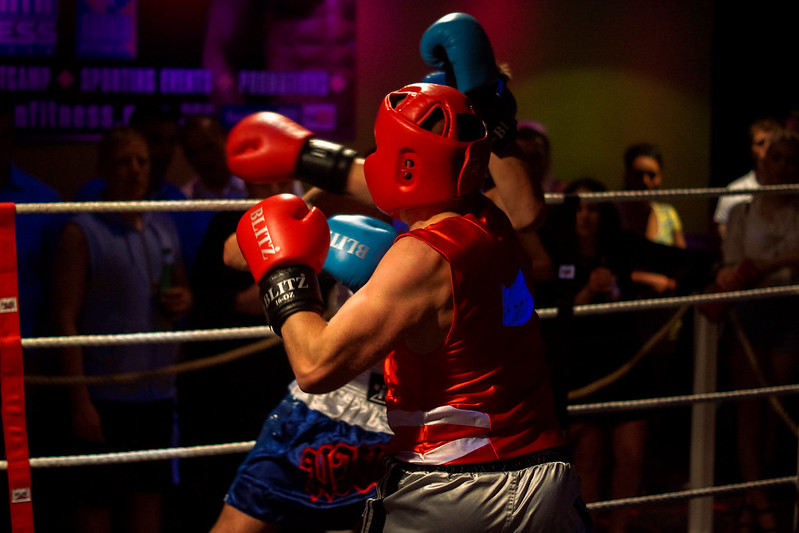
In the Ring
About These Stories
YC runs intensive nonfiction writing programs for teens in New York City, where they’re mentored by a professional editor to write personal stories about their lives and about issues that affect young people. Their stories are then published and read by thousands of teens, educators, policymakers, and other adults who work with and for young people.