
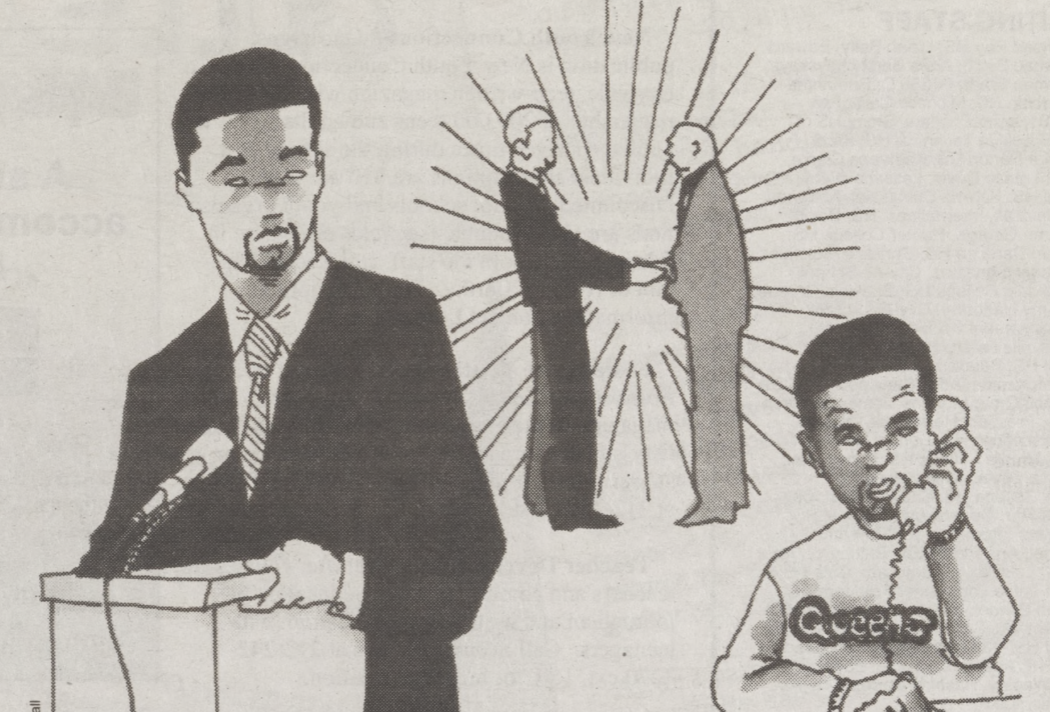
When I first entered Queens College, I knew that if I really wanted to take advantage of all that college had to offer, I had to get involved.
Campus activities seemed like the best way for me to find out what I was good at and what I liked to do.
So I joined the school paper (The Quad), tried out for the track team and became a member of two ethnic clubs on campus, the Black Student Union and the Haitian Club.
I went to their meetings and parties as often as possible.
And even though I’m Haitian, I went to the Alliance of Latin American Students’ meetings and racked my brain trying to follow meetings that were conducted in Spanish.
I used every ounce of Spanish I had ever learned in school or while hanging around the five-cent Nicaraguan deli on my block.
I Wasn’t Commited
But while I was doing a lot for many different clubs, I was not committed to one thing that I cared about.
I didn’t feel like I was making a real contribution to any of the organizations that I was hanging around.
Then, one day during my junior year, all that changed. I was in the Student Life Office picking up some mail when the assistant director of Student Life asked me if I wanted to be a part of the Black History Month Planning Committee.
It was a committee of faculty and students that would be putting together events for Black History Month in February.
She said she had seen my work for The Quad and other organizations and was sure I would make a worthwhile contribution to the committee. I was grateful for the compliment.
I said, “Sure,” but I didn’t think much of it. I had been on other committees before, and they hadn’t been that exciting.
But unlike the smaller events I had helped prepare on other committees, the BHMPC was in charge of planning for an entire month.
And, even better, each student on the committee was in charge of planning an entire day’s events.
We Had Responsibility and Power
During the first meeting of the BHMPC, we went around the room giving our ideas for the month (fashion show, a play, a vendors’ fair).
I immediately felt like I would be a real part of the decision making, and that the BHMPC would give each person an opportunity to contribute.
The BHMPC was also different from other committees because it was organized and headed by students, not faculty.
The students on the BHMPC were expected to carry most of the load, and the co-chairs were both students.
I was excited that students could make or break the committee. And when I was elected to be one of the co-chairs, I was on a high.
Working Around the Clock
Soon after getting elected co-chair, I realized that the BHMPC was not going to be a two-day-a-week project. I knew I couldn’t just stick my head into a few meetings and walk away-I was in charge.
Before I knew it, I found myself in the Student Life Office practically every day for four months. I constantly had to check up on whether the speakers we were trying to get for the events had confirmed, if any vendors had responded for the vendors’ fair, or if there was another memo that I had to write.
One day I spent almost an hour on the phone trying to obtain commemorative African kings and queens posters so we could display them or give them out at our events.
I must have been transferred to every department and branch in the corporation. When I finally reached the person I needed, he politely informed me that the company no longer issued the posters.
I was mad because I had just wasted an hour that could have been spent doing something else, but I knew that I couldn’t afford to waste any more time dwelling on it. So I moved on.
I met a lot of people by working on the BHMPC. When I was trying to contact Dr. Betty Shabazz to see if she would be free to speak, I expected to get her answering machine, but I got to speak to her directly.
A Proud Moment
But my most memorable event with the BHMPC was the professors’ forum. The professors spoke about the work that they did outside of their classrooms so that their students could see another side of the person that they usually see in class.
Before the forum, I told both of the professors to arrive half an hour early, but by accident, I wasn’t there to meet them. The professors were mad, but once the program started, they got into it and so did the students.
The professors read from their work, and cracked jokes about being young and thinking that they were going to conquer the world.
Even after the program was over, they stayed to talk to the students about their careers and to give advice about how to handle parents.
Winning Praise and New Members
After every event, I was always surprised by how many people came up to congratulate us for putting together a wonderful program, and how many more people came up to us to ask how they could be a part of the committee next year.
When February was over and all of our events were done, I was really happy because I knew that I had participated in something special.
Although working with the committee was rewarding in itself, it also made me a more recognizable student on campus. When events related to Black students were being planned on campus, I was usually one of the people asked to participate or to give information.
More To School Than Women and Free Pizzas
But I was also sad when it was all over because I knew that although the committee required a lot of work, I could always count on it to put a spin on my regular school day.
When I woke up in the morning, I was happy to know that I was going to school for more than my classes, women and free pizzas (that the clubs often offer during their events).
It gave me an incentive to go to school.
View the lessons based on this story
- More Than Just Class Level Up Unit 3 | Session 15