
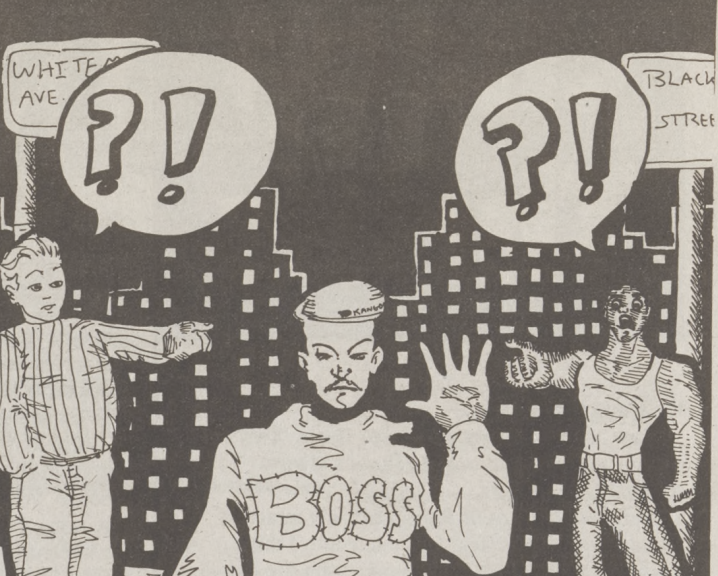
In the fantasy game Dungeons & Dragons, players get to create their own characters. First you choose your race (Human, Elf, Dwarf…), then your class (fighter, paladin, mage…), and finally comes alignment, or moral stance. For instance, Superman would be “lawful good,” Adolf Hitler, “chaotic evil.” Certain combinations are not allowed, however. A white knight in shining armor (paladin) cannot be chaotic evil.
The way the game works is not so far off from everyday life. People are always looking at your race and attempting to file you into certain categories. If you are Black, for example, then you only have a limited number of “alignments” to choose from if you expect to fit in with a group. Either you can wear khakis and Tommy Hilfiger shirts, go to church on Sunday, and play ball in a league or you can walk around in army fatigue pants, a hooded sweater and bubble jacket, listen to rap religiously, and smoke weed all the time.
I’m Black-or at least that’s what most people think I am when they see me-but I never fit into any of society’s categories. One reason is that I’m really mixed. My mother is a southern Black woman, but my father is a Jewish guy originally from New Jersey.
I was born in Upper Manhattan in a neighborhood known as Washington Heights, and for a while race wasn’t an issue. I was dark, and so was everyone else. Then, during the first grade my family moved to Staten Island, and I went to a private school that was practically all White. There I was taunted every day. “Look at the Black cupcake!” they’d say. Or “Why are you so dark?” “What’s wrong with you?” “Maybe if you took a bath, you’d be like us.” It was pretty hard to cope.
In the middle of the second grade, we moved again, to Brooklyn, and whenever I would meet new kids, I’d think, “Great, everything is cool now, but eventually I’m going to have to answer the same questions again.” It started with my last name, Wasserman. People heard it and wanted to know why this Black kid had that name. “Well, my dad’s Jewish,” I’d explain. No big deal.
Then it came time for my first parent-teacher conference. I remember walking home wishing that Mom would be the one to go. “Don’t let them see my dad,” I thought. If Mom went, then at least I could look normal, without the hassle.
‘Are You Adopted?’
In the end, Dad came, however, and I could feel the eyes on my back. The next day, everybody at school was waiting with the same questions that I’d been answering all my life. “Hey, who was that guy?” they asked.
“My dad.”
“No, he’s not your father. Are you adopted?”
When I told them no, they wouldn’t believe me.
“No, you just don’t know,” they insisted. “Your parents didn’t tell you.” It made me so mad. Why couldn’t anyone at least believe that it was possible to be mixed?
I remember another time my dad and I were standing on a corner in the East Village, talking, and an older Black guy came up to me and asked if this guy was my father. He seemed to be worried, like my dad might be trying to kidnap me or something. My father and I are so close, but to this other guy we seemed to be strangers. That really bothered me.
In the middle of my fourth grade year, we moved to the Bronx. By this point my parents had split up, so it was just me and Mom. One of the first friends I made in school was this skinny Black kid named Dee. We used to bug out. We’d stick M-80s into payphones, light them, run away, and then collect all the quarters and go play video games.
Chillin’ With My Friend’s Family
Lots of times we would just hang at Dee’s house (he had Genesis). He lived in the projects with his sister, brother, and his parents. Sometimes I would chill with his family, and we’d sit around the dinner table talking about the last time the Bulls played the Knicks, or Shawn Kemp’s latest ally-oop. I would bump into Dee’s father at the barbershop and our mothers would see each other in the laundromat and chat every now and then. We were chillin’.
Then after about a year, things changed. Every time Dee asked his parents if I could come over, the answer was always no. When I called and asked to speak to him, his father would be like, “No, he’s busy” or “No, he’s not here.” Once I was talking to Dee and I had to get off the phone for a few minutes. When I called back 10 minutes later, his father told me he wasn’t there. I would see his parents on the street, and they would say hi but not much else. I started to realize that they just didn’t want me around their son.
As you can imagine, I was pretty confused. “Why are they treating me like a disease all of the sudden?” I wondered.
A Blue-Eyed Devil in Disguise?
After this had been going on for about a month, I finally mentioned it to my mom. She said that she was talking to Dee’s mom and the subject of my father had come up. According to Mom, when Dee’s mother found out that he was White, she didn’t have the best reaction. My mother didn’t tell me exactly what she said but I understood that it wasn’t good.
Finally everything was clear. Even though they had known me for months, the fact that I was really a blue-eyed devil in disguise meant that I shouldn’t be around their son. Dee and I remained tight. The fact that I was mixed wasn’t an issue for him, but now all of a sudden we couldn’t chill like we used to.
The whole thing was pretty wack. I mean, come on, how are you going to cut someone off just because he’s half White? I couldn’t change the fact that I was mixed. Besides, they knew me. It’s not like I was one of Mr. Charlie’s spies on a mission to convert their son to the dark-or light-side. I mean, damn! What’s up with that? And to top it all off, I couldn’t have been older than 10, 11 at the most. Something like that would be weird enough now, but back then it had me feeling really awkward and self-conscious.
‘Sir Oreo’
I reached the height of my isolation in junior high school. I can honestly say that the eighth grade was the worst nine months of my life. Because of the way I speak, I was officially knighted “Sir Oreo.”
Every day was an adventure. People would mess with me all the time. On top of being weird and all that, I was small, probably around 5’4″ and 110 pounds. I used to get pushed around and beat up all the time. People would talk trash about the name too. “Yo Satra, is that a girl’s name?” “I got a dog named Sasha.” I had to listen to this all the time.
It was beyond being different; I was an alien who lived completely in my own world of baseball, Super Nintendo, and my comic book collection. My only connections to the world around me were dodgeball, handball, and Street Fighter II (and I don’t care how nice you are, I’ll whip your ass!). The latest fashions and walking “left foot first,” meant nothing to me. But in the minds of my 12 and 13-year-old classmates, this was mad important. I was always the weirdo.
You Can’t Please Everybody
The biggest favor I did for myself was not trying to choose one race to be, which is a mistake most people in my situation make. The reason is that if I decided I was going to be Black, first I’d have to figure out what that meant. I’d be watching other people and imitating their image. Or, even worse, I would be watching TV or listening to music, trying to imitate the media’s idea of blackness. And the same thing went for trying to be White. OK, first I’d have to dress like this, then I’d have to talk like that, then I’d have to walk like so and hang out with those guys over there. It goes on and on.
I have often wondered why I am the way I am at this point. Looking back at my life has given me an answer. When I was younger, White kids in school would bother me for being so dark. Later on, Black kids would ask what the f-k was wrong with me because I was so light. Finally, I realized you just can’t please everybody. Now I just do my own thing. Wake up, puff a blunt, put on some Eric B & Rakim, then go and play handball. I dress, talk, look, say and do what I want, the way I want.
I’m Just Being Myself
To this day there is really no one particular group that I’m down with, but on the other hand I have so many hobbies that I can chill with all kinds of different people. My relationships are based on interests. Some people I meet through rap, just standing around free-styling. Others I meet on the handball court. Right now this system is working out nicely.
Before I was always on display and people would look at me and pass judgment. But now, I’m not in junior high school anymore, and I don’t have to answer to anybody. It feels like I’m rebelling against the demons of my past by just being myself.
SIDEBAR: The Right Crowd
Remember the first day of school, standing in a corner pretending to have something to do, looking at the legions of kids thinking, “Who am I going to hang with?” Don’t even front-on the first day of school, that’s the deal. Which crowd did you pick? If your school is like the one I used to go to, you can probably draw a map of the lunchroom or the sidewalk out front with different colored areas to indicate all the different cliques and where they hang out. In one corner is the JV basketball team, the Black kids with the Guess? gear and the duffle bags. Over yonder by the garbage can are the long-haired, White metalheads-the tight black jeans wearin’, same Pantera T-shirt for three days rockin’, knee-high boot lacin’, joint smokin’, last night’s concert talkin’ dudes.
From Scuffed Tims to Skateboards and Beastie Boys
Across the street are the buddha-heads-the time 4sum aksion shoutin’, pass the dutchie to the left hand side rollin’, h- slappin’, skuffed Tims wearin,’ straight-from-the-sewer hoods. Down the block from the buddha-heads are the sober, wannabe hoods. Then you have the rich White kids with their North Face jackets, the not-so-rich White kids on their skateboards listening to the Beastie Boys. And the list goes on and on. I realize that at many schools the list wouldn’t even be this long, but I went to Bronx HS of Science and it was all there. In the first few months of my freshman year at Science, I was down with the current fake player, punk smooth pretty-boy bullsh-t basketball team.
Different Races Stick Together
There were very few Black kids in the school, so in the very begining all the Black kids would sit together in class. I knew the whole squad; we would play basketball in gym class, we’d all sweat the same five decent-looking Black girls (the only ones in the whole school), and talk about how funny-looking our classmates were. From September until springtime it was all good, then JV Basketball team tryouts came around and I didn’t show up. These guys couldn’t believe it. “Yo Sat, where were you?” they asked.
A Traitor to the Cause?
Basketball is cool, but I told them handball was my game. It only took about one day for the reality of it to sink in. “Satra, you were playing handball with those weird kids?” they asked in disbelief. Then, when they realized that I really was playing handball with the White and Asian kids, I was exiled. Before, we would chill with each other all the time. Then, almost overnight, if I would see one of them in the hallway, we would pretend we didn’t know each other. I went about two years before talking with any of them again. It’s just one example of what happens with cliques.
View the lessons based on this story
- Doing My Own Thing All In Unit 1 | Session 6