
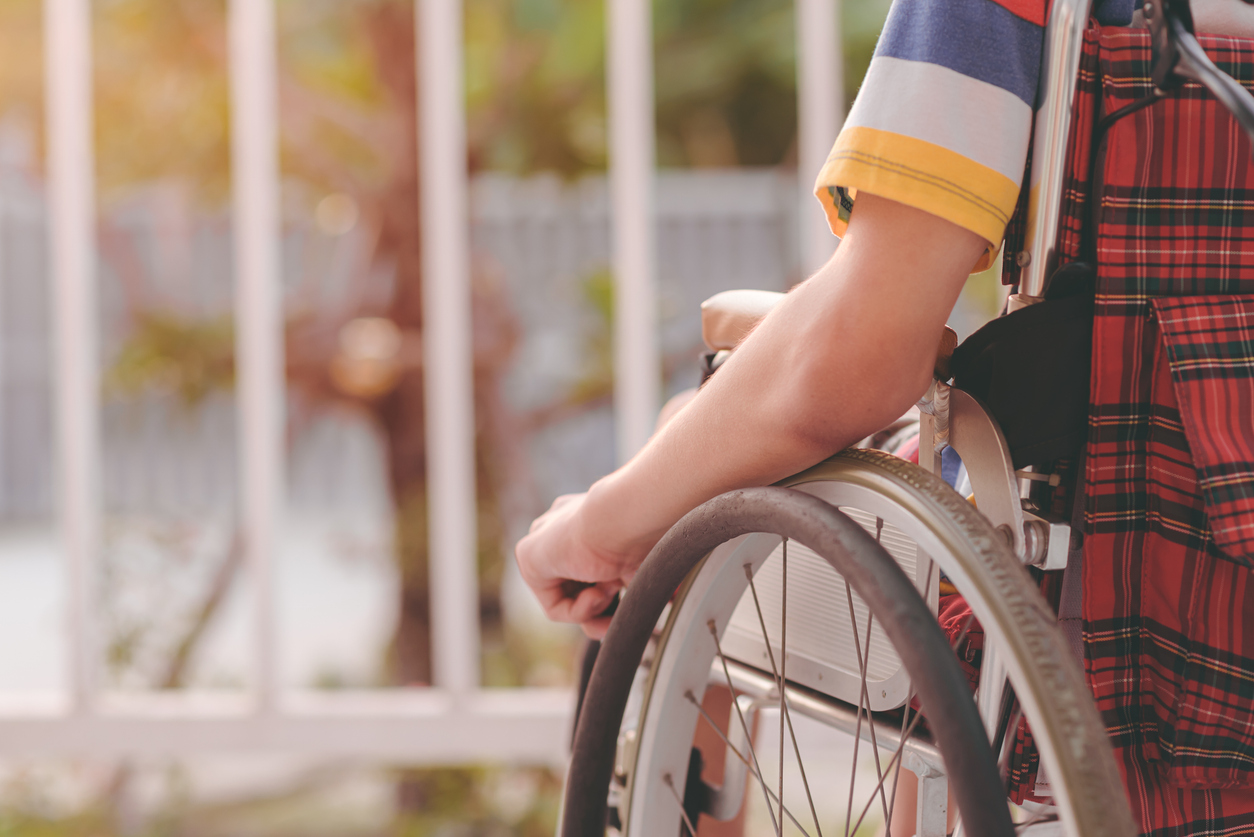
I first saw him freshman year, rolling by in his wheelchair. His short arms rested on the desktop attached to his chair. He had dark hair, a frozen smile, and he stared straight ahead. He didn’t seem to look anyone in the eye. “They let people like that in Brooklyn Tech?” I thought.
One day, I was standing in the hall with some other kids waiting for our history class to begin, when he rolled up. I felt myself stiffen and I wanted to get away from him, but I couldn’t. I didn’t want to hurt his feelings by moving, and I didn’t want to embarrass myself by being seen next to him. I had the urge to say something, but my mind was blank.
Finally, I glanced at him and decided to smile. He looked at me as if I were a ghost and tried to smile back. That surprised me. I thought he would just ignore me. I quickly looked away wishing the teacher would come, so I could rush into class.
A Creepy Feeling
Then I noticed everybody else was quiet too. Suddenly it hit me. I wasn’t the only one who felt creepy when he was around. Nearly everyone’s attitude changed when he entered class. The chatter stopped and kids looked the other way. Even the teachers ignored him. It was like they wanted to erase him from the class. I began to wonder what was behind this “weird” feeling.
“We feel sorry for them,” said Cynthia Chu, 17, of Brooklyn Tech, who grew up with a mentally disabled sister. “When I’m around a handicapped person who can’t walk, I feel like I’m taking advantage of the fact that I can.”
Most of the teens I interviewed agreed that they felt sorry for people with disabilities. It’s as if teens imagine that all disabled people are completely helpless and have no way of getting around.
But Slade Anderson, a 21-year-old student at SUNY Oneonta, who is blind, said that teens with disabilities develop skills, such as walking with a cane and operating an electric wheelchair, to help themselves.
“Someone who could walk would flip out if they had to be in a wheelchair,” he said. If you were suddenly blind and “you hit a wall you didn’t see, you’d curse your brains out.
“So, the reason for the guilt and uncomfortableness is because you don’t understand how we live,” he explained.
Why We Feel Sorry
Ellen Rubin, of Educational Equity Concepts, an organization that works to bring teens with disabilities into regular schools, acknowledges that many teens feel pity for their disabled classmates.
She said teens should ask themselves, “Is there a reason for me to feel sorry?”
When I thought about it, I began to realize that my own sympathetic attitude really just masked how uncomfortable and afraid I feel around disabled people. After all, before high school, the only people I ever saw in wheelchairs were in the movies. Because I didn’t really know anyone who was disabled, I got all my ideas from family, friends, and TV.
Ellen said that in movies and books disabled people are mostly portrayed as either “helpless victim[s] or…evil.”
Superstitions
The teens I talked to seemed to agree. They said they grew up hearing things about disabled people that made them scared and uncomfortable.
Ivan Placidio, 17, said, “There are superstitions that if [you] look at [a disabled] person too much, [you] might get [their disability] in the future.”
Marvin Parks, 16, of John F. Kennedy HS, was told that disabled people “never have a girl [or a guy],…never get married, never have jobs and are on welfare for the rest of their lives.”
I definitely believe that the stories I’ve heard about disabled people influenced the way I felt around them. For instance, the day I smiled at the boy in the wheelchair, I came home and told my mom about it.
“I don’t know why he looked at me so weird,” I said.
“Well, he probably felt uncomfortable in his position,” my mom said. “I don’t think it’s a good idea for you to get too friendly with him. People like that could get possessive because they’re always lonely, and he might try and take advantage of you.” Then she told me she read a magazine article about a disabled man who killed his best friend for wanting to spend less time together.
Keeping My Distance
That made me think twice about becoming friends with him. For most of the next year, I listened to my mom’s advice. Whenever the boy in the wheelchair was around, I just ignored him. If I saw him in the hall or in class, I turned my head. I would have kept it up if something hadn’t happened that made me wonder why I was so afraid of him.
My junior year, I was walking around my Government class selling Snickers bars for the debate team, but nobody was buying. When I walked past the boy in the wheelchair, I heard a murmur that sounded like a request for candy. I was so shocked that I wasn’t even sure if he had spoken.
I stood there gaping for a moment and then handed him two bars. From under his desk he got two dollars and gave it to me. I walked back to my desk in amazement.
Later, I realized that when I was going around the classroom asking everybody else if they wanted candy, I hadn’t even thought to ask him. I just didn’t think he ate Snickers, or anything else that my friends and I liked. I thought he was too different.
More Contact=Less Guilt
After this, I really wanted to learn how to act around him. A part of me wanted to be extra-friendly, but in my heart I knew I would feel like a fraud. Even now, I’m afraid of what my friends might think if I started hanging out with him. But ignoring him didn’t work either, because I still felt uncomfortable whenever he was around.
“I think the more contact you have with a person with disabilities, the less guilty and uncomfortable you feel,” Ellen Rubin told me.
I agree. Talking with Ellen (who is blind) and Slade helped me start to deal with that “weird” feeling I get around disabled people. I tried to be very honest about my feelings and stereotypes, and I asked a lot of questions. I think it paid off, because as I reported and wrote this article, my attitude began to change a little. Now I know there’s more to being around people with disabilities than feeling pity.
A Classmate in a Wheelchair: I Didn’t Know How to Act
About These Stories
YC runs intensive nonfiction writing programs for teens in New York City, where they’re mentored by a professional editor to write personal stories about their lives and about issues that affect young people. Their stories are then published and read by thousands of teens, educators, policymakers, and other adults who work with and for young people.