
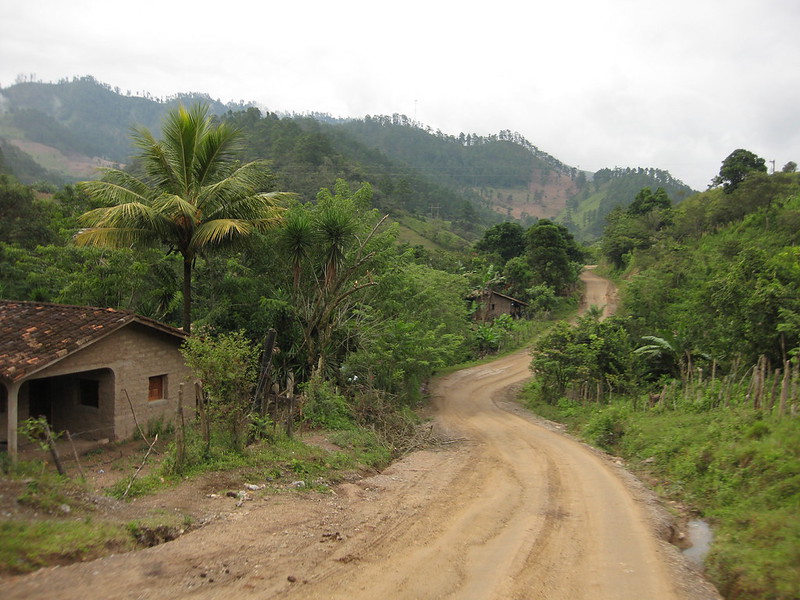
Two years ago, my half-brother Waldo talked me into spending the summer with him in Honduras, the country my family is from. It is an extremely poor country in Central America, near Nicaragua and El Salvador.
I’d been there a few times before, always with my mother. When I was two I went there and almost died of dysentery, a painful stomach infection that causes fever and severe diarrhea. You get it from drinking contaminated water or eating unclean food. Because conditions are so bad in Honduras, thousands of babies die of diarrhea every year.
I remembered a hot, boring place where the mosquitoes tore you to pieces and the food and water made you sick.
I Was Scared
My brother assured me if I stayed with his side of the family that summer, I wouldn’t have to go through all that. He painted a picture of blue seas, white sand beaches, kids my own age (15), and memories that would last a lifetime. It would be my first time away from my mother for any real period of time. I was scared but I agreed to go.
After a ten hour flight the plane came down over muddy rivers and miles and miles of coconut and banana palm trees all arranged in neat rows.
Inside the little airport soldiers stood around in dark glasses, fatigues, and combat boots. Over their shoulders were slung machine guns. Even though it has a president and a congress Honduras is almost completely controlled by the military (and the United States). You see soldiers every-where you go and they’re not exactly friendly.
As we lined up to go through customs we were praying the officials wouldn’t take a liking to any of the gifts we were bringing for the family. They didn’t.
The flight and the heat and the soldiers were taking their toll and I just wanted to get wherever we were going. I was glad that Waldo’s aunt and uncle picked us up at the airport.
Soldiers By The Side of the Road
Along the road was a military checkpoint where everyone had to stop. Some officers had been found killed a few days earlier and the government was accusing the communists. They set up “retenes” (roadblocks) all over the area and were searching for anything suspicious. They examined our passports and went through all our luggage.
One of them, a man in his fifties with a beerbelly and a slow cowboy walk (they all seem to have that walk) accused me of coming to Honduras to sell the clothes in my suitcases. (That would have been illegal.) He was just trying to scare a little kid and he stopped bothering me after my brother explained to him that I had just overpacked. To a fifteen year old in a foreign country without her mother, it was all pretty scary.
When we finally got to the house I went to bed early and cried myself to sleep, wishing I was back in Coney Island.
The town where we stayed had everything from little wooden shacks to huge, flashy mansions with big metal fences around them and four by fours in the driveways. The group of teenagers my brother hung out with were called “los buitres,” the vultures. They’d sit on this little bridge by the corner and yell rude comments whenever some girl in a mini-skirt passed by.
Los Buitres
Los buitres were famous for their mischief. The religious old ladies used to call them lazy bums and “marijuaneros,” potheads. Once they fixed it so some of these ladies got locked in the church courtyard and someone had to call a blacksmith to pry the gate open.
Another time the school band was marching through the streets at five in the morning practicing for the independence day parade. Los buitres silenced them with flying bags of urine.
Every once in a while you’d see los buitres suddenly scatter in all directions. That was because they had spotted the infamous yellow Datsun of the military police. It wasn’t that they had done anything wrong. In Honduras all young men are required to do two years of military service. Kids as young as 14 and 15 have been picked up off the street and put in the army.
Watching out for the “DIN” (Department of National Investigation) was second nature to these guys. It got so they could even smell the car’s diesel engine a few blocks away. A couple of them had been caught and came back with stories of being beaten up, made to strip down to their underwear and being thrown into a cell with bums and drunks.
The Ride To Copan
Scary as it sounds, this stuff becomes the raw material for their jokes and insults. I guess it helps them maintain their sanity and mask their anger. In Honduras it’s better not to hold a grudge, especially against the men in uniforms.
My first few days there dragged on forever. I was surrounded by strangers. There was nothing to do and the heat was driving me insane. I kept telling my brother I wanted to go home.
Waldo was the only one I could really talk to. I spoke Spanish, but not really well, and I didn’t want to make a bad impression or make a fool of myself.
One Sunday a neighbor offered to take us to Copn, an ancient ruined city. The three adults got in the front seat of his pick-up truck and the rest of us hopped in the back. We traveled up out of the valley and into the Honduran mountains. The road started turning sharply and we had to hold on for dear life as we stood in the back of the truck.
All around us there was nothing but sky and greenery and we screamed every time we imagined we had another brush with death. We yelled and laughed through the strong and silencing wind. We whistled at men in approaching cars, flirted with people on passing busses, and made jokes about the people by the roadside. Sometimes we just stared at the deep green and never ending scenery. It was the longest, most exciting roller coaster ride I’ve ever taken (and I grew up in Coney Island).
An Ancient Ruined City
Copn was a major city of the Maya, the native people who lived in Southern Mexico, Guatemala, and Honduras in the times before Columbus came to America.
The Mayas, like the Incas of Peru and the ancient Greeks and Egyptians, were one of the most advanced civilizations ever.
The ruins were a massive complex of stone temples, pyramids, sculptures and wide open spaces. There were huge slabs of rough, beige rock (steles) more than twice my height and the surfaces were carved with images of elaborately dressed Mayan rulers. They were worn down by time and weather but were still powerful to look at.
We started exploring the temples. (I couldn’t believe all this took up only two pages in my history textbook.) We climbed up the steps and got a perfect view of the whole place. Archaeologists were still digging a lot of it up. There were stones all over the place. Some of them had carvings of skulls and the faces of Mayan gods.
We saw a gigantic tree, hundreds of years old with the soil on one side cut away so you could see the roots. They were wrapped around a big slab of rock covered with hieroglyphic writing. It looked as if the tree had sprouted from this giant writing tablet.
Then we realized that the hieroglyphic slab was just a part of something much larger. Underneath the hill we were standing on was buried an entire temple.
Dark Tunnels
We discovered a series of interconnecting tunnels through which the Maya could escape if the city was being invaded. With no one around to tell us not to, we decided to explore one for ourselves. My brother went first.
We were all pretty small and still could barely squeeze through the entrance. Inside it was dark and damp, almost slimy. There wasn’t a lot of air and we were all getting short of breath.
My brother almost hit his head on a piece of rock hanging down from the ceiling. He stopped for a second and felt the rock, then stuck his foot out to take another step. There was nothing, no place to step, just a dark, gaping hole. We got out of there as fast as we could. We were all pretty spooked.
On the way back home we stopped at the town of Copn Ruinas to get something to drink. This place was right out of a fairy tale: gleaming cobblestone streets and a bright, white Spanish church on the plaza.
My brother and I were sitting outside drinking our sodas when two small, thin, barefoot girls came over selling souvenirs. They were wearing dingy little dresses and their hair was a mess but they were both incredibly beautiful. The older of the two was no more than 10 or 11. Her name was Esmeralda, Spanish for emerald, the color of her eyes.
Honduran Kids Grow Up Fast
Esmeralda was nothing like those third world kids they ask you to sponsor on TV. She didn’t seem sad or lost, she was vibrant and proud. She told us she and her sister walked four miles everyday to sell souvenirs and help support their family.
She asked us questions about who we were and where we were from. The way she spoke was confident and adultlike. She had wit and plenty of charm and seemed to know it. All the time Esmeralda was making a sale.
Kids like her have to grow up fast. They have to learn to carry themselves as adults in order to survive. I didn’t pity Esmeralda like I did the children in those commercials-she made me respect her. In the end she gave us one of the little Maya stone blocks she was selling but we still paid her twice what it was worth.
After we got back to San Pedro I wasn’t afraid to talk to people anymore. I became less self-conscious about my Spanish and once I loosened up it just seemed to flow from my lips. My brother’s cousins and I would gossip about the boys in the neighborhood, watch telenovelas (soap operas) and go to the movies. I did their English homework for them and they taught me how to dance the punta and the merengue. We found our own little bridge to hang out on and sang Spanish pop songs at the top of our lungs.
The four weeks I was supposed to stay in Honduras turned into six. When I got back to New York my parents didn’t even recognize me. I had gotten thinner and darker and even started to look more Honduran. And they were stunned by the Spanish that gushed out of me.
Of course six weeks isn’t enough time to really find out what it’s like to live in another country but at least I got my taste.
SIDEBAR: A Few Facts About Honduras
Honduras is a Central American country. Like the U.S. it was inhabited entirely by Native American “indians” until Columbus got there on his last voyage in 1502. Today it’s 90% mestizo-mixed Indian and European. The Caribbean coast is almost all Black and they speak English there. Almost everybody else speaks Spanish. How does the average Honduran teenager live? If you live in the South Bronx, the poorest district in the U.S., your chances of graduating from college are roughly one in 35. If you’re Honduran they’re one in 4,000. Less than half the country can read and write and only 75% ever go to school at all. On the other hand, most of the kids who die in Honduras (and there are a lot of them) die as babies from bad food or water. In the South Bronx the main causes of death are homicide, AIDS and other drug related illnesses. Why are the people so poor? As in many poor countries, most of the good land is owned by a very few rich people and corporations. The people who work the land get paid almost nothing. The military keeps them from complaining too much or threatening the status quo. Honduras is one of the so called “Banana Republics.” It provides countries like ours with bananas and a few other export crops and must depend on us for virtually all its needs. For years, the politicians and generals who run Honduras have been caught again and again taking bribes from the American fruit companies. Are there a lot of Hondurans in New York? Not compared with groups like Puerto Ricans and Dominicans. The biggest Honduran community is in the South Bronx. You probably heard about it at the time of the Happy Land Social Club fire last year, in which 87 Hondurans were killed.